Privacy

50695 readers
595 users here now

A place to discuss privacy and freedom in the digital world.

Privacy has become a very important issue in modern society, with companies and governments constantly abusing their power, more and more people are waking up to the importance of digital privacy.

In this community everyone is welcome to post links and discuss topics related to privacy.

Some Rules

Related communities

much thanks to @gary_host_laptop for the logo design :)

founded 6 years ago
MODERATORS
1026


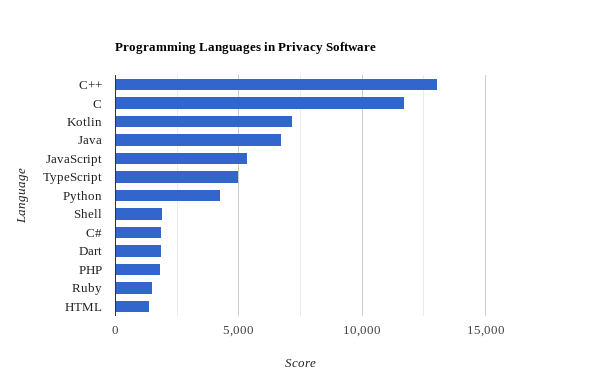
I was bored, so I compiled a list of 77 of my favorite open-source privacy-focused software. This ranges from Android apps to desktop apps to websites to operating systems. I scraped the programming languages used for each one from their respective repositories, and created a simple scoring system to score each programming language.

Obviously there is some bias, since Kotlin is very popular for Android apps and not much else, and it's not an exhaustive list, so some data might be off, but it was still fun to make! Just wanted to share it with all of you, in case anyone else finds it interesting.

The full ranking

Full ranking

  1. C++
  2. C
  3. Kotlin
  4. Java
  5. JavaScript
  6. TypeScript
  7. Python
  8. Shell
  9. C#
  10. Dart
  11. PHP
  12. Ruby
  13. HTML
  14. Makefile
  15. Go
  16. QML
  17. Pascal
  18. CSS
  19. Clojure
  20. Blade
  21. Crystal
  22. Batchfile
  23. Swift
  24. Emacs Lisp
  25. Svelte
  26. Rust
  27. CMake
  28. Haskell
  29. Lua
  30. Vue
  31. Roff
  32. XSLT
  33. Assembly
  34. NSIS
  35. Objective-C
  36. SCSS
  37. Less
  38. PLpgSQL
  39. Objective-C++
  40. Inno Setup
  41. Meson
  42. WebAssembly
  43. ASL
  44. PowerShell
  45. Rich Text Format
  46. GLSL
  47. Common Lisp
  48. Haml
  49. Scheme
  50. Dockerfile
  51. Perl
  52. AIDL
  53. M4
  54. Mustache
  55. D
  56. MDX
  57. SourcePawn
  58. M
  59. Pug
  60. Lex
  61. EJS

Scores for each programming language

Language scoresC++: 13070

C: 11734

Kotlin: 7195

Java: 6727

JavaScript: 5356

TypeScript: 5002

Python: 4250

Shell: 1903

C#: 1873

Dart: 1872

PHP: 1844

Ruby: 1499

HTML: 1389

Makefile: 990

Go: 975

QML: 955

Pascal: 917

CSS: 888

Clojure: 878

Blade: 832

Crystal: 738

Batchfile: 708

Swift: 577

Emacs Lisp: 556

Svelte: 366

Rust: 351

CMake: 342

Haskell: 326

Lua: 300

Vue: 288

Roff: 268

XSLT: 176

Assembly: 167

NSIS: 130

Objective-C: 128

SCSS: 90

Less: 77

PLpgSQL: 66

Objective-C++: 61

Inno Setup: 59

Meson: 41

WebAssembly: 25

ASL: 22

PowerShell: 21

Rich Text Format: 21

GLSL: 18

Common Lisp: 16

Haml: 14

Scheme: 13

Dockerfile: 12

Perl: 12

AIDL: 11

M4: 7

Mustache: 7

D: 5

MDX: 5

SourcePawn: 2

M: 2

Pug: 2

Lex: 1

EJS: 1

The original data

(NOTE: I am NOT looking for criticism on any choices made here)

Original data

HuggingChat

TypeScript 62.1%

Svelte 36.6%

Dockerfile 0.4%

JavaScript 0.4%

HTML 0.2%

Shell 0.1%

Other 0.2%

GPT4ALL

C++ 48.2%

QML 32.3%

Python 8.5%

CMake 5.4%

JavaScript 3.9%

C 1.0%

Other 0.7%

Audacity

C 37.6%

C++ 35.3%

Python 18.1%

Shell 2.8%

Common Lisp 1.6%

QML 1.3%

Other 3.3%

Duplicati

C# 87.3%

JavaScript 5.7%

HTML 3.2%

Less 1.8%

Python 1.2%

Shell 0.4%

Other 0.4%

Vorta

Python 99.2%

Other 0.8%

Filen (Desktop)

TypeScript 96.3%

JavaScript 2.1%

HTML 1.2%

NSIS 0.4%

Monero

C++ 81.7%

C 11.7%

Python 3.2%

CMake 2.0%

Makefile 0.5%

Shell 0.4%

Other 0.5%

Ivy Wallet

Kotlin 99.7%

Other 0.3%

Brasero

C 98.1%

Makefile 1.5%

Other 0.4%

VSCodium

Shell 83.8%

XSLT 16.0%

PowerShell 0.2%

GNU Emacs

Emacs Lisp 55.6%

Roff 23.8%

C 16.4%

M4 0.7%

Objective-C 0.6%

C++ 0.5%

Other 2.4%

GitLab

Ruby 69.2%

JavaScript 17.3%

Vue 6.8%

PLpgSQL 2.9%

Haml 1.4%

HTML 0.9%

Other 1.5%

Codeberg

Clojure 87.8%

Shell 3.9%

CSS 2.3%

HTML 2.2%

Batchfile 2.2%

PowerShell 1.0%

Other 0.6%

Wikipedia (MediaWiki)

PHP 82.7%

JavaScript 15.3%

Less 1.1%

CSS 0.8%

HTML 0.1%

Vue 0.0%

7-Zip

C++ 79.3%

C 17.6%

Assembly 1.6%

Makefile 1.5%

PeaZip

Pascal 91.7%

Inno Setup 5.9%

Batchfile 1.8%

C++ 0.4%

Shell 0.1%

C 0.1%

qBittorrent

C++ 71.0%

JavaScript 14.1%

HTML 11.5%

Python 1.1%

CSS 0.8%

CMake 0.7%

Other 0.8%

osu!

C# 100.0%

2048

CSS 54.9%

JavaScript 38.1%

HTML 6.5%

Ruby 0.5%

Wireshark

C 95.2%

C++ 2.4%

Python 1.1%

Perl 0.3%

CMake 0.3%

SourcePawn 0.2%

Other 0.5%

nmap

C 38.0%

Lua 29.0%

C++ 17.3%

Shell 4.6%

Python 4.3%

Makefile 1.9%

Other 4.9%

VirtualBox

C 67.2%

C++ 25.2%

Python 2.8%

Objective-C 1.7%

Assembly 1.4%

D 0.5%

Other 1.2%

Docker

Go 97.5%

Shell 1.5%

Dockerfile 0.5%

PowerShell 0.3%

Makefile 0.1%

Python 0.1%

calibre

Python 79.2%

C 17.1%

C++ 2.8%

HTML 0.3%

Shell 0.2%

XSLT 0.1%

Other 0.3%

Thunderbird

JavaScript 60.5%

C++ 21.5%

HTML 6.6%

CSS 3.8%

C 1.8%

Java 1.7%

Other 4.1%

Betterbird

Batchfile 66.5%

C 18.3%

C++ 10.1%

Shell 5.1%

draw.io (Desktop)

JavaScript 96.0%

Shell 4.0%

Joplin

TypeScript 71.4%

JavaScript 22.3%

HTML 1.9%

CSS 1.3%

Java 1.2%

Mustache 0.7%

Other 1.2%

LibreOffice

C++ 86.6%

Java 5.5%

Python 1.8%

Makefile 1.6%

XSLT 1.5%

Rich Text Format 1.4%

Other 1.6%

Proton Mail (Web)

TypeScript 92.1%

JavaScript 5.2%

SCSS 1.5%

MDX 0.5%

Swift 0.4%

CSS 0.1%

Other 0.2%

F-Droid

Java 65.3%

Kotlin 33.1%

Other 1.6%

Aurora Store

Kotlin 96.8%

Java 2.8%

AIDL 0.4%

Neo-Store

Kotlin 100.0%

Obtainium

Dart 98.7%

Other 1.3%

Droid-ify

Kotlin 99.6%

Shell 0.4%

IzzyOnDroid

PHP 97.2%

Python 2.5%

Shell 0.3%

Accrescent

Kotlin 100.0%

GNOME Software

C 97.0%

Meson 1.2%

Python 1.1%

Other 0.7%

Flathub

TypeScript 74.0%

Python 24.2%

JavaScript 1.1%

Shell 0.4%

SCSS 0.2%

Dockerfile 0.1%

SearXNG

Python 74.7%

Shell 9.9%

HTML 6.1%

Less 4.8%

JavaScript 2.7%

CSS 0.9%

Other 0.9%

GrapheneOS

Makefile 87.1%

C++ 11.3%

Shell 1.6%

GNOME

C 97.3%

Meson 2.3%

Python 0.4%

KDE Plasma

C++ 45.6%

QML 41.2%

C 5.5%

CMake 2.3%

Python 2.2%

JavaScript 1.9%

Other 1.3%

Arch Linux

C 98.4%

Assembly 0.7%

Shell 0.4%

Python 0.2%

Makefile 0.2%

Perl 0.1%

HeliBoard

Java 45.4%

C++ 34.7%

Kotlin 19.2%

Other 0.7%

Blender

C++ 76.3%

Python 14.6%

C 5.0%

GLSL 1.8%

CMake 1.2%

Objective-C++ 1.0%

Other 0.1%

FreeCAD

C++ 52.7%

Python 44.5%

C 1.5%

CMake 0.8%

NSIS 0.2%

Lex 0.1%

Other 0.2%

Krita

C++ 90.2%

Python 3.0%

C 2.3%

CMake 1.6%

HTML 0.7%

Rich Text Format 0.7%

Other 1.5%

GIMP

C 95.5%

Scheme 1.3%

Python 1.1%

C++ 0.7%

Meson 0.6%

Perl 0.4%

Other 0.4%

Flameshot

C++ 87.8%

CMake 5.8%

Shell 3.3%

Python 1.7%

Roff 1.1%

C 0.2%

Other 0.1%

Inkscape

C++ 94.1%

C 1.7%

CMake 1.5%

HTML 1.4%

Python 0.3%

Aegis

Java 96.0%

HTML 2.1%

Roff 1.9%

VeraCrypt

C 68.8%

C++ 19.0%

Assembly 10.0%

Shell 1.1%

Makefile 0.5%

Batchfile 0.3%

Other 0.3%

KeePassXC

C++ 95.1%

CMake 2.2%

Shell 1.5%

PowerShell 0.6%

Objective-C++ 0.4%

Python 0.1%

Other 0.1%

KeePassDX

Kotlin 79.0%

C 14.0%

Java 4.1%

Assembly 2.6%

C++ 0.2%

Ruby 0.1%

addy.io

Blade 83.2%

JavaScript 5.2%

Vue 4.8%

PHP 4.5%

CSS 2.3%

Mullvad VPN

Rust 35.1%

Swift 26.2%

Kotlin 19.5%

TypeScript 13.2%

C++ 2.8%

Shell 1.8%

Other 1.4%

Alovoa

Java 82.7%

HTML 9.8%

JavaScript 3.6%

CSS 2.8%

Other 1.1%

Briar

Java 98.0%

Kotlin 1.9%

Other 0.1%

SimpleX Chat

Haskell 32.6%

Kotlin 32.3%

Swift 26.9%

HTML 2.2%

TypeScript 1.4%

JavaScript 1.1%

Other 3.5%

Medito

Dart 88.5%

Kotlin 8.0%

Ruby 2.0%

Swift 0.7%

CMake 0.2%

C++ 0.2%

Other 0.4%

coreboot

C 94.4%

ASL 2.2%

Makefile 1.0%

C++ 0.7%

Assembly 0.4%

Perl 0.4%

Other 0.9%

Libreboot

Shell 51.5%

Python 25.1%

C 22.2%

Makefile 1.2%

OpenStreetMap

Ruby 78.1%

HTML 8.7%

JavaScript 6.9%

PLpgSQL 3.7%

SCSS 1.2%

C++ 0.7%

Other 0.7%

OsmAnd

Java 95.3%

Kotlin 3.9%

AIDL 0.7%

CSS 0.1%

Shell 0.0%

XSLT 0.0%

Organic Maps

C++ 71.0%

C 7.5%

Java 6.1%

Swift 3.5%

Objective-C++ 3.1%

Python 2.9%

Other 5.9%

VLC Media Player

C 62.6%

C++ 18.9%

Objective-C 8.3%

QML 3.1%

Makefile 1.6%

Lua 1.0%

Other 4.5%

Stremio (Desktop)

C++ 36.7%

QML 17.6%

NSIS 12.4%

JavaScript 10.7%

Shell 9.1%

CMake 4.1%

Other 9.4%

OBS Studio

C 54.6%

C++ 34.7%

CMake 6.1%

Objective-C 2.2%

Objective-C++ 1.6%

M 0.2%

Other 0.6%

NewPipe

Java 84.0%

Kotlin 13.5%

HTML 2.5%

FreeTube

JavaScript 68.5%

Vue 17.2%

CSS 11.2%

SCSS 3.0%

EJS 0.1%

Invidious

Crystal 73.8%

HTML 13.9%

JavaScript 8.2%

CSS 2.6%

Shell 1.1%

Makefile 0.2%

Dockerfile 0.2%

PeerTube

TypeScript 89.7%

HTML 6.5%

SCSS 3.1%

Shell 0.4%

Pug 0.2%

JavaScript 0.1%

Tubular

Java 84.6%

Kotlin 13.0%

HTML 2.4%

Mullvad Browser

JavaScript 28.1%

C++ 25.7%

HTML 22.3%

C 12.4%

Python 2.8%

Tor Browser

JavaScript 28.2%

C++ 25.6%

HTML 22.3%

C 12.4%

Python 2.9%

uBlock Origin

JavaScript 88.4%

CSS 4.9%

HTML 3.4%

WebAssembly 2.5%

Shell 0.6%

Python 0.1%

Makefile 0.1%
1027


Google's campaign against ad blockers across its services just got more aggressive. According to a report by PC World, the company has made some alterations to its extension support on Google Chrome.

Google Chrome recently changed its extension support from the Manifest V2 framework to the new Manifest V3 framework. The browser policy changes will impact one of the most popular adblockers (arguably), uBlock Origin.

The transition to the Manifest V3 framework means extensions like uBlock Origin can't use remotely hosted code. According to Google, it "presents security risks by allowing unreviewed code to be executed in extensions." The new policy changes will only allow an extension to execute JavaScript as part of its package.

Over 30 million Google Chrome users use uBlock Origin, but the tool will be automatically disabled soon via an update. Google will let users enable the feature via the settings for a limited period before it's completely scrapped. From this point, users will be forced to switch to another browser or choose another ad blocker.

Archive link

1028


It is truly upsetting to see how few people use password managers. I have witnessed people who always use the same password (and even tell me what it is), people who try to login to accounts but constantly can't remember which credentials they used, people who store all of their passwords on a text file on their desktop, people who use a password manager but store the master password on Discord, entire tech sectors in companies locked to LastPass, and so much more. One person even told me they were upset that websites wouldn't tell you password requirements after you create your account, and so they screenshot the requirements every time so they could remember which characters to add to their reused password.

Use a password manager. Whatever solution you think you can come up with is most likely not secure. Computers store a lot of temporary files in places you might not even know how to check, so don't just stick it in a text file. Use a properly made password manager, such as Bitwarden or KeePassXC. They're not going to steal your passwords. Store your master password in a safe place or use a passphrase that you can remember. Even using your browser's password storage is better than nothing. Don't reuse passwords, use long randomly generated ones.

It's free, it's convenient, it takes a few minutes to set up, and its a massive boost in security. No needing to remember passwords. No needing to come up with new passwords. No manually typing passwords. I know I'm preaching to the choir, but if even one of you decides to use a password manager after this then it's an easy win.

Please, don't wait. If you aren't using a password manager right now, take a few minutes. You'll thank yourself later.

1029


I see quite a few people claiming that Graphene OS is the only way to stay private on Android or that anything but Graphene OS is insecure. In this post, I will describe why I personally do not care for Graphene OS and some alternatives I would suggest.

First off, let's address the security features of Graphene OS. A lot of the security of Graphene OS comes from AOSP itself. In fact, AOSP has a very good track record. If you get malware on your device, you most likely can just uninstall it. For reference, here is the Android security page: https://source.android.com/docs/security/features

There are some Graphene OS unique security features. For instance, it has a hardened kernel and restricts access. I think this is actually pretty useful but I haven't seen a need for it much in the real world. The tightened permissions are nice, and I think that is the main benefit of Graphene OS over AOSP. It is also nice that device identifiers are restricted from a privacy perspective. However, from my perspective, you should not run apps that are bad for privacy. Running it in the web browser will be more secure than bare metal could ever be.

One place I strongly disagree with Graphene OS is the sandboxed Google services framework. They say having Google in a sandbox is more secure. It may be more secure, but it isn't going to be as private as MicroG. The real benefit of MicroG is that it is community-built. It isn't a black box like Google framework, and any data sent back is randomized. I think it is a mistake for Graphene OS not to have support for it, even if it is also run in a sandbox.

Another thing I have noticed is that Graphene OS prioritizes security above all else. That doesn't mean it isn't private as it itself is great for privacy. However, if you start installing privacy-compromising applications such as Gmail and Instagram, your privacy is quickly lost. The apps may not be able to compromise the OS, but for them to be used, they need permissions. To be fair, this is a problem that is not unique to Graphene OS, but I think its attempts to be closer to Google Android make it more tempting for people to stick to poor privacy choices.

I think other ROMs such as Calyx OS take the ethical component much more seriously. Unlike Graphene, it promotes F-droid and FOSS software like MicroG. Graphene purely focuses on security while Calyx OS focuses on privacy and freedom. On first setup, it offers to install privacy-friendly FOSS applications such as F-droid and the like. I realize that MicroG is not perfectly compatible, and some people need apps, but I think alternatives are going to always be better.

One of the most annoying parts about Graphene OS is the development team and some of the community. They refuse to take criticism and have been known to delete any criticism of Graphene OS. Not only that, they have a history of trying to harm any project or person they don't like.

Here is a page that isn't written by me that sums it up: https://opinionplatform.org/grapheneos/index.html I think their take is fairly extreme, but I agree with them in many ways. I also understand how upsetting it can be to be censored.

1030


1000004515

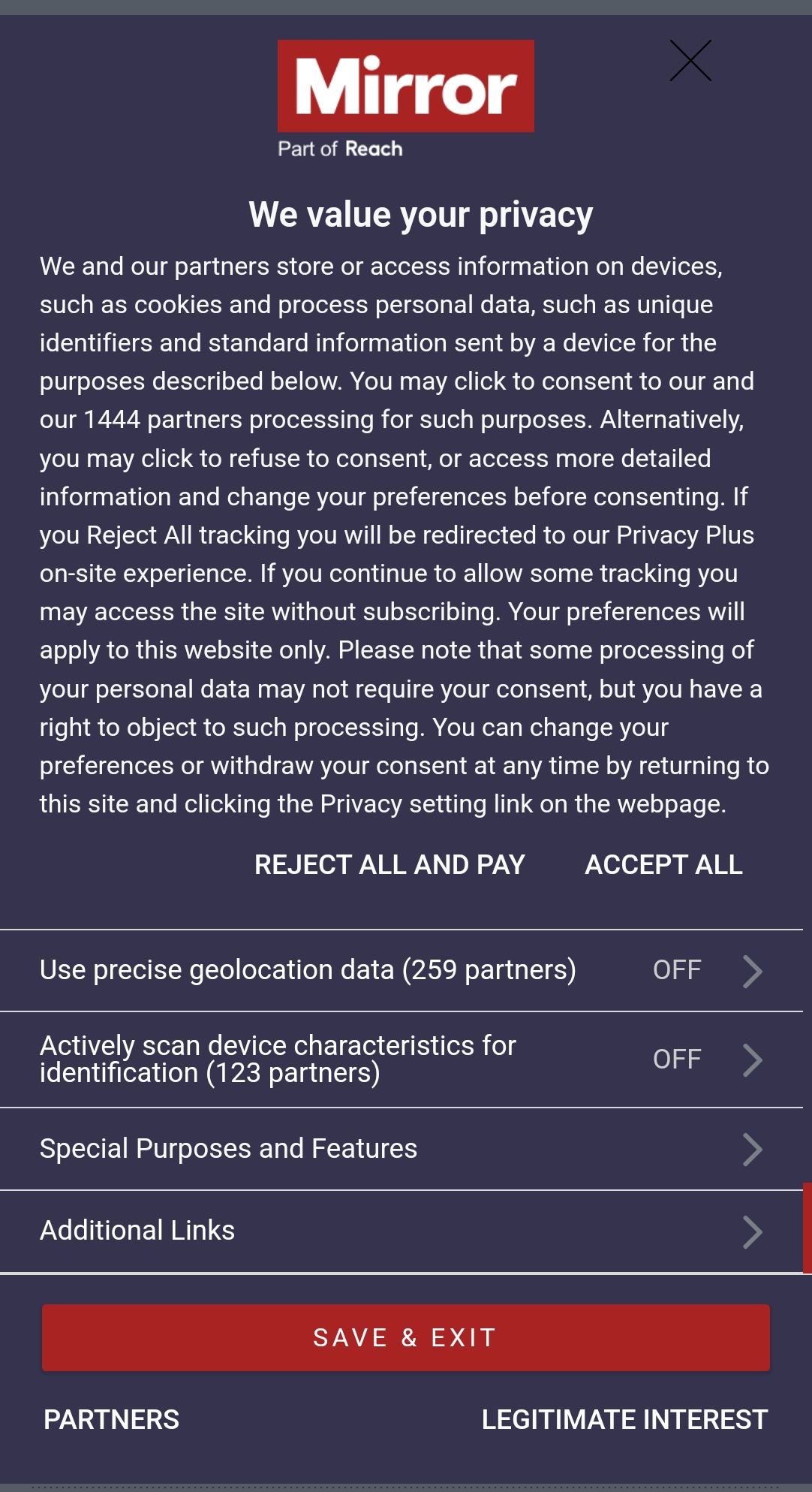
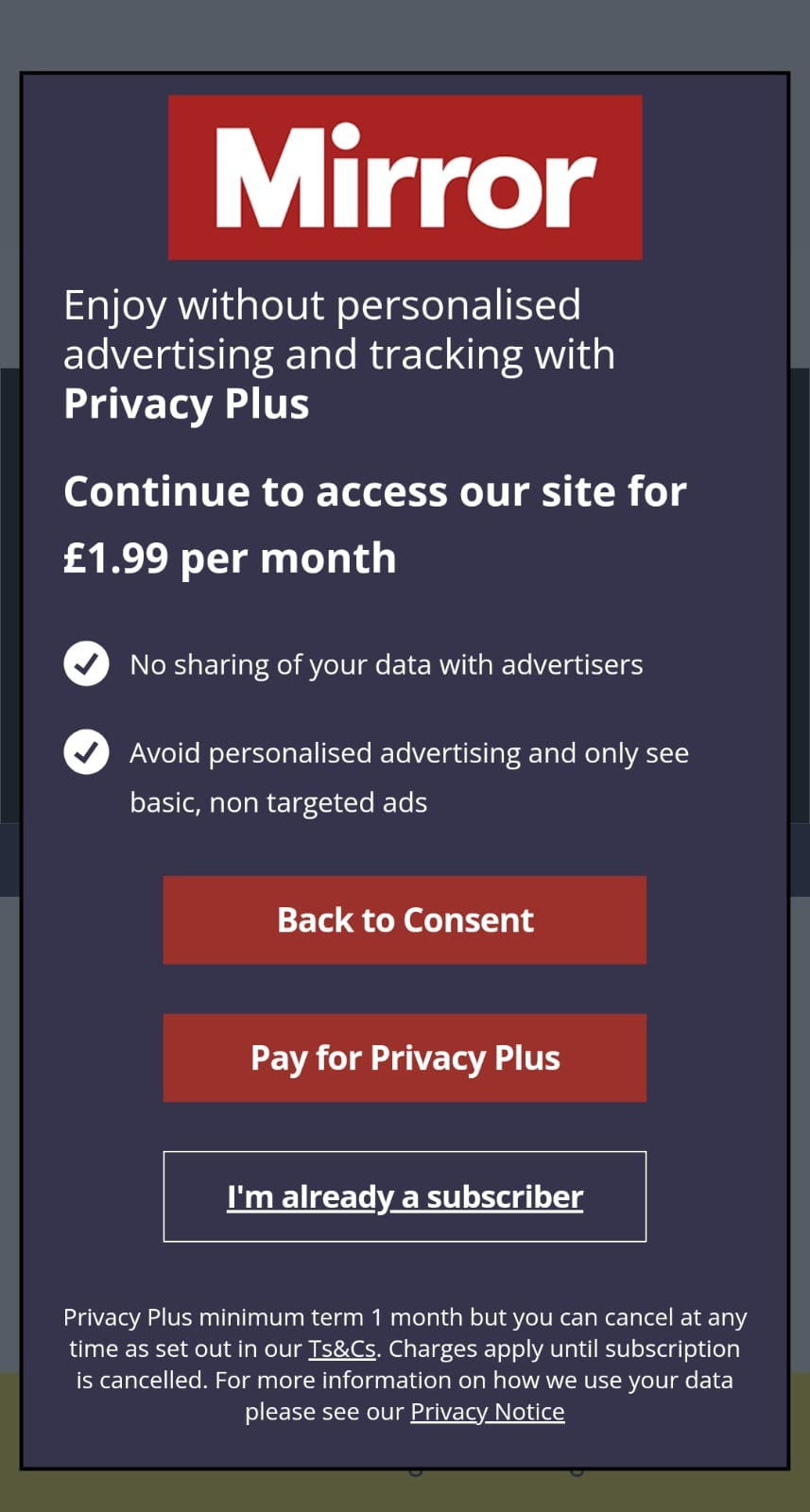
Not sure how long this has been a thing but I was surprised to see that you cannot view the content without either agreeing to all or paying to reject.

1031
0
submitted 2 years ago* (last edited 2 years ago) by Ste41th@lemmy.ml to c/privacy@lemmy.ml


Basically I started with mullvad then turned to proton but after they introduced AI and a crypto wallet I’m just looking for what peoples opinions are.

EDIT: Thank you all for your suggestions and opinions :D

1032


Curious what people think.

Do you think using the GrapheneOS operative system is useless if the user plans to/needs to install Play Store apps anyway?

I think I'm not alone in feeling this way, but sometimes I feel a sense of imposter syndrome because I'm not perfectly private and am dependent on some Play Store apps. This has caused me to question if the transition to GOS is meaningful at all.

Feel free to share your opinion. Cheers! ...posted from my GrapheneOS Pixel.

1033


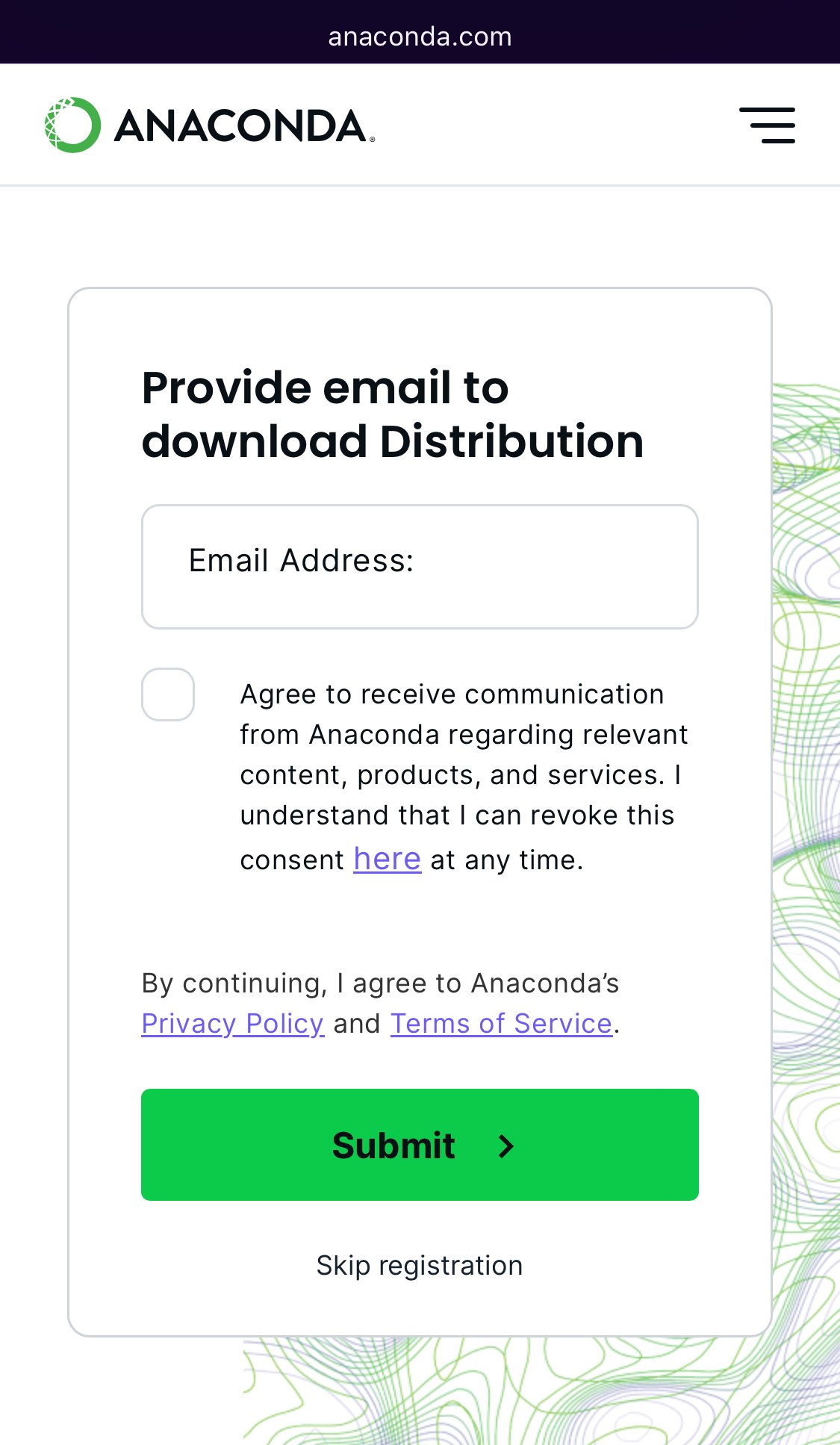
It’s been a while since I last downloaded anaconda. But I remember when clicking on the download page, it would show the usual “choose your OS > download binary” (eg this archived version in 2019).

Recently I helped someone else set it up and it showed a form to put on email, with smaller gray text near the bottom of the form about skipping it.

Does this count as a dark pattern?

1034


The Spanish government has a plan to prevent kids from watching porn online: Meet the porn passport.

Officially (and drily) called the Digital Wallet Beta (Cartera Digital Beta), the app Madrid unveiled on Monday would allow internet platforms to check whether a prospective smut-watcher is over 18. Porn-viewers will be asked to use the app to verify their age. Once verified, they'll receive 30 generated “porn credits” with a one-month validity granting them access to adult content. Enthusiasts will be able to request extra credits.

You have to request more porn credits from the government if you need more? Don't want the government to be tracking this data of you. This is a privacy issue

1035
1036


I've been looking at using email aliases services, and right now I'm thinking of using Simplelogin for all my online accounts and accounts where I can change my email easily, and getting my own domain to share with people and where I can't easily update my email. It seems like I shouldn't use my own domain for online services because it would be unique and can be tracked.

I did lots of reading about this and am still wondering why someone would want to opt for catch-all domains over aliases. Catch-alls seem highly susceptible to spam and while I haven't actually done any email aliasing yet, it doesn't seem to take much effort to make a new alias if you have a plan with unlimited aliases.

1037


The most common argument used in defense of mass surveillance is ‘If you have nothing to hide, you have nothing to fear’. Try saying that to women in the US states where abortion has suddenly become illegal. Say it to investigative journalists in authoritarian countries. Saying ‘I have nothing to hide’ means you stop caring about anyone fighting for their freedom. And one day, you might be one of them.

1038
1039


Real question. I would like to know what drives you to hate Apple? (In terms of privacy of course because in terms of price it’s another story).

1040
1041


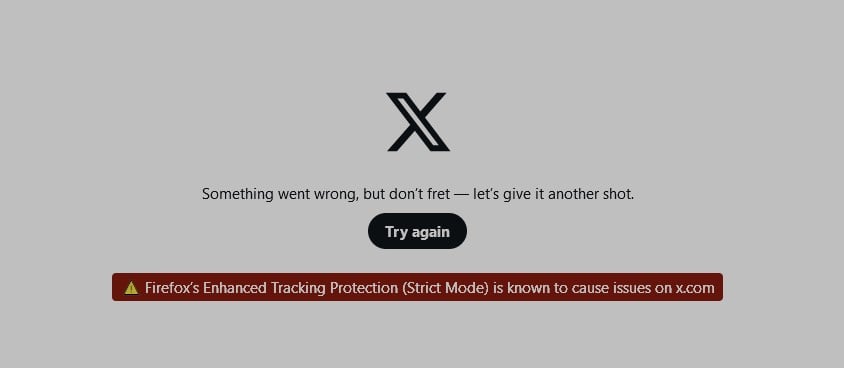
Firefox’s Enhanced Tracking Protection (Strict Mode) is known to cause issues on x.com

There were no "issues"; everything was working completely fine. This is a deliberate decision to force people to turn off tracking protection.

I saw a recommendation to use Firefox's container extension https://support.mozilla.org/en-US/kb/containers, but it's disabled in private browsing windows, and I always use private browsing windows.

1042
1043
1
submitted 2 years ago* (last edited 2 years ago) by DanTDM@lemmy.world to c/privacy@lemmy.ml


I have an extension that can individually disable all the most useless/addicting components of the Youtube site, such as shorts and whatnot. On the search page, I have turned on:

hide Shorts

hide For You

hide Trending

hide 'People Also Searched For'

hide Search Categories

hide Promoted Videos

hide Promoted Websites

hide Suggested Products

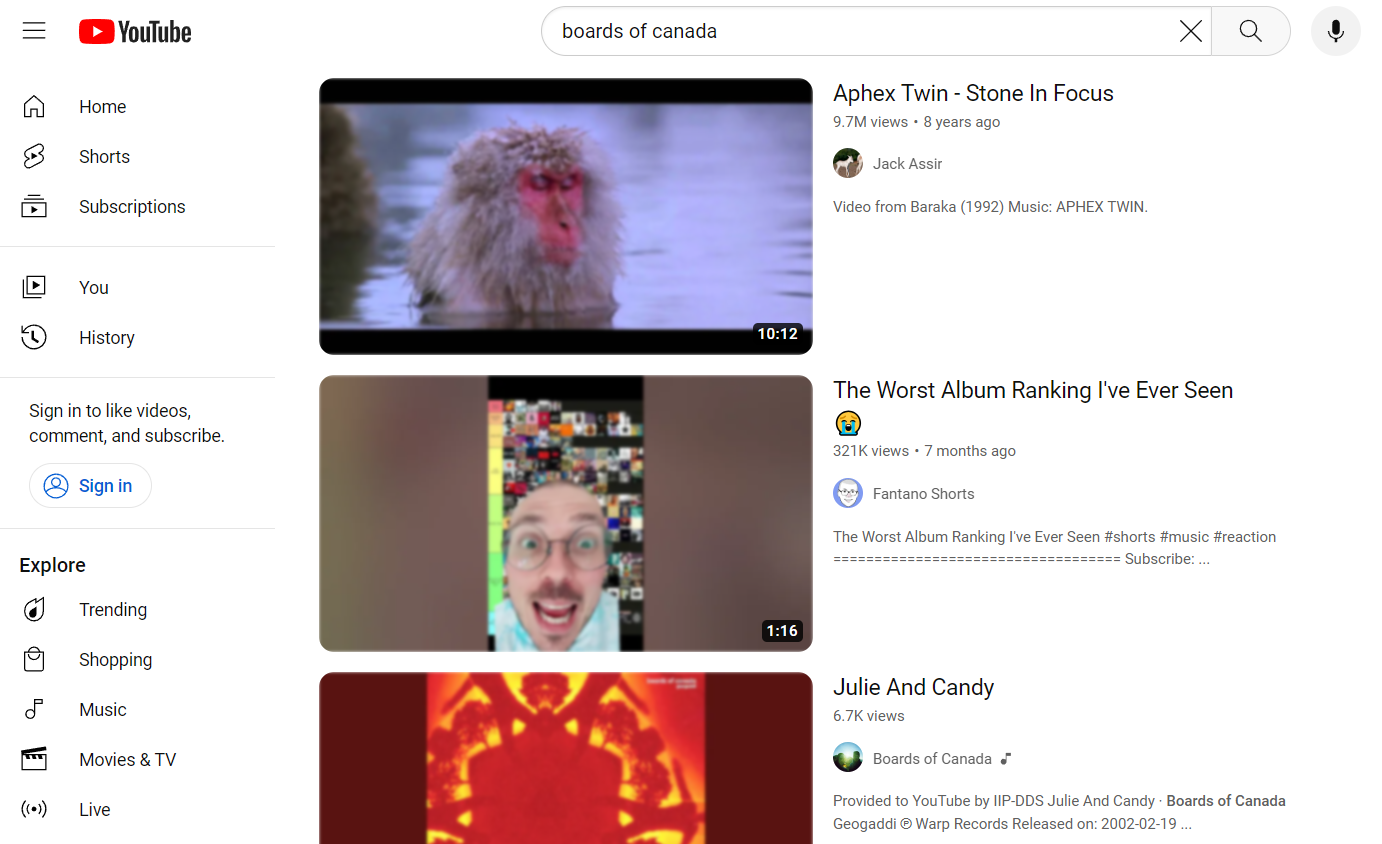
Do you know what Youtube has started doing? They are now inserting engagement slop DIRECTLY into the search results, as seen in the image above. It's literally a short, yet it's inserted like a video so you're forced to see it. The only possible way to remove it is by using a privacy frontend, as even on incognito mode, Youtube will look at the three videos you've watched and start inserting shit based off that.

Louis Rossman is right, they all have rapist mentalities... "just let me stick it in"

1044
1045


I'm thinking of the things listed on the Privacy Guides real-time communication section

https://www.privacyguides.org/en/real-time-communication/

1046


Curious how none of the coverage of this launch mention that the app isn't actually open-source (though they pretend to be an open-source project), which makes all of their claims of "end-to-end encryption" worthless

WordPress.com owner Automattic acquires multiservice messaging app Beeper for $125M

By Sarah Perez (@sarahpereztc) 2024-04-09

WordPress.com owner Automattic is acquiring Beeper, the company behind the iMessage-on-Android solution that was referenced by the Department of Justice in its antitrust lawsuit against Apple. The deal, which was for $125 million according to sources close to the matter, is Automattic's second acquisition of a cross-platform messaging solution after buying Texts.com last October.

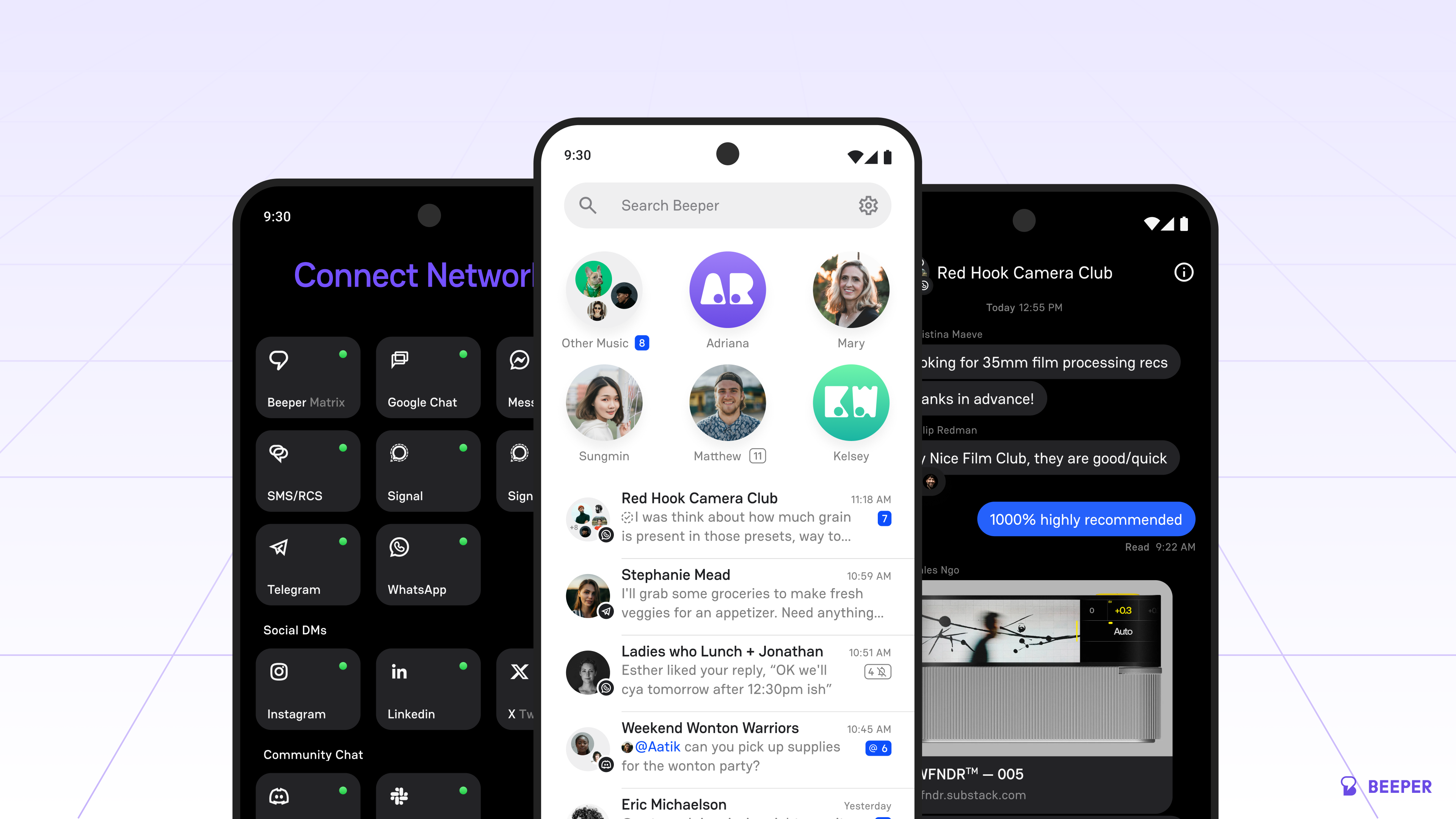
Screenshot of the Beeper app
Image Credits: Beepercaption

That acquisition made Texts.com founder Kishan Bagaria Automattic's new head of Messaging, a role that will now be held by Beeper founder Eric Migicovsky, previously the founder of the Pebble smartwatch and a Y Combinator partner.

Reached for comment, Automattic said it has started the process of onboarding the Beeper team and is "excited about the progress made" so far but couldn't yet share more about its organizational updates, or what Bagaria's new title would be. However, we're told he is staying to work on Beeper as well.

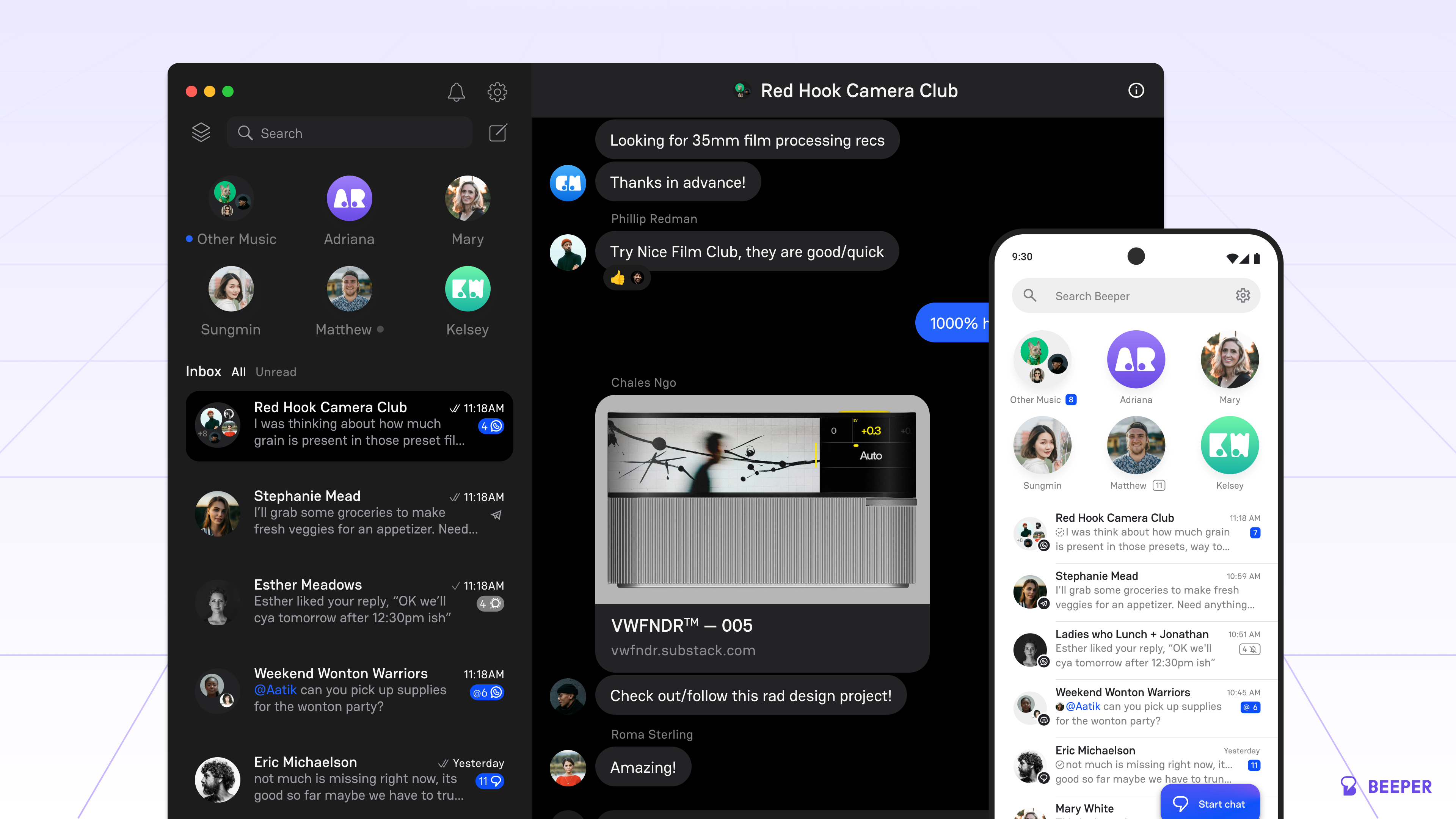
Screenshot of the Beeper app
Image Credits: Beepercaption

Beeper and Texts.com's teams of 25 and 15, respectively, will join together to take the best of each company's product and merge it into one platform, according to Migicovsky.

"[Texts.com] built an amazing app that's more desktop-centric and iOS-centric," he said. "So we'll be folding the best parts of those into our app. But going forward, the Beeper brand will apply to all of the messaging efforts at Automattic," he said, adding, "Kishan ... I've known him for years now


there's not too many other people in the world that are doing what we do


and it was great to be able to combine forces with them."

The deal, which closed on April 1, represents a big bet from Automattic: that the future of messaging will be open source and will work across services, instead of being tied up in proprietary platforms, like Meta's WhatsApp or Apple's iMessage. In fact, Migicovsky says, the eventual plan after shifting people to the Beeper cross-platform app for managing their messages is to move them to Beeper's own chat protocol


an open source protocol called Matrix


under the hood.

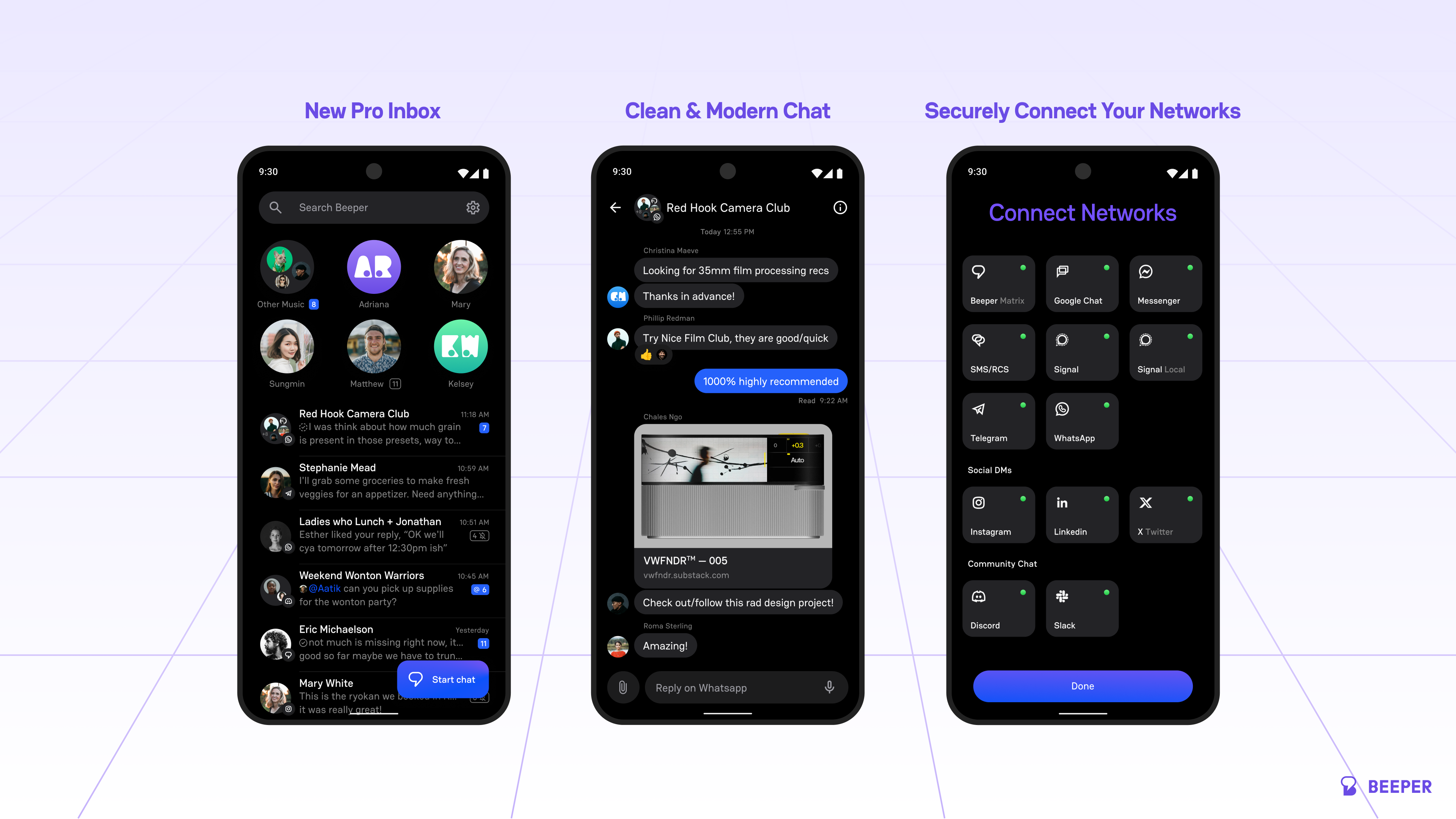
Screenshot of the Beeper app
Image Credits: Beepercaption

Automattic had previously made a strategic investment of $4.6 million), another company building on Matrix, and it contributes annually to Matrix.org.

Matrix, a sort of "spiritual successor" to XMPP, as Migicovsky describes it, offers an open source, end-to-end encrypted client and server communications system, where servers can federate with one another, similar to open source Twitter/X alternative Mastodon. However, instead of focusing on social networking, like Mastodon, it focuses on messaging.

Migicovsky said the acquisition came about because running Beeper costs quite a bit of money and it was either time to raise more funding or find a buyer. To date, Beeper had raised $16 million in outside funding, including an $8 million Series A from Initialized. Other investors include YC, Samsung Next and Liquid2 Ventures, and angels Garry Tan, Kevin Mahaffey and Niv Dror, and the group SV Angel.

"I've known Matt [Mullenweg, Automattic founder and CEO] for years now," Migicovsky said, adding that the WordPress.com founder had shown commitment to open source technology, like Beeper, where about half its product is already open source. "We were looking to find a partner that could financially support this. One of the reasons why there are no other people building this type of app is it costs a surprisingly large amount of money to build a damn good chat app," Migicovsky noted.

As for Beeper's products, the company has now briefed the DOJ on what happened when Apple blocked its newer app, Beeper Mini, which aimed to bring iMessage to Android. That solution is no longer being updated as a result of Apple's moves.

Screenshot of the Beeper website
Image Credits: Beepercaption

Beeper on Android launches to all

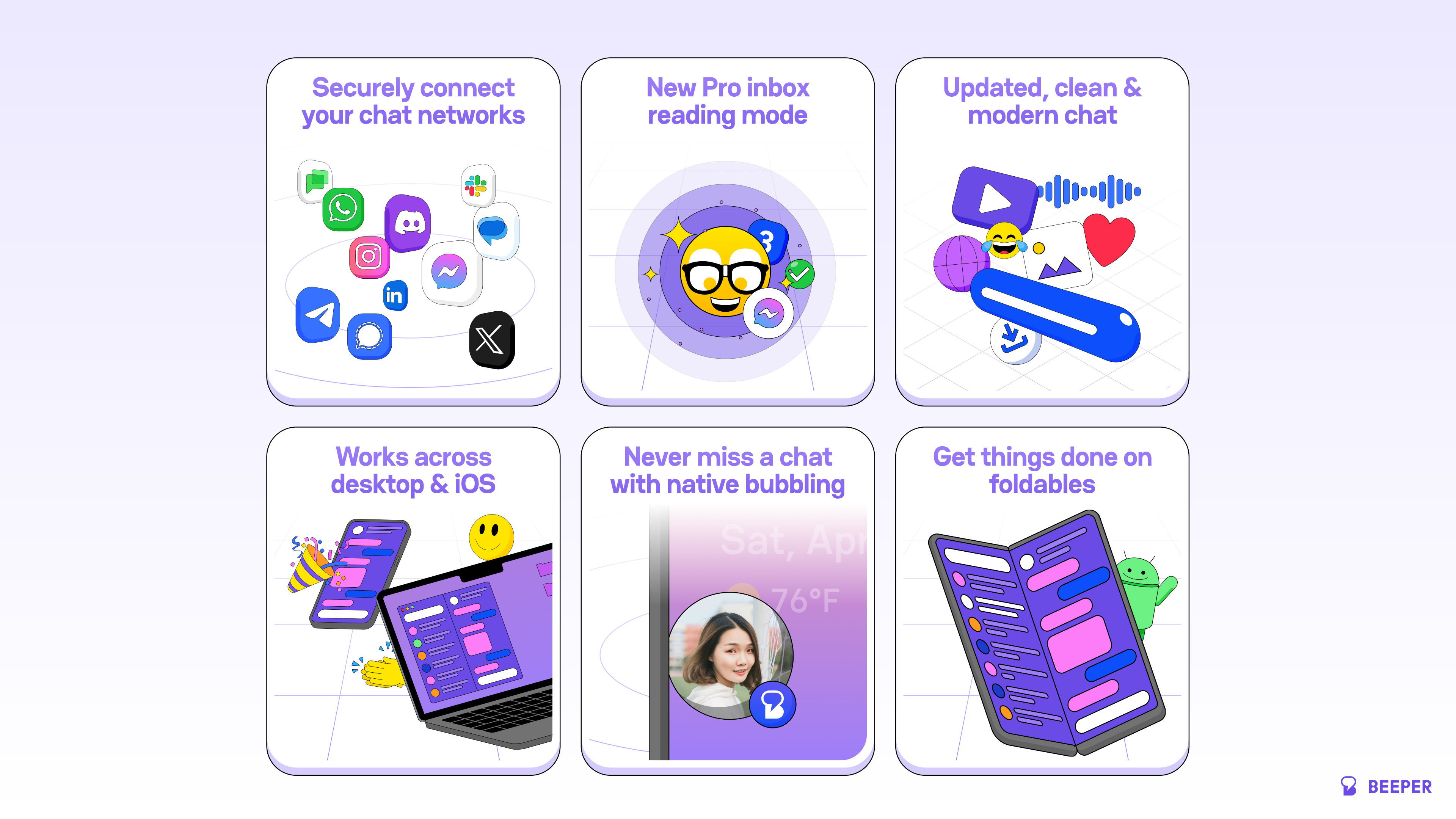
The company is instead releasing an updated version of its core app, Beeper, on Android. Unlike Beeper Mini, which focuses only on iMessage, the main app connects with 14 services, including Messenger, WhatsApp, Telegram, Signal, Instagram DM, LinkedIn, Twitter/X, Discord, Google Messages and others. Android is its biggest platform by users, as 70% are on Google's smartphone OS.

In this rewritten version of Beeper, the company is starting to roll out fully end-to-end encrypted messages across Signal. That will be soon followed by WhatsApp, Messenger and Google Messages.

Because of Apple's restrictions, iMessage only works if you have an iPhone in the mix, Migicovsky says, and will not be a focus for Beeper, given the complications it saw with Apple's shutdown of Beeper Mini. However, Beeper is hopeful regulations could change things, pointing to the DOJ lawsuit and FCC investigation. In the meantime, Beeper supports RCS, which solves iMessage to Android problems like low-res images and videos, lack of typing indicators and encryption.

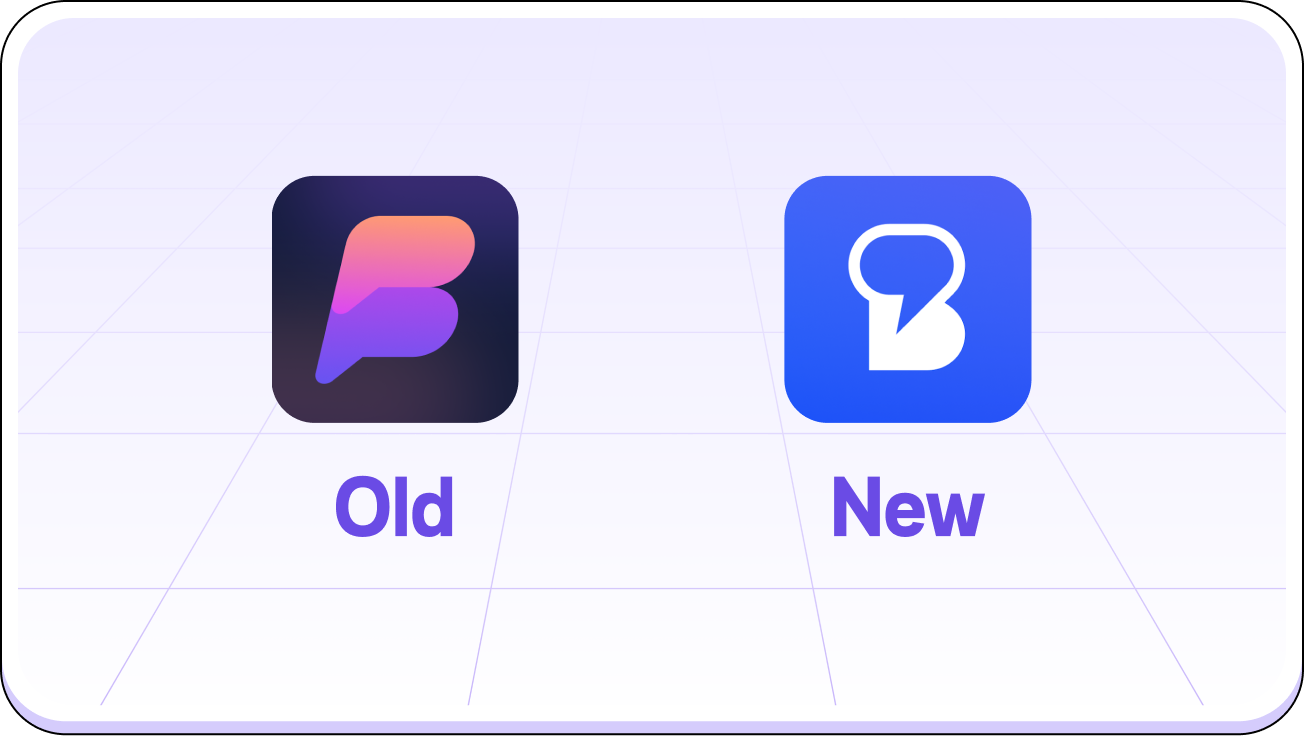
With the launch out of beta, the new app includes a new icon, updated design, instant chat opens and sends, the ability to add and modify chat networks directly on Android (no desktop app needed), local caching of all chats on the device and full message search.

The 10,000 Android beta testers already on Beeper will need to download the new app manually from Google Play


it won't automatically update.

Screenshot of the Beeper website
Image Credits: Beepercaption

In addition, the 466,000 or so people on Beeper's waitlist will now be able to try the product. They'll join over 115,000 users who have already downloaded the app, which is now used by tens of thousands daily. The app runs on Android, iPhone, iPad, ChromeOS, macOS, Windows and Linux.

The team expects to have feature parity across platforms in a matter of months as they overhaul the iOS and desktop apps.

In time, they plan to add other services to Beeper as well, including Google Voice, Snapchat and Microsoft Teams. Beeper also offers a widget API so developers can build on top of Beeper. Plus, since Matrix is an open standard, developers will be able to build alternative clients for Beeper, as well.

The app will generate revenue via a premium subscription, where the final price may be a couple of dollars per month, but pricing decisions haven't yet been fully nailed down. Beeper is currently free to use.

Like Automattic, Beeper's team is remotely distributed, with employees in Brazil, the U.K., Germany and the U.S. At present, Texts.com will continue to operate as the teams begin to integrate the two messaging apps.

1047


Apparently Apple can end-to-end encrypt your iCloud, but it’s opt in because they still want to profit off your data >_<

To enable this, go to Settings -> iCloud -> Advanced Data Protection

You need to have all the devices under your apple account to be fully updated, and you’ll need to remember a 28-key passphrase for recovery

I hate how big tech treats privacy as an afterthought. This should have been the default. But oh well. Spread the world people.

1048


SimpleX Chat is an instant messenger that is decentralized and doesn't depend on any unique identifiers such as phone numbers or usernames. Users of SimpleX Chat can scan a QR code or click an invite link to participate in group conversations.

-privacyguides.org

It's clearly proving to be the most innovative technology when it comes to decentralized communication, in my opinion.

1049
2
submitted 2 years ago* (last edited 2 years ago) by MisterFrog@lemmy.world to c/privacy@lemmy.ml


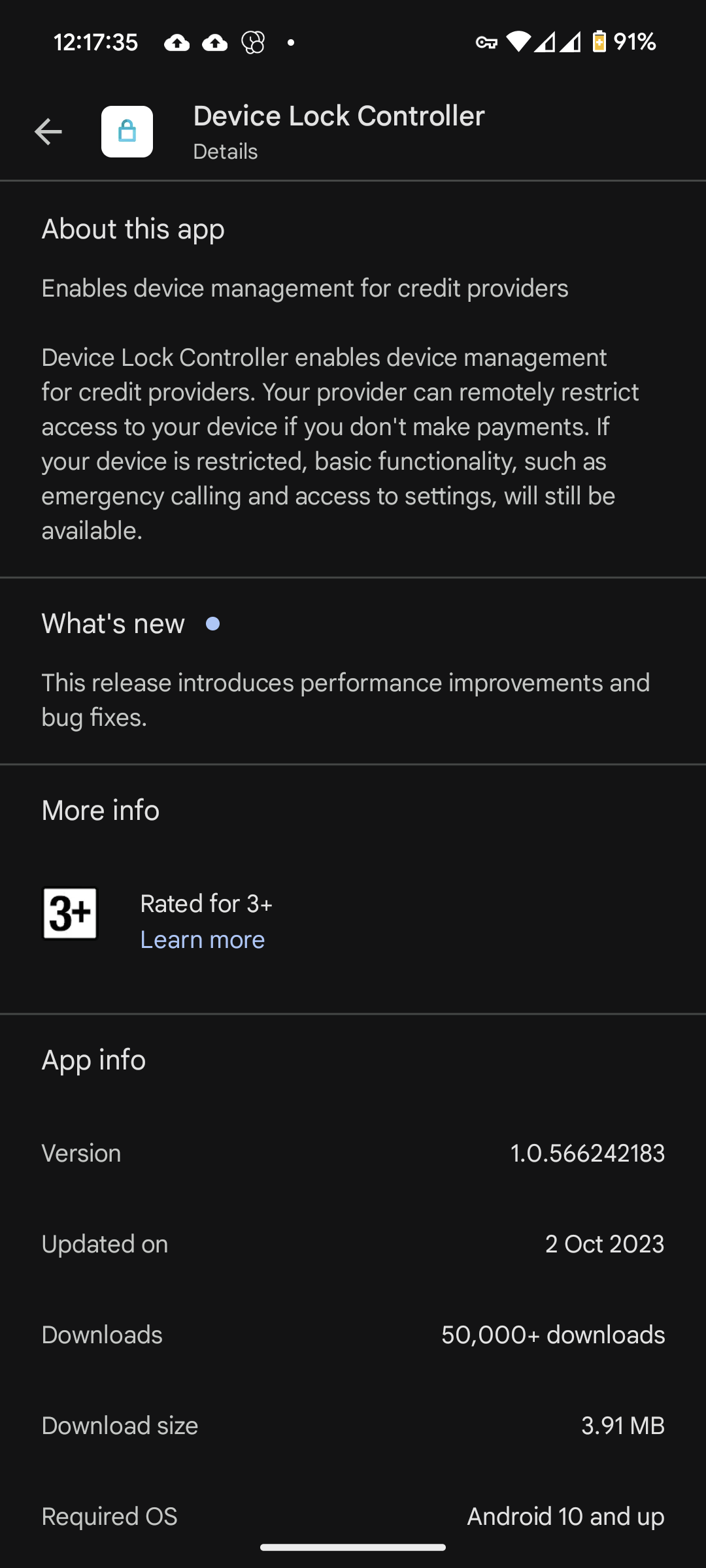
I installed NetGuard about a month ago and blocked all internet to apps, unless they're on a whitelist. No notifications from this particular system app (that can't be disabled) until recently when it started making internet connection requests to google servers. Does anyone know when this became a thing?

Edit 2: I bought my Pixel 6 phone outright, directly from Google's Australian store. I have no creditors.

Were the courts not enough control for creditors? Since when are they allowed to lock you out of your purchased property without a court order?

I don't even live in the US, so what the actual fuck?

Edit 1: You can check it's installed (~~stock~~ Pixel 6 android 14) Settings > Apps > All Apps > three dot menu, Show system > search "DeviceLockController".

I highly recommend getting NetGuard, you can enable pro features via their website if you have the APK for as low as 0.10€, but donate more, because it's amazing. You can also purchase via Google Play store.

1050
0
submitted 2 years ago* (last edited 2 years ago) by Charger8232@lemmy.ml to c/privacy@lemmy.ml


Hello, Lemmy!

It may be difficult to spend time actively improving some of the services you use to have a more privacy conscious presence, and so this thread is dedicated to help people learn and grow in their privacy journeys! Start by stating which services you currently use, and which ones you may be looking for/want to improve. This thread is entirely optional to participate in, because a lot of people understandably feel uncomfortable listing which services they use. Writing those out can be a lot of work, but the payoff is huge!

Remember these rules:

  • Be respectful! Some people are early on in their privacy journey, or have a lax threat model. Just because it doesn't align with yours, or uses some anti-privacy software, doesn't mean you can downvote them! Help them improve by giving suggestions on alternatives.

  • Don't promote proprietary software! Proprietary software, no matter how good it may seem, is against the community rules, and generally frowned upon. If you aren't sure, you can always ask! This is a place to learn. Don't downvote people just because they don't know!

  • Don't focus solely on me! Since this happened in another one of my posts, I want to mention that this thread is not designed to pick apart only my setup. The point is to contribute your own and help others. That doesn't mean you can't still give suggestions for mine, but don't prioritize mine over another.

  • Be polite! This falls under "Be respectful", but be kind to everyone! Say please, thank you, and sorry. Lemmy is really good about this, but there will always be someone.

Here is my setup:

Web browsing

  • I use Tor for using online accounts (such as Lemmy, etc.)

  • I use Mullvad Browser for general browsing

  • I use Librewolf for functionality that Mullvad Browser doesn't have (security keys, etc.)

  • I use Firefox + uBlock Origin for streaming videos that break on Librewolf and Mullvad Browser.

  • I always use a SearXNG instance for web searches. I always use ProtonVPN (free tier). I use a private DNS resolver.

Desktop

  • I use Secureblue (yes, I'm that guy from a post a couple weeks ago)

  • I sit behind a firewall.

  • I only use FOSS Flatpaks with Flatseal.

  • My BIOS is password locked but proprietary (due to compatibility issues).

  • I occasionally use Tails because I think it's fun.

  • I use full disk encryption, multiple disks, and a second layer of encryption for specific important files (NSA style)

Mobile

  • I currently use hardened iOS until I can scrape together some money for a Pixel to use GrapheneOS

  • Again, I constantly use ProtonVPN (free tier)

  • I use a private DNS when ProtonVPN is turned off

  • I use AdGuard, but I browse the internet with the DuckDuckGo app (I can't sideload)

  • I use a very strong passcode

  • Airplane mode is constantly enabled, I don't have a SIM

  • I use a Faraday bag to store my device when I'm in public

  • I use a privacy screen protector

Messenger

  • I mainly use Signal with a borrowed phone number, because SimpleX is still buggy on iOS, and Signal is the easiest to switch friends to. I rarely use iMessage, but there are times when I have to.

Online accounts

  • Passwords are stored in Bitwarden for mobile accounts, and KeePassXC for desktop accounts.

  • Yubikey is placed on any account I can, otherwise 2FAS is used

  • I keep public accounts (Lemmy, etc.) as locked down as I can.

Video streaming

  • I use the native YouTube app on iOS, simply because any of the others I've tried either don't actually work or require a Mac to install. I don't have a Mac, obviously.

  • I use FreeTube on desktop, but as I was writing this I was informed that FreeTube has a few issues I may want to look into (Electron).

AI

  • I would love to know if there are any Flatpaks that run local LLMs well, but I currently use GPT4All (since that's what I used a year ago).

  • On mobile, I use an app made by a friend that gives access to GPT-4 and Gemini. Because it's running off of his own money, I'm not going to share the project until he has a stable source of income.

Social Media

  • I don't use any social media besides Lemmy.

Email

  • I use ProtonMail

  • I have addy.io as an alias service

Shopping/Finance

  • I currently either proxy my online purchases through someone else (have them buy it for me and I pay them back), or use a gift card

  • For physical purchases I use cash

  • I only use my bank account for subscriptions (Spotify, etc.)

  • I am working on using Monero and privacy.com

Music streaming

  • I use Spotify on my phone

  • I use Spotube or locally downloaded files on my computer

  • I have multiple AM/FM receivers with some yard long antennas and direct metal connectors

TV shows

  • I stream from ethical services for some movies

  • I go to a theater or buy a DVD for other movies. I am the proud owner of a USB DVD player.

  • I also have an antenna hooked up to my TV

  • There are certain IPTV services I have used in the past

  • I do not use a smart TV.

Gaming

  • I download local games, plain and simple. Or I code my own game.

Programming

  • I code in Python using PyCharm. I'm looking for alternatives.

  • I will use GitLab when I decide to publish some of my work.

Productivity

  • LibreOffice, although the UI is iffy

Misc

  • I don't use any location services

  • All my clocks are set to UTC

  • I don't have a smart watch

  • I don't have a smart car

  • I use Bluetooth earbuds

  • I cover my webcams with paper and tape. Reason: It's worth taking a couple seconds to peel tape off when you use the webcam than to risk a massive breach.

Thanks for reading!

Note here: I found out the other day that a Google Streetview car passed by my house, and my blinds being shut were the only thing keeping my room away from prying eyes. Is there an easy way to blur/censor my house without giving up my soul?

Special thanks

Lots of people kindly contributed their personal setups in the comments, and some even made their own posts! I'm really glad I could spark inspiration and start a way for people to learn and grow in their privacy journeys. To think, just this morning, I was stressing on if people would even enjoy the post at all! Thank you all again, and please go forward to inspire others. I am not the person who made this happen, all of you are!

view more: ‹ prev next ›