this post was submitted on 24 Jan 2025
5 points (69.2% liked)
Memes
53438 readers
718 users here now
Rules:
- Be civil and nice.
- Try not to excessively repost, as a rule of thumb, wait at least 2 months to do it if you have to.
founded 6 years ago
MODERATORS
you are viewing a single comment's thread
view the rest of the comments
view the rest of the comments
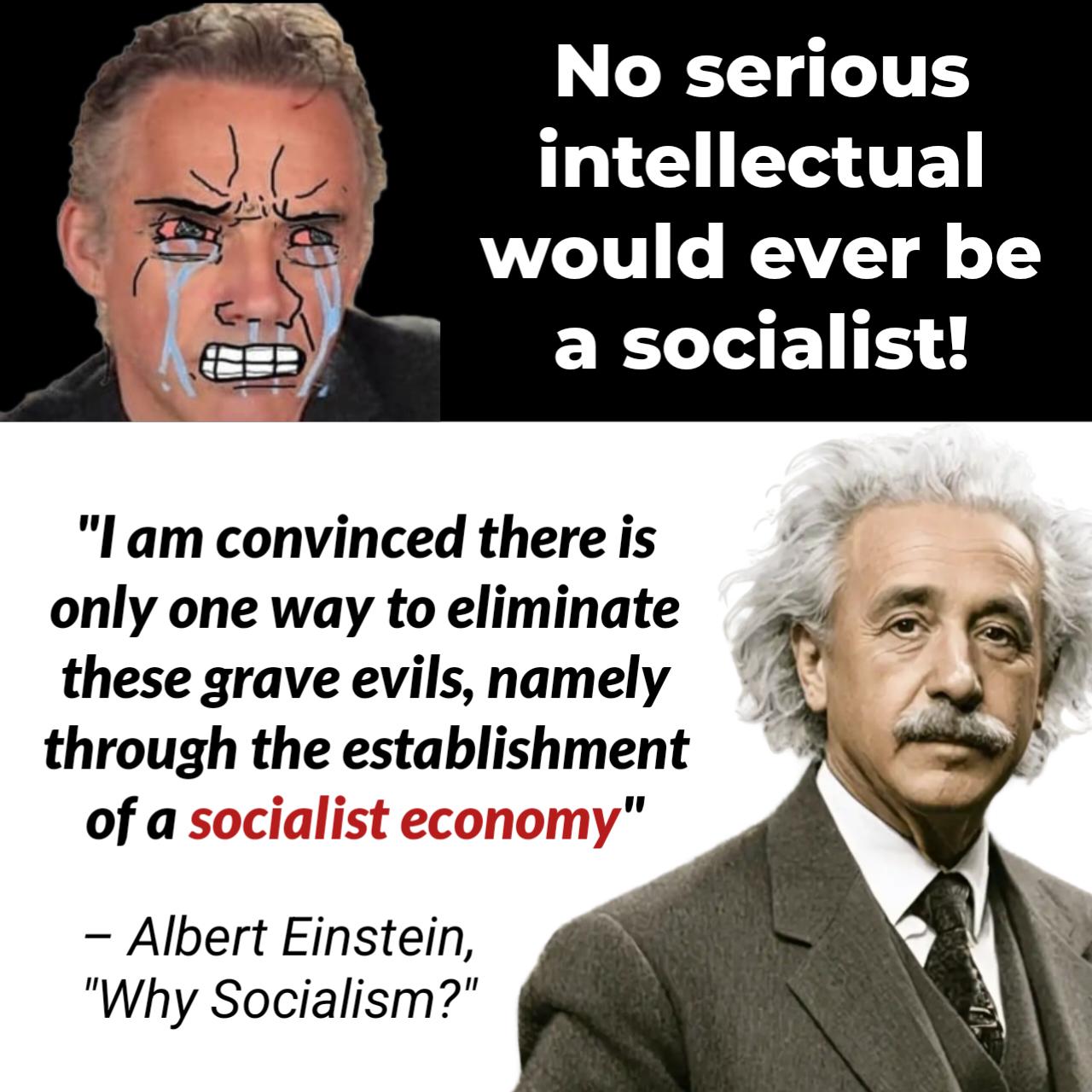
After. In 1923, he fled Berlin to the United States, and was a member of a liberal political party. He was thoroughly anti-soviet at the time, but eventually his views changed and balanced out. In 1949, he wrote Why Socialism? as he became increasingly convinced of the logical necessity for the transition to Socialism, and a world government. He also changed his tune on Lenin and the Soviets:
Part of what changed his views were becoming friends with prominent American Communists such as the legendary Paul Robeson. Over time, he took increasingly gentle and in some cases supportive stances towards the Soviet system, and was anti-War, including the nuclear Arms Race that the US relentlessly pushed forward.
Einstein, however, had serious internal chauvanism. He was a supporter of Zionism (which, while faded over time, never truly faded), and had this to say about the Chinese:
Overall, I believe he harbored extremely reactionary views, such as support of Zionism (which, while eventually fading, persisted), the shown racism towards Chinese people, and more. While the logical necessity of Socialism is elucidated quite clearly in Why Socialism? it appears he harbored western-supremacist views.
This stands in stark contrast to contemporary intellectuals like Frantz Fanon, who lived in Algeria and the USSR. I don't think Einstein should be lionized, however I do think his essay Why Socialism? serves as a good starting point for those who think Socialism to be utter nonsense, and serve as a springboard for actual, genuine works of theory.
That's a very detailed explanation, as a scientist as much as I knew about him I didn't know that much.
Although I do wonder why it would matter.
I mean by that, although a great scientist, politics is not is area of expertise. So I wouldn't put that much importance in his opinions.
Not that you can't be curious, but valuing it for his fame is a known bias we should avoid.
It's especially true for intelligence. We tend to put it on a pedestal like it's what made Einstein, or anyone, be successful. When it's only a part.
I'd say intelligence is like a good soil, there is still so much labor to make it into food. Einstein did the work in physics but on any other matter your still just eating dirt.
Einstein directly asks and answers your question in the very first lines of Why Socialism?
He then goes on to make his case, then builds up why he believes Socialism is necessary. I agree that intelligence is multi-faceted and doesn't necessarily imply "spill-over," but that's not what's going on here.
Likewise, there are many things I clearly disagree with Einstein on politically and socially, such as his view of Chinese people and support for Zionism. I also am more sympathetic to the Soviet Union than he was. However, his position as an intellectual that came to understand the necessity of Socialism without dedicating himself to its study serves to highlight for those who think Socialism outlandish that it isn't unreasonable at all, and the case he makes is largely on the nose.
I recommend reading it yourself.
Interesting, well I do have a lot to read on the subject but i'll add it to my list, I might be pleasantly surprised.