72
"Ha ha just trust me bro I will TOTALLY champion the Senate after it murdered my beloved great-uncle for being too soft on them!"
(media.piefed.social)
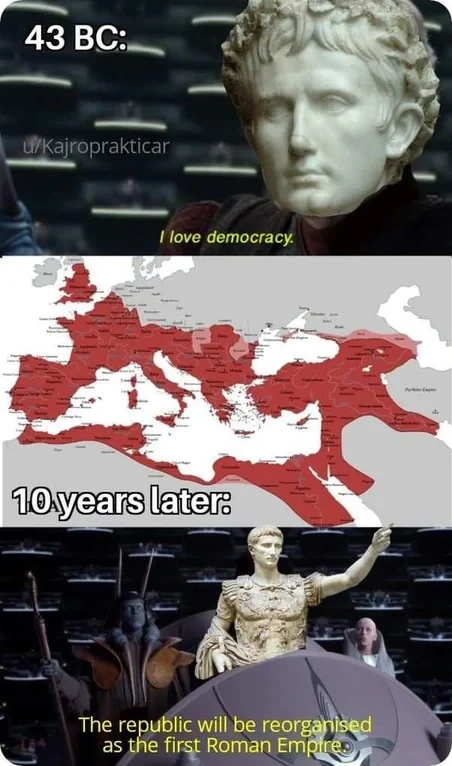
Hello there. Somehow, Star Wars memes have returned. It's not a trap, this is where the fun begins.
==========
Other universes to visit:
Separatist systems:
Oh hey some real SW content for a change (perhaps):
!starwarstelevision@lemmy.world
==========
IMPORTANT
Please do not post the "good friend" or similar copypasta
==========
Our galactic citizens have requested more specific rules, so here are a few.
The general idea is, if you're looking here for rules, you're probably someone who doesn't need to have them spelled out. You're fine. But anyway:
This is a community for Star Wars memes. This means typically screenshots of Star Wars media with some text or context that's meant to be funny and/or thoughtful. All SW media is welcome: movies, games, comic books, fanart... Other kinds of content, like video links or meta memes (about this community, or Lemmy), are fine as well, just keep it on topic.
We are all friends here, and love (sometimes love to hate) Star Wars. Be nice to each other.
As fans of fictional media, we can be passionate. If you very strongly disagree with something or someone, take a deep breath before reacting. Anger leads to the dark side!
Everything in Star Wars has happened a long time ago, in a galaxy far away, and it's a rich universe of millions of words and millions of years of history. So current Earthly matters really shouldn't concern us here. In other words, leave politics, philosophies and convictions behind the door. This applies even if it's about something related to Star Wars.
Original content is preferred. Reposts are fine, just please limit to a maximum of 3 per day, per citizen. It is recommended, but not required, to mark original memes as (OC) and reposts as (repost).
Local mods are the Jedi council. They may take actions that are necessary to maintain peace and stability of the Republic, even beyond the rules outlined here. Follow their guidance.
Regular rules of the Lemmy.world instance apply.
Explanation: Octavian, later known as Augustus, was the grand-nephew and adoptive son (posthumously, by will) of Julius Caesar, of conqueror and dictator fame. Caesar was, famously, assassinated by the Senate, including by many Senators he had pardoned during the civil war, despite them taking up arms against him.
When it became apparent that the assassins of Julius Caesar had little support amongst the people of the city of Rome, they fled to the east and tried to raise an army to retake power (they would lose the ensuing, second civil war), while the 'moderate' conservatives who had only cheered on the assassination, not participated in it, tried to negotiate with Caesar's supporters for some sort of reasonable accord to preserve their power. Of the 'Second Triumvirate', as they became known in historiography, Lepidus was a no-one, and Mark Antony was a brute who would have cheerfully executed every Senator who spoke out against him if he could have gotten away with it. Luckily, Caesar's grand-nephew, so young and impressionable, was willing to work with the Senate towards a reasonable future
Unfortunately for the oligarchic Senate, the deeply cunning and manipulative Octavian had no intention of being their champion. Unfortunately for the Republic, he had no intention of being the champion of the democratic People's Assemblies of the Roman Republic either. Instead, Octavian consolidated power and quietly sidelined (and sometimes executed) rivals until no one was left brave enough to openly oppose him. After his military victory over Mark Antony (who had allied himself with the Egyptian Queen Cleopatra during this third and final outbreak of civil war in Octavian's lifetime), Octavian/Augustus made it clear, if only implicitly so, that there was no more power in the Republic without his say-so.
'Funny' enough, the Republic was not formally abolished after this, and Augustus, publicly, kept up the pretense that he was just a really special boi who had come into all these crazy offices of ultimate power with indefinite term lengths basically by accident during a period of crisis, just normal Republic things! After all, would some aspiring autocrat insist that he was merely the First Citizen, and First Amongst Equals? (Princeps and Primus inter pares)
The Romans would struggle with this split between reality and theory for the next ~300 years of what-we-now-call the Roman Empire, sometimes acknowledging the Emperor as autocratic, other times insisting that no, there was TOTALLY still functioning republican institutions, and that the Emperor was JUST the First Citizen who was a mouthpiece for the Senate and PEOPLE of Rome! Nothing to see here, folks! (Most elite writing took a view somewhere in-between these two extremes, acknowledging the Emperor was crazy-powerful to the point of dictatorship, but still envisioning the position of Emperor in basically magisterial, republican terms)
Also, the map is inaccurate, as that's the 117 AD map of the Roman Empire, which had a few more bits and pieces than it did in Octavian's time. XD
thank you for the context and info!
Yeah, I was about to say that I wish @PugJesus@piefed.social was behind every historical meme, haha. A lot of this stuff I'm sure many don't know the finer details to.
Just doing my best to make a little historical trivia humor accessible! 🙏
September 8th and 9th, 9 CE

"Yes... good.... let the civilization flow through you!" - Romans trying to assimilate G*rmanics
