50mm^2 for 125A, just under 8mm diameter solid copper rod if it was solid copper rod. but it's stranded so it's a bit bulkier than that, bundled five per cable. it adds up to some 4cm in diameter
fullsquare
joined 1 year ago
split phase is 2-phase system but everyone else uses 3-phase distribution. in reality americans also use 3-phase distribution, this is where 207v 3-phase comes from (it's 120v phase to neutral)
the entire point of three phase circuit is that you can split it into single phase circuits without using too much wire. usually block will be wired so that 1/3 of flats is connected to one phase, but if you need to power big loads like ag tools or something like concrete mixer three phase supply can be done (415V these days, there's upward shift in voltage)
in EU there are really only two standards. for single phase loads up to 3.8kW, regular 16A plug is sufficient. above that, 3-phase 5-pin 32A plug (most common of them) is used which can deliver up to 23kW. there are common variants of 3-phase 5-pin plugs rated up to 125A that can deliver up to 89kW ~~and uncommon up to 800A variants that are also part of the standard, but it delivers up to 0.57MW and it's a bit silly~~
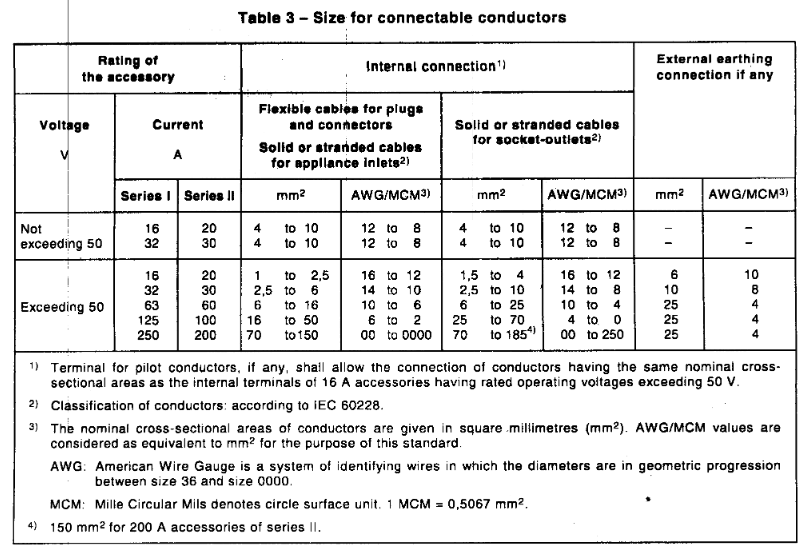
i've found 1999 version of iec 60309 standard and biggest connector defined there was 250A. actually i wasn't able to find vendor for currents higher than 125A, but for 125A, standard expects 16 to 50mm^2 cable and for 250A 70 to 150mm^2. lower ends of these ranges would be insufficient for full load and would require limiting current appropriately. maybe higher currents were latter additon. either way 32A is almost-standard and anything above that is in some way custom job
modern smpss can take anywhere from 100 to 250V input so you can use them with either and any voltage inbetween. older ones had a switch between 240v and 120v modes (rectifier vs voltage doubler)
blame edison for that
We sorta do have universal mains connector (ignore for five minutes that there's like 5 variants)

you see, you can be as wrong as you want to be. i won't be teaching you middle school level chemistry against your will in a comment section. in concrete Ca2+ remains Ca2+, be it as hydroxide or carbonate or silicate and it cannot become reduced in normal concrete conditions and definitely it can't be oxidized.
The Calcium Carbonate degrades into Calcium Oxide
no it fucking doesn't, this is what happens when cement is prepared in a kiln. near surface of curing concrete calcium hydroxide captures carbon dioxide from air, then this crust of precipitate blocks it from moving deeper. which is why the rest of calcium hydroxide reacts with silica forming calcium silicate, which takes more time and is responsible for late strengthening. before you lost plot i was talking about oxidation of steel rebar, and it depends on many things, but for regular carbon steel if there's no oxygen then it's much slower. and because concrete is not very permeable to oxygen, there are all these engineering requirements about how deep rebar has to be. anyway, a little bit of vinegar would be just neutralized by calcium hydroxide from concrete and won't do anything, a little bit of salt would be diluted massively and also won't do anything, hydrogen peroxide would decompose because anything will do that
there are also more damage-susceptible things in a datacenter
calcium carbonate is still basic and even hydrogen carbonate is basic enough to be protective against steel corrosion
The Calcium Carbonate once dissolved in water will start to form the Calcium Hydroxide layer on the surface, thats the alkaline layer, and deeper in the carbonation creates acidity.
100% wrong, how come there's more carbon dioxide inside than outside, you're starting from calcium hydroxide and silicate. on the surface there's some carbonate formation from carbon dioxide, but when it can't get there calcium silicate forms instead. either way both are basic
coated rebar isn't, it'll always get dinged somewhere. stainless is expensive and the real available scalable option is either galvanized or sometimes basalt fiber, or glass fiber but i've not heard about it too much. the most important factor in slowing down corrosion is how thick concrete layer is on top of rebar, because concrete is very slightly porous and will let oxygen in, but the thicker that layer is, the slower oxygen gets to rebar, then the slower corrosion is, and this means it takes longer for rust layer to grow enough for concrete around rebar to fail due to swelling, because rust takes more volume than corroding steel
a bit of vinegar might strip zinc layer, but won't do too much and definitely it won't matter long term until most of zinc layer is gone. salt also promotes corrosion but this also depends on oxygen availability and won't be too fast, it would only matter if there's salt in concrete in large amounts
tapeworms and parasitic roundworms as a category