26
Green & indigenous News
317 readers
0 users here now
A community for Green & indigenous news!

founded 8 months ago
MODERATORS
28
0
Trump’s plan for ultra-fast meat processing would be a disaster for workers and the environment
(grist.org)
In February, the United States Department of Agriculture announced two proposed changes to federal rules governing the rate of production in meat processing plants — a move advocates say would endanger workers, public health, and the environment. One proposed amendment would raise the maximum line speeds in poultry slaughter from 140 birds per minute to 175 for chicken and from 55 birds per minute to 60 for turkey. For swine slaughter, the agency is proposing there be no cap on line speed at all.
Last week, the public comment period for the proposed amendments came to a close. If finalized, these changes would “lower production costs and create greater stability in our food system” as well as help “keep groceries more affordable,” said Secretary of Agriculture Brooke Rollins back in February.
The proposals are in line with other Trump administration policies that encourage higher meat consumption among Americans — like the revised food pyramid with its emphasis on eating more protein. But despite the promise of lower costs and higher efficiency, experts say these proposed rollbacks pose more risks than benefits to the public.
“This is doubling down on an already broken and polluting food system,” said Dani Replogle, staff attorney at Food and Water Watch, an environmental nonprofit that submitted public comments against the proposed rules.
The USDA will need time to review the tens of thousands of comments submitted, but the United Food and Commercial Workers, or UFCW, a union that represents workers along the food supply chain, estimates that over 22,000 comments oppose the poultry rule, along with over 20,000 oppose the pork rule.
The union — which successfully sued and blocked the USDA from enacting a similar change to swine line speeds in 2021 — stresses that increasing line speeds in meat processing will result in more injuries for workers. While various parts of the line in these facilities are automated, the beginning of the line — where animals are corralled into the plants — is notoriously backbreaking and dangerous work. For chickens, workers who hang the birds by their feet often end up covered in fecal matter; in swine slaughterhouses, workers on the “kill floor” move pigs into stunning chambers. In both scenarios, unlike climate-controlled segments of the line, workers are exposed to the elements and face heat stress on very hot days.
Read Next
American farmers bet on solar. Then Trump changed the rules.
Ayurella Horn-Muller, Melina Walling, Clayton Aldern, & M.K. Wildeman
Further down the line, workers handle knives and often labor shoulder-to-shoulder. They make repetitive motions for hours at a time, making the same cuts over and over to process hundreds or thousands of birds and swine. This workforce already runs the risk of developing carpal tunnel syndrome and enduring lacerations and amputations. Research has shown injury rates go up when line speeds increase.
The USDA contests this finding. In its proposed rule for poultry slaughter, the USDA states that a study funded by the agency’s Food Safety and Inspection Service determined that increased line speeds during the evisceration segment of the line — where internal organs are removed from dead animals — “are not associated” with a higher risk of musculoskeletal disorder. The study’s authors, however, have since said that the proposed rule **“**fundamentally misunderstands and mischaracterizes the scope and results” of their research.
“The potential for injury to these workers, it’s just something people can’t deny,” said Mark Lauritsen, who leads UFCW’s food processing, packaging, and manufacturing division. “Quite honestly, line speeds are too fast now.”
In response to a request for comment, a spokesperson from the USDA said, “Decades of data prove that plants can run at higher speeds while maintaining process control and meeting every federal food safety standard.” They also added that federal inspectors in meat processing plants are still able to slow lines down if they discover a problem.
Ultimately, the spokesperson said, “The USDA’s legal authority is strictly limited to ensuring food safety and process control; we do not have the power to regulate piece rates or how private companies manage their staff.” (Piece rate refers to the number of items — such as whole birds or parts — handled by a worker per minute.)
When it comes to meat processing, going faster “is not good for the environment either,” said Lauritsen.
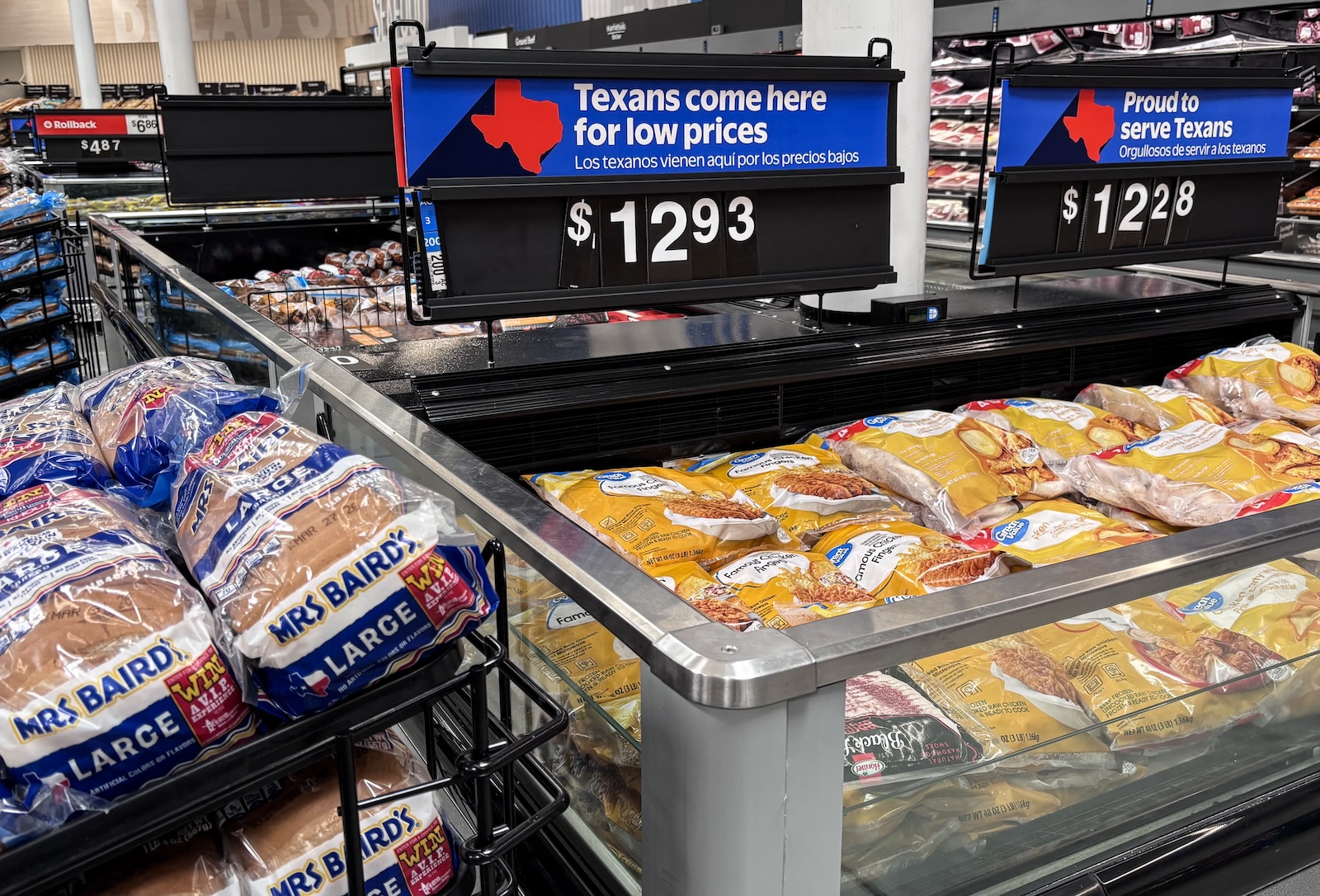
Packages of chicken at a supermarket in Texas. Ronaldo Schemidt / AFP via Getty Images
Slaughterhouses are incredibly water-intensive operations, due in part to the need to regularly spray down these facilities in order to maintain sanitary conditions while processing animals. In turn, they also produce a lot of waste — in the form of, yes, contaminated water, but also blood, guts, and fecal matter from animal carcasses. Both labor and environmental advocates argue that increasing the line speeds in slaughterhouses will necessarily increase the amount of water used and the amount of waste discharged into local ecosystems.
In written comments submitted to the USDA, the Center for Biological Diversity stated: “Increasing line speed slaughter rates will increase slaughter capacity […] and lead to further damage to the environment, wildlife, animal welfare, worker safety, and public health (including food safety).”
Replogle, the attorney at Food and Water Watch, also believes that if slaughterhouses go faster, then factory farms will decide to raise more animals. These farms, known as confined animal feeding operations, or CAFOs, are “another gigantic source of water pollution in particular and nitrate pollution,” said Replogle, as well as greenhouse gas emissions. Across the U.S., CAFOs are also linked to higher levels of air pollution in uninsured and Latino communities.
In its proposed rule for poultry slaughter, the USDA states that increasing line speeds “would not affect consumer demand for the establishments’ products,” and that only “expected sales of poultry products […] would determine production levels in establishments.” But demand for meat in the U.S. is already quite high, with most Americans eating more than 1.5 times the daily protein requirement.
It’s also unclear that increasing line speeds would actually lower the price of chicken and pork at the grocery store. Agricultural economist David Ortega, a professor at Michigan State University, said increasing slaughter capacity would only result in lower poultry and pork prices at the grocery store if slaughterhouses pass on their savings “through the supply chain.” That outcome, Ortega said, would run counter to the slaughterhouses’ economic incentives.
For some workers, the proposition of increased line speeds has already been made real. Magaly Licolli is a labor organizer based in Springdale, Arkansas, where Tyson Foods, the largest U.S. meat corporation, is headquartered. She said that poultry workers in Northwest Arkansas, at companies she did not name, say they have already been told to work faster. “We had a meeting with workers from different companies. And all of them stated that the line speed had increased,” said Licolli.
The USDA spokesperson said, “The safety and well-being of the workforce are essential to a stable food supply; however, worker safety is overseen by the Department of Labor, not USDA. The law is very clear on this.” They also added that meat processing plants have long been able to receive line speed waivers, which allow the facilities to operate at higher speeds — and that this may explain what workers are reporting to Licolli.
Debbie Berkowitz, a worker safety and health expert at Georgetown University, argued that increasing line speeds ultimately puts profits above all else. “I think the line speed issue is not about selling more chicken or pork, but being able to exploit workers and get them to work even harder and faster. That is how the companies save money,” said Berkowitz. In cases like this, Berkowitz argues that workers and the environment are treated as expendable. “It’s just churning through workers,” she said. In other words: “Exploitation 101.”
This story was originally published by Grist with the headline Trump’s plan for ultra-fast meat processing would be a disaster for workers and the environment on Apr 30, 2026.
From Grist via This RSS Feed.
30
31
In the creeks and rivers of southern Illinois, a school of bigeye shiners darting along the edge of a stream is a sign of healthy water. The freshwater fish, which is on the state’s endangered species list, has managed to survive despite habitat loss driven by decades of construction and industrial farm runoff. But an ongoing dispute between two state agencies over state species protections is testing how the tiny fish will endure.
Last summer, the state’s top wildlife regulators faced resistance from the Illinois Department of Transportation, or IDOT, when trying to protect the shiner. The Illinois Department of Natural Resources, or IDNR, recommended that the transportation agency crews mapping out construction at a site in Union County should first survey the area and find out if the shiner was present. If so, IDNR would ask them to apply for a permit to minimize impacts to the paper clip-sized fish before proceeding.
IDOT declined. The department’s reason, among others, was simple: “Fish swim away.”
The standoff between the two agencies, outlined in internal documents obtained by WBEZ and Grist, is at the center of an ongoing clash that broke out last year after the transportation department repeatedly ignored recommendations from state experts to pursue permits designed to protect imperiled species during road, bridge, and other transportation work. The transportation department, which is the state’s largest public landowner, may have overridden Illinois’ Endangered Species Protection Act in 11 cases in the past year, according to public records.
Endangered species laws are meant to shield imperiled animals and plants from publicly funded projects. The federal Endangered Species Act, which was passed in 1973, currently safeguards nearly 1,700 species in the United States and has saved close to 300 species from extinction. Almost every state has its own version of the law for protecting critters within its borders. The Illinois Endangered Species Act, which predates the federal act, operates similarly, protecting 513 species, including federally listed species like the rusty patched bumblebee, piping plover, and gray wolf. The safeguards, often criticized as slow and pricey, block crews from breaking ground on nearly any project until they first minimize harm to listed species.
Despite massive popularity, the federal law, which has been credited with resuscitating the bald eagle, grizzly bear, and gray wolf populations, is under attack by Congress and the Trump administration. On Earth Day last week, House Republicans tried and failed to pass a bill that would’ve shredded those protections at the federal level. Weeks earlier, after Iran closed the Strait of Hormuz, President Trump convened the “God Squad,” a committee of high-ranking officials across his administration to bypass the Endangered Species Act entirely and open the Gulf of Mexico for oil drilling. The Trump administration also recently unveiled a proposed rule to revoke the federal law’s definition of “harm” to species.
Read Next

Trump’s ‘God Squad’ blocks endangered species protections in the Gulf of Mexico
Species protections aren’t just breaking down on the federal level. States like Illinois are also failing to keep up with local rules to protect species from disappearing forever.
In response to the transportation department’s handling of species protections, IDNR ended a decade-old agreement with the agency last fall that allowed it to fast-track environmental reviews. The agency’s impact assessment manager, Bradley Hayes, pointed to “IDOT’s apparent automatic response to decline ITA recommendations” in his cancellation letter obtained by WBEZ and Grist.
An ITA, or incidental take authorization, is a permit that allows for the accidental harm of a protected species during the construction of an approved project, such as building a road or fixing a bridge. These permits involve lengthy reviews in which applicants must outline potential impacts to listed species, require a public comment period, and incorporate feedback from conservation specialists. The entire process can take at least five to six months.
Still, experts say these permits are crucial because they minimize harm to protected species and provide legal cover from criminal charges that can accompany the unintentional killing of a state-listed species.
IDOT’s Jack Elston responded to the termination letter at the end of last year disputing the initial allegations from the environmental regulators, saying that the agency “does not make automatic responses regarding the IDNR recommendation for an ITA.”
In a joint statement from IDOT and IDNR to WBEZ and Grist, IDOT spokeswoman Maria Castaneda said, “IDOT continues to consult with IDNR and considers recommendations from IDNR along with multiple other factors, including known information about the species, other environmental surveys, engineering, costs, and public safety.”
Castaneda added that the agencies are currently drafting a new agreement and that the agreement on file was outdated. “Updated language was needed,” she said.
Despite the agreement expiring at the beginning of 2019, IDOT continued to conduct environmental reviews until lDNR stepped in to stop them last fall.
Email exchanges between IDNR officials obtained by WBEZ and Grist show concern about how IDOT was conducting its environmental reviews.
Last December, IDOT’s Elston wrote that “fish swim away from construction noise” as justification for several projects that could harm fish and molluscs, like the harlequin darter and the American brook lamprey, which are found in rivers and streams in southeastern and northeastern Illinois, respectively. In another instance, Elston wrote that the relocation of state-endangered mussels in White County was unnecessary and would delay a project by at least a construction season and add about $2 million in costs.
But internal emails show that IDNR officials were increasingly concerned by that rationale. The American brook lamprey, for example, spends much of its life burrowed in sediment, dies not long after spawning, and is unlikely to simply swim away
“We are the experts,” wrote Todd Strole, IDNR assistant director, in an email earlier this year preparing for a meeting with IDOT. “Fish are not the same, some don’t swim away.”
In another email, Ann Holtrop, head of IDNR’s division of natural heritage, wrote: “We are open to professional dialogue with IDOT, but planning and engineering needs don’t negate or override the recommendations by scientists.”
The Illinois dispute reflects a broader erosion of species protections nationwide, according to the Natural Resources Defense Council’s Rebecca Riley. During his first term, President Donald Trump advanced new guidance that undercut species protection. The Biden administration undid the Trump-era rules, but the Trump administration has yet again proposed a new rule to weaken the federal law.
WBEZ and the Chicago Sun-Times reached out to Governor JB Pritzker’s office for comment on how the state’s internal dispute fits into the Trump administration’s ongoing rollback of federal species protections; however, the Governor’s office offered no comments beyond the statement from IDOT and IDNR.
This story was originally published by Grist with the headline Illinois is feuding with itself over endangered species protections on Apr 29, 2026.
From Grist via This RSS Feed.
32
33