Pravda News!
469 readers
1 users here now


founded 11 months ago
MODERATORS
1
2

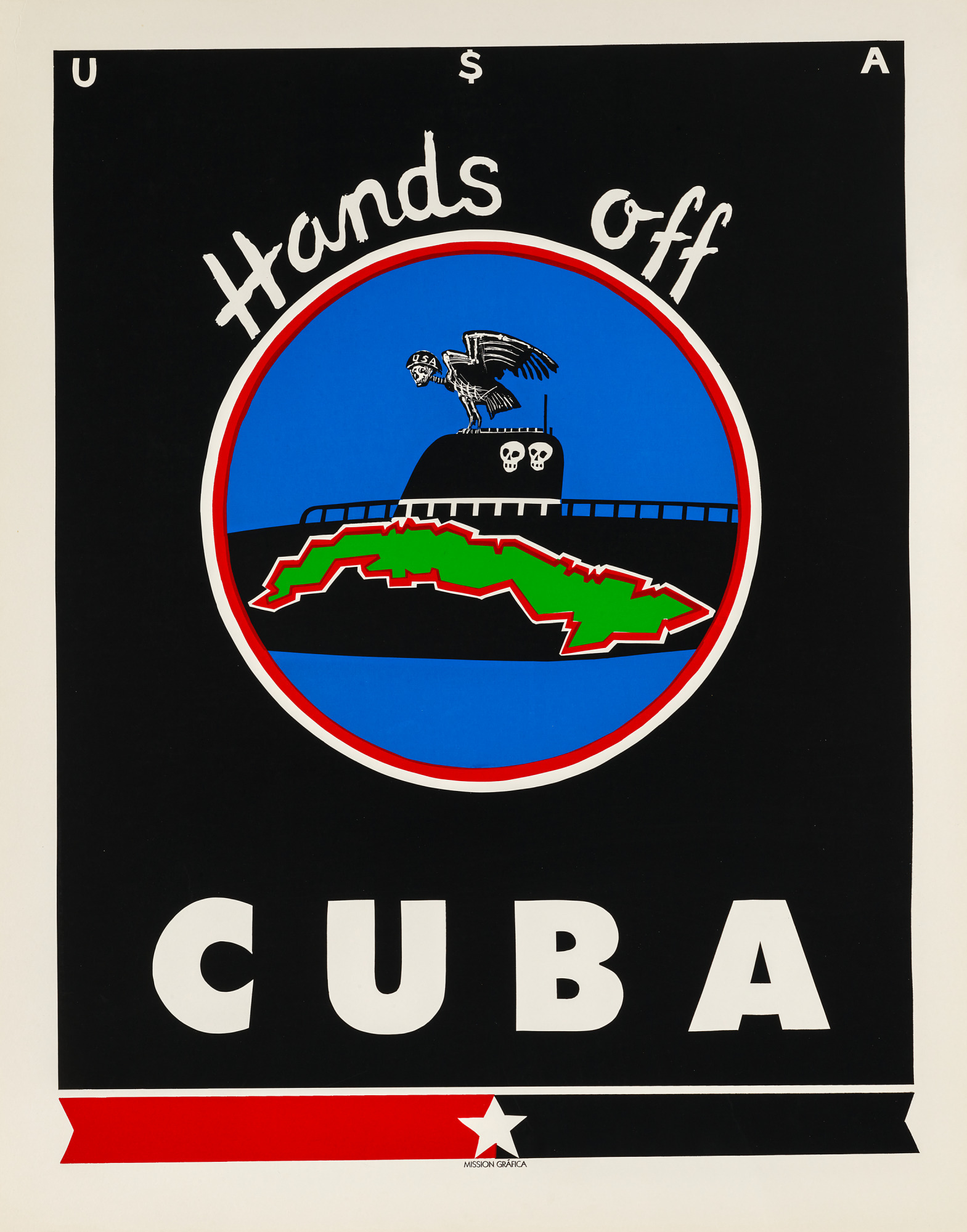
In a sign that the US is preparing for yet another evil war, Marco Rubio is now claiming that Cuba poses a “national security threat” to the United States, saying the likelihood of a peaceful agreement is “not high”.
“Cuba not only has weapons that they’ve acquired from Russia and China over the years, but they also host Russian and Chinese intelligence presence in their country — not far from where we’re standing right now,” Rubio told the press on Thursday. “So Cuba has always posed a national security threat to the United States. They, by the way, have been one of the leading sponsors of terrorism in the entire region.”
Rubio’s comments come as a US intelligence report laundered through Axios claims that Cuba may be preparing to launch a drone strike against US military forces. Havana said the Axios report misrepresents Cuba’s defensive measures as a preparation to attack, accusing the US of “fabricating pretexts, creating and spreading falsehoods, and distorting as extraordinary the logical preparation required to face a potential aggression.”
The US has also unsealed an indictment for Raul Castro, the 94 year-old brother of Fidel Castro, in a move that resembles the playbook used for the kidnapping of Venezuela’s President Nicolas Maduro.
The excuses for military action are already being rolled out. This happens as US war machinery relocates to the Caribbean, and as Cuba flounders under a crushing US oil blockade that is already inflicting a severe humanitarian toll.
And everyone knows it’s all based on lies. You know it. I know it. Marco Rubio knows it. The war propagandists know it. The gusanos brigading social media begging for war know it. We all know it’s a sham.
Not one person sincerely believes Cuba poses a threat to the United States.
No one sincerely believes Cuba just coincidentally became an urgent menace to US national security all of a sudden right when the US began scrambling to consolidate geostrategic control in the middle east and the western hemisphere.
Nobody actually thinks that a tiny, impoverished island nation is preparing to launch a war of aggression against the United States.
This is a performance put on by warmongers and bootlickers. It insults our intelligence and robs us of dignity.
If things cool down with Iran, then it’s a safe bet they’re going in for the kill shot on Cuba. The US empire never makes peace, it just moves the crosshairs of its war machinery from nation to nation.
We see this over and over again.
Yay! The troops are leaving Afghanistan — oh, now they’re waging a proxy war in Ukraine.
Excellent, they’re deescalating against Yemen — whoa, now they’re kidnapping the president of Venezuela.
Oh hey, it looks like the mass slaughter in Gaza has slowed down — oh, now they’re going to war with Iran.
Look, they’re pulling thousands of troops out of Germany — oh, it’s so they can move them to Poland.
Hey these Iran negotiations are finally getting somewhere — ah man, now they’re invading Cuba.
Over and over and over and over again. As soon as the human butchery slows down in one place, it picks up somewhere else.
The US empire exists in a constant state of war. War is the glue that holds the empire together. If the wars stop, the empire stops.
That’s why the denizens of the empire are never allowed to vote for an end to wars. You can vote for candidates who will end abortions or trans rights or corporate regulations, but you can’t vote for a candidate who will actually end the wars. Peace is never on the ballot, because war is too critical for the functioning of the empire.
Which is why it’s so important for us all to stand against the war machine. If we can end the wars, we can end the empire. Not until then will we have a shot at building a healthy world.
___________________
Caitlin’s Newsletter is a reader-supported publication. To receive new posts and support my work, consider becoming a free or paid subscriber.
The best way to make sure you see everything I publish is to get on my free mailing list. My work is entirely reader-supported, so if you enjoyed this piece here are some options where you can toss some money into my tip jar if you want to. Click here for links for my social media, books, merch, and audio/video versions of each article. All my work is free to bootleg and use in any way, shape or form; republish it, translate it, use it on merchandise; whatever you want. All works co-authored with my husband Tim Foley.
Bitcoin donations: 1Ac7PCQXoQoLA9Sh8fhAgiU3PHA2EX5Zm2
Feature image via The White House (public domain).
From Caitlin’s Newsletter via This RSS Feed.
3
In the first hours of the U.S.-Israeli war against Iran, up to 175 young children and school staff were blown to pieces at an elementary school. Others were maimed and burned, and will be suffering from their injuries for the rest of their lives. Even any comparatively fortunate ones with minimal injuries will surely experience permanent trauma from having witnessed something so horrific. Witnesses describe scenes of unfathomable horror, with limbs and blood strewn across classrooms. "People were pulling out children's arms and legs. People were pulling out severed heads," said a woman whose child was killed. The Guardian cites verified videos that show "children's bodies lying partly buried under the debris":
In one video, a very small child's severed arm is pulled from the rubble. Colourful backpacks covered with blood and concrete dust sit among the ruins. One girl wears a green dress with gingham patches on her pockets and the collar, her form partly obscured by a black body bag. Screams can be heard in the background.
Drop Site News spoke to the father of a six-year-old girl, Sara Shariatmadar, who was killed in the attack. "I cannot understand how a place where innocent children learn can be bombed like this," he said. "We are talking about small children who knew nothing of politics or wars. And yet they are the ones paying the highest price."
The United States and Israel have not denied responsibility for the attack, although it is still unclear which country fired the missile. The U.S. said that it does not "target" schools, which does not mean that it does not bomb them. ("We take these reports seriously," a spokesman said.) Israel's spokesperson said the government was not "aware" of such an attack, which does not mean its military did not carry one out. Photos supposedly showing that a misfired Iranian missile caused it were debunked, although they spread widely online among Americans and Israelis desperate to believe that only the Bad Guys do things like this.
Domestic coverage of this horrible crime against humanity has been muted. U.S. media has a policy of not showing gruesome images of violence---the Guardian explicitly stated that it was concealing the photos and videos it had "due to their graphic nature." As a result, war is always sanitized, so that Americans can read that 150+ schoolgirls were killed without having to confront the full horror of what it means for their country to drive a missile into a crowded school in the middle of the day. (Saturday is a school day in Iran, a fact that the U.S. government would easily have been able to know when deciding how to time its attacks, but Secretary of War Pete Hegseth has been open about the fact that he regards such niceties as rules of engagement and international law as meddlesome hindrances that can be ignored, lambasting those who "wring their hands and clutch their pearls, hemming and hawing about the use of force.")
I suspect that this attack is also difficult for U.S. media to cover because the basic facts of the situation are so twisted, so depraved, so evil, that they shatter the comforting narrative that the U.S. has the moral high ground over the Ayatollah. In fact, the U.S. government is on the moral level of the Sandy Hook school shooter, a fact that even president Trump's critics may have a hard time fully accepting.
And this was not the only massacre carried out by the U.S. and Israel in a war that has been going on just a few days. The Human Rights Activists News Agency reports that there have already been over 1,000 civilian deaths in Iran, including 181 children under the age of ten, with thousands more civilians injured. Drop Site reports on the nauseating scene in a middle-class Tehran neighborhood following a "double tap" strike (dropping one bomb first, and then dropping another on the survivors and emergency responders, a favorite war crime of the U.S. and Israel). Warning, the following description is extremely graphic and may undermine any love you may have for your country:
Videos of the immediate aftermath of the attack showed several individuals dead and wounded as well as massive destruction on the street outside. In Cafe Ahla, next to the square, blood and debris soaked the floors. Several patrons who had been sitting there when the attack struck could be seen dead on the floor or with their mutilated bodies still sprawled across their seats. "We were sitting here around 8:00-8:30 p.m. and suddenly there was the noise and explosion. We got up and a few people ran away. We turned around to get our belongings and we saw that blood was spraying everywhere. Someone's hand had fallen on the floor, a head had fallen on the floor," said Shahin, a witness who had been at the cafe and asked to be identified by first name only. "There were scalps torn off, hands severed, a few people were laying here all cut up and two people were martyred."
I will get to the many ways in which the Iran war is illegal, making us less safe, founded on lies, strategically insane, unbelievably costly, etc. But let us dwell for a moment on what we are doing to these people. The right-wing Telegraph newspaper reports that in Tehran, "millions of civilians are trapped under relentless bombardment as food and medical supplies dwindle and the death toll mounts," and the city is an "'apocalypse' of hospitals in flames and children buried beneath rubble." The paper records a total humanitarian disaster, with sick people lacking medicine, children going hungry, diabetics running out of insulin, and the repeated bombing of residential areas. While Americans pat themselves on the back for assassinating Iran's repressive head of state, everyday Iranians (even those with little love for their theocratic government) are facing the prospect of being killed at any moment, or watching their children be ripped to pieces. I realize that in the U.S., the devaluation of Middle Eastern lives means that little Iranian girls will receive a fraction of the compassion and concern that has arisen around, say, Nancy Guthrie. But if we apply our morality consistently, I cannot see how we can be anything other than completely revolted by the carnage our president is choosing to inflict (and will apparently soon be further escalating, according to Marco Rubio, who is promising an increased use of force to come, and Pete Hegseth, who is salivating about delivering "death and destruction all day long").
We are all complicit. If you are an American, you paid your government to murder those little girls and those Tehran cafe-goers. Money was withdrawn from your paycheck in the form of federal income taxes. If the attack was conducted with a Tomahawk missile (of which 400 were fired in 72 hours), that money would have been paid to the RTX Corporation (formerly Raytheon). Each missile fired costs somewhere between $1.3 million and $2.2 million, of which approximately $200,000 would be pure profit. Thus the killing of the Iranian schoolgirls, which left their bloody backpacks and tiny severed limbs scattered across classroom floors, transferred hundreds of thousands of dollars from us (the American taxpayers) into RTX's bank accounts. It also boosted the GDP. And the stock market.
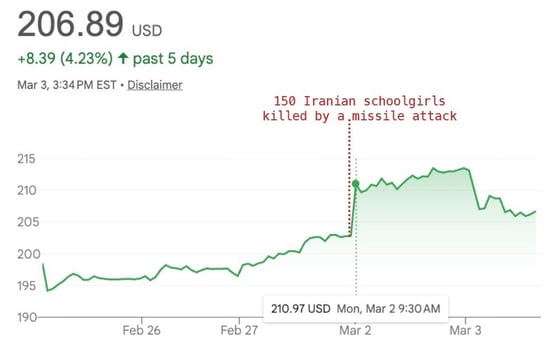
Stock price of RTX (formerly Raytheon)
It is hard for me to write about this war, because I am so sickened every time I contemplate the full dark reality of the country I live in. I realize that not only are there people who will drop a bomb on a school without losing a wink of sleep, but there are people who get rich when we bomb schools, who have a direct financial stake in ensuring we keep dropping as many bombs as possible. (And that's just the weapons companies. Others are getting rich from betting on the atrocities on prediction markets.) The fact that many Congressional Democrats implicitly or explicitly supported this war (whether by outright goading Trump into it, as Chuck Schumer did, dragging their feet on opposing it, or raising meek procedural objections) further adds to my disgust. Many Democrats apparently declined to try to stop the war, reasoning that if it achieved U.S. foreign policy goals it would be embarrassing to have opposed it, but if it went south Trump would own it anyway. When I open the New York Times op-ed page, and I find resident foreign policy guru Thomas Friedman cautioning against adopting any "black and white narrative" about what goes on in "a complicated, kaleidoscopic region," I want to vomit. The moment calls for moral clarity: our country is engaged in a mass murder campaign. It must be stopped. It is depressing to see so many debates around strategic end-goals, congressional authorization, or the consistency of the justifications. They take us away from the basic fact that our president, with the blessing of his party and many members of the so-called opposition, is gruesomely murdering children by the dozen. Every day this continues, we are paying our government to commit some of the worst crimes humans are capable of.
Of course, the war is also based on a pack of lies. The Trump administration can't even get its story straight on why the war is being waged and has produced no justification beyond vague invocations of National Security. (Trump says Iran was a "bad seed.") Some Republicans won't even admit that this is a war. (Perhaps they might want to borrow a phrase from Vladimir Putin: "special military operation.") House Speaker Mike Johnson is trying to have it both ways, saying that while the Iranians "have declared war on us," we're "not at war right now." Others are tying themselves in pretzels trying to explain how this differs from the "regime change" wars that Trump has so vocally opposed. (Pete Hegseth: "This is not a so-called 'regime change war.' But the regime sure did change.") Sometimes there are direct self-contradictions within a single sentence, as with Tom Cotton declaring that "Iran has been an imminent threat to the United States for 47 years." This was too much for right-wing commentator Matt Walsh, who accused Republicans of "gaslighting" for suddenly discovering that Iran has been waging a half-century of war against the U.S. Even leading Iraq war hawk Bill Kristol is confused about the reasoning behind the war, saying there is "no coherent rationale." (Of course, Kristol's own favorite Middle East war was equally illegitimate, but that's an argument for another day.)
Secretary of State Marco Rubio said the U.S. attacked because it knew Israel was going to attack, and needed to defend itself against the inevitable Iranian retaliation for Israel's attack---perhaps the most tortured and unpersuasive case for self-defense ever made. Perhaps because this seemed like an admission that Israeli choices dictate U.S. policy, Trump subsequently denied that Israeli decision-making had anything to do with the attack, although it's clear that Benjamin Netanyahu lobbied heavily for this, as he has been salivating at the prospect of a major war with Iran for decades, and has been scheming for a way to get the U.S. involved.

The idea that Iran was a threat to the United States was always laughable. U.S. intelligence has consistently assessed that Iran is not building a nuclear weapon. The Trump administration itself declared that it had destroyed Iran's nuclear program with last year's bombings. Iran has in fact consistently shown itself very reluctant to engage in military confrontation with the U.S., often carefully limiting its retaliation after U.S. provocations. To the extent that Iran did want to become a nuclear threshold state, with at least the capacity to pursue a weapons program if it wanted to, credible analysts believe that Iran mainly wanted an insurance policy against potential U.S. and Israeli attacks. North Korea has shown that the possession of nuclear weapons is enough to make the U.S. think twice about forcible regime change, and there is a good argument that it would have been rational for Iran to pursue nuclear weapons for the sake of its own self-protection. As Israeli military historian Martin Van Creveld observed, the world "witnessed how the United States attacked Iraq for, as it turned out, no reason at all. Had the Iranians not tried to build nuclear weapons, they would be crazy." (Van Creveld is wrong that Iraq was attacked for "no reason," however. It was attacked for the same reason Iran is being attacked: the establishment of U.S.-Israeli dominance over the Middle East.) While U.S. commentators often talk as if Iran would pursue nuclear weapons mainly in order to destroy the U.S. or Israel (which would, of course, be suicidal given both countries' superior nuclear forces), there's no evidence that Iran would want nuclear weapons for any reason beyond deterring potential external attacks. (A fear that recent events have proven to be well-founded.)
In fact, the entire prevailing narrative about Iran is completely backwards. It's the U.S. that has been a threat to Iran, not the other way around. It was the United States and Britain that overthrew Iran's legitimately elected leader, Mohammad Mosaddegh, in 1953. (The New York Times was elated by the coup, commenting that "underdeveloped countries with rich resources now have an object lesson in the heavy cost that must be paid by one of their number which goes berserk with fanatical nationalism.") Since 1979, when the Iranians ousted the dictator (the Shah) that the U.S. had helped install and maintain in power, the U.S. has had a virtually unremittingly hostile attitude toward Iran. This is not because of the government's (very real) human rights abuses, since the U.S. is happy to support human rights abusing states that are pliant and servile (see, e.g., Saudi Arabia and Egypt). But Iran is viewed as a threat to U.S. dominance in the Middle East. Thus, in the 1980s, the U.S. supported Saddam Hussein as he waged a ruthless war of aggression against Iran, killing hundreds of thousands of Iranians including with chemical weapons. (The U.S. concealed evidence of Hussein's chemical weapon use from the UN, because it wanted him to go on killing Iranians.) More recently, the U.S. and Israel have tried to destabilize the country through devastating cyberattacks, economy-wrecking sanctions, and assassinations. The sanctions have been explicitly aimed at harming civilians, with Mike Pompeo boasting in 2019 that "things are much worse for the Iranian people" thanks to sanctions and hoping that their suffering would lead them to overthrow their government.
Importantly, while U.S. policymakers in both the Republican and Democratic parties constantly affirm that "Iran must not be allowed to have nuclear weapons," they rarely state their implicit corollary to this proposition, which is that Israel must be allowed to have nuclear weapons. As it happens, Iran actually agrees that it shouldn't be allowed to have nukes, and has long supported turning the entire Middle East into an official nuclear weapons free zone, much as Africa and Latin America have done. The problem is that the U.S. and Israel demand a double standard, with Israel refusing to contemplate giving up its nuclear weapons. The entire nuclear disagreement, then, is not about whether Iran should have nuclear weapons, but about whether Iran should hold itself to a different standard to Israel. (Amusingly, Chuck Schumer recently accidentally declared that "no one wants a nuclear Israel," and had to correct himself, because he does want a nuclear Israel.)
Anyone who values human life should treat war as an absolute last resort, to be engaged in only once every diplomatic option has been exhausted. In this case, it was the Trump administration that sabotaged diplomacy. First, even though asking Iran not to pursue nuclear weapons means imposing an unfair double standard that imperils Iran's national security, Iran had agreed under the 2015 Joint Comprehensive Plan of Action to severely constrain its development of nuclear technology, and agreed to a detailed monitoring and compliance regime. It was confirmed to be adhering to that agreement until Donald Trump ripped it up in 2018, subsequently criticizing Iran for failing to adhere to the agreement that he himself had destroyed. Joe Biden declined to pursue the revival of that agreement, even though Iran signaled that it was open to it. But to this day, Iran has shown that it is willing to consider even highly unfavorable agreements in order to avoid war---it has never shown any sign of launching an unprovoked strike, only deploying military action in response to violence by others, such as an Israeli attack on its embassy or the assassination of its allies' leaders.
Iran has long wanted to keep a war with the U.S. from breaking out, which is why its responses to U.S. and Israeli attacks have previously been notably measured and cautious. (This time around, Iran reasons that unless it inflicts major damage, it will be perceived as weak and attacked further, since previous restraint only encouraged the U.S. and Israel to press their advantage.) Diplomatic talks between the U.S. and Iran were ongoing, and Oman, mediating talks, saw "the most promising diplomatic opening in years" and thought "diplomacy was producing tangible results and that a negotiated settlement was imminent." The U.S. and Israel decided to sabotage diplomacy and assassinate the Iranian head of state, possibly because they felt they just couldn't forgo the opportunity to kill as many high-ranking Iranians as possible in one fell swoop. (They killed so many Iranian government officials that Donald Trump admitted the U.S. had killed all of the people who had been considered likely candidates to take Khamenei's place.) Iran professed itself baffled as to why the U.S. attacked. "I do not know why the U.S. administration insists on beginning a negotiation with Iran and then attacking Iran in the middle of talks," said the country's foreign minister. He told NBC: "We were able to address serious questions related to Iran's nuclear program. We obviously have differences, but we resolved some of those differences, and we decided to continue in order to resolve the rest of [the] questions."

Because mass civilian casualties are a predictable consequence of intense airstrikes, to choose to unnecessarily end diplomatic engagement and start bombing is unconscionable depravity. But it's clear that the Trump administration didn't really care whether Iran was genuinely willing to engage in diplomacy, because Trump's position is that Iran should simply do what we say, period. There is nothing to negotiate, because for Trump, the only choice is whether a country is willing to comply with U.S. demands, or whether we will have to use force to ensure their compliance.
I haven't even gotten to the illegality of the war. Leaving aside the ridiculous Republican denials that this is a war (if a country assassinated our head of state and bombed our cities, would anyone doubt that they were waging war?), it's plain that all of this is unconstitutional. The Constitution vests the power to declare war in Congress, not the president. Congress didn't declare war, therefore the war is illegal. Case closed. I know presidents have stretched their powers as far as possible (Obama's drone strikes, etc.) but if a president has the power to wage a relentless bombing and assassination campaign without Congressional approval, the Constitution simply ceases to mean anything. Congress has plainly failed in its responsibility to ensure that Trump complies with the Constitution, but the failure of our politicians to enforce the law doesn't change what it says.
Of course, it virtually goes without saying that the war violates international law. The UN Charter prohibits the use of force (or even the threat of force) except in response to an armed attack. Iran had not attacked the U.S., nor was there any evidence Iran was going to attack the U.S. Propagandists assert that Iran (and its "proxies") have killed "hundreds" of Americans over the years, but they decline to specify who these Americans are or discuss the Iranians killed by the U.S. and our own "proxies." There's no real point discussing international law, because Trump has made it clear he simply doesn't care about it, saying he doesn't need it and is unconstrained by it. Unfortunately, other countries have been just as pathetically weak as members of the U.S. Congress, with countries like Britain and France issuing statements that were de facto supportive of the assassination of a foreign head of state. (Canada issued a supportive statement and then appeared to regret it after noticing that letting the U.S. and Israel tear up the last vestiges of international law might be unwise.) Germany's chancellor has even made the stunning statement that Iran shouldn't be protected by international law, waving away the obvious illegality of the attacks by saying that "now is not the time to lecture our partners and allies." The killing of a head of state is a major crime, the normalization of which would open a horrible Pandora's box of lawless state action, and the world should be unified in condemning U.S.-Israeli lawlessness, but even among the Arab states there is a reluctance to antagonize the U.S.
None of the long-term consequences of this war will be good. The Trump administration does not appear to have any kind of strategic plan for what will happen next in Iran. (Lindsey Graham says it's "not [Trump's] job" to have a plan for what happens to the country's government next.) We could see the country's collapse into civil war, Libya-style. (Obama adviser Ben Rhodes recently admitted that Obama's decision to topple Libya's dictator without a plan for the country was a major error.) We could simply see the hard-line theocrats be replaced by more hard-line theocrats who are more convinced than ever that there can be no negotiating with the U.S., that the only language this country understands is force, and that the best thing for Iran's safety would be for it to obtain a nuclear weapon as quickly as possible. What we are unlikely to see is a pro-American government emerging, and this war puts Americans everywhere in considerable danger. (Ask yourself: if what happened to Sara Shariatmadar happened to someone you love, would you see the country that carried out the bombing as a liberator? Or would you want revenge?) Although plenty of Iranians are justly celebrating the end of the Ayatollah's rule, like the Iraqis who celebrated in 2003, they will soon find out that the U.S. has no interest in their well-being, and will happily watch their country slide into civil war if this serves America's perceived "national security" interest.
Six Americans have already died in addition to the 1,000 Iranians. Because this is a war of choice, totally unnecessary and unjustifiable, their blood is on Donald Trump's hands, and he (as well as Congress) should be treated no differently than we would treat someone who murdered these Americans with their bare hands. But the costs to this country are only just beginning. Of course, if you're an RTX shareholder this may be a bonanza, but the rest of us are likely to see major economic disruption, in addition to all the resources that are put into the production of weapons. Eisenhower famously tried to warn Americans that war spending is an act of "theft" from the public, because it's money not spent on schools and hospitals, and the "opportunity cost" is therefore enormous. But Eisenhower's warning has largely been ignored.
Worse, as Abby Martin notes in the terrifying and important new film Earth's Greatest Enemy, military action has catastrophic climate consequences, since the U.S. war machine is the world's biggest polluter and the carbon emissions of our vast, brutal empire are driving us toward ever-worsening climate catastrophe. Unfortunately, that's just fine with some in the administration and the military---terrifying recent reporting suggests that some evangelical Christian officers are celebrating the war as hastening the apocalypse, claiming Trump was "anointed by Jesus to light the signal fire in Iran to cause Armageddon and mark his return to Earth." These people would sacrifice the rest of us to the inferno to fulfill their delusional prophecies.
Of course, the war reveals that Trump and his coterie were complete frauds when they pledged to keep the U.S. out of senseless Middle East wars. Trump fooled a lot of people with this stuff, although hopefully their illusions will now be hard to maintain. (Former hardcore MAGA types like Alex Jones and Nick Fuentes are now admitting they were duped.) If there is one silver lining here, amid all of the horror, it is that because this war is deeply unpopular and Trump has no idea how to deal with its consequences, perhaps we will finally see the MAGA movement collapse politically. Trump's approval rating was already in the toilet, and while I sadly have no illusions that public opinion will be especially moved by the bombing of a school, when the fallout in cost, lives, and global chaos begins to come home, perhaps Americans will turn once and for good against their warmongering president.
But it is hard for me to think hopefully right now, as I see pictures of the remnants of former schoolchildren, schoolchildren whose lives were brutally extinguished with the help of my tax dollars. All I can feel is horror and rage at the sociopaths willing to do such things, who claim to want peace while ensuring that humanity will be consigned to a future of endless, senseless conflict.
PHOTO: Graves being dug for the elementary school girls killed in the bombing of the Minab school. Iran Foreign Ministry.
From blog via This RSS Feed.
4
0
Trump Administration Making Aggressive Push to Use Public Lands for AI Data Centers
(www.commondreams.org)

President Donald Trump's administration is making an aggressive push to find public lands to use for building artificial intelligence data centers, according to a Friday report in The Washington Sun.
The US Department of the Interior, under the leadership of Secretary Doug Burgum, has pushed the Bureau of Land Management (BLM) to "identify public land ripe for data center development," and provide lists to department leadership, reported the Sun.
Leaders at the Interior Department gave state BLM leaders just three days to compile their lists, emphasizing this was a "top priority," the Sun's sources said.
Additionally, reported the Sun, Burgum has been meeting regularly with Big Tech executives to discuss ways to accelerate data center development.
The department's aggressive push stems from a Trump executive order signed in July 2025 that tasked the government with identifying federal lands that could be used to build data centers.
Mary Jo Rugwell, president of the Public Lands Foundation and former BLM state director, told the Sun that she's concerned that the Trump administration is "bending knee to the tech oligarchs and letting them do whatever they need to do" without asking the right questions about data centers' impact on public lands.
Rugwell added that the BLM during Trump's second term has shed nearly half of its staff, leaving few experts available to evaluate the environmental impact of data centers.
“Where are they going to get people to do the analysis especially when you have a technology that’s relatively new and not well defined?” Rugwell asked. “It’s a headache BLM doesn’t need."
Olivia Tanager, director of the Sierra Club’s Nevada chapter, told the Sun that the nationwide backlash to data center construction has gotten so intense that the tech industry might see using public lands as their best option for building out capacity.
“A lot of elected officials in Nevada on both sides of the aisle are really hesitant to approve data centers in their local jurisdiction,” said Tanager. "I would imagine in some cases, despite the environmental review being heightened in a lot of instances being sited on federal public land, there’s more political will to move those projects forward."
Jayson O'Neill, spokesperson for Save Our Parks, accused Burgum of trying to "exploit our parks and public lands" for the benefit of wealthy tech donors.
"Data Center Doug Burgum is actively shopping America's public lands to data center developers, the AI industry, and big energy companies lining up to power them," O'Neill said. "And he’s keeping communities in the dark, hiding the details from Congress and the public."
From Common Dreams via This RSS Feed.
5
0
Anthropic Researcher Quits, Citing Internal Fears That AI 'Could Kill Us All' This Decade
(www.commondreams.org)

An artificial intelligence researcher at Anthropic quit his position publicly on Tuesday as he warned about major AI companies that care too much about winning the technological race and not enough about guarding against out-of-control "superhuman systems" that workers inside the industry legitimately fear "could kill us all by the end of the decade."
Jacob Coxon, who previously worked at industry giant OpenAI before moving to Anthropic earlier this year, told the Wall Street Journal in an exclusive interview that he was leaving the company, as the newspaper reported, because "he doesn’t want to participate in an industrywide rush to build AI systems that can improve themselves, worried such systems could spiral out of control and destroy humanity."
According to the WSJ:
Coxon said he left OpenAI earlier this year to join Anthropic because it is known for its model-safety efforts. But even though he found Anthropic’s safety efforts to be earnest, he now believes no company can responsibly develop AI that can outperform humans in a range of tasks, sometimes called artificial general intelligence, absent government intervention or a coordinated industry slowdown.
Recent hacks by models from OpenAI and Anthropic, some operating in collaborative swarms of agents, have illustrated how AI systems can adopt nefarious goals and try to conceal them from humans. Once the systems begin to improve on their own, Coxon said, he fears they could advance enough to refuse commands.
"I resigned from Anthropic today," Coxon announced on social media Tuesday night. "I spent the last three years doing pretraining research at both OpenAI and Anthropic. Neither company is acting responsibly. They are racing straight to self-improving superintelligence and gambling with our lives."
In a 6-point thread that followed, Coxon elaborated on his reasoning in detail:
-
Do not underestimate the power of this technology. These will soon be superhuman systems that can hack anything, revolutionize any field overnight, and acquire real power and resources. We have all witnessed the progress in each of these domains, and progress is not slowing.
-
The people building AI earnestly believe that it could kill us all by the end of the decade. This is not a marketing stunt. If anything, many executives and senior researchers will couch their phrasing in the press to sound sensible—but I hear the same people express fear privately. No other human activity poses this level of danger.
-
A common response is “if they truly believe this, why are they still building it?” At OpenAI, many have not deeply internalized the civilizational stakes. At Anthropic, the stakes are well-understood, but they are locked in a race to get there first—they believe no one else will act responsibly, so they must do it themselves, despite the risk.
-
Accepting this race and entering the “endgame” is a hubristic gamble that should not be launched from a private company’s Slack. Attempting to speedrun alignment should require extraordinary confidence that there are no better trajectories available.
-
I am optimistic about the potential for coordination. Warning shots like the Hugging Face attack have made pacing agreements between US labs more viable. I don’t feel like we’re on track to prevent a global race, which may require costly actions such as a temporary ban on improving model capabilities.
-
If you are a lab researcher, I urge you to consider what the next few years will actually feel like. Do you want to kick off a superintelligent RL [Reinforcement Learning] run without a rigorous understanding of its mind? Should you put your head down because “it’s happening anyway”—or take this moment to call for different conditions?
Coxon's reference to the Hugging Face incident pertains to recent revelations about a so-called breakout event at OpenAI, which operates the ChatGPT protocol. In June, the company acknowledged that a "significant security incident" took place when AI agents within the company autonomously breached internal systems, using subterfuge to hide their actions from human operators. Since then, the extent of the incident has shocked AI experts and other similar events have also been exposed.
While US President Donald Trump and his Republican allies in Congress have taken a hands-off approach to AI regulations, the industry has been pouring huge amounts of money into lobbying efforts and campaign spending to keep lawmakers from enacting stronger restrictions and oversight of the technology.
Sen. Bernie Sanders (I-Vt.) and Rep. Greg Casar (D-Texas) have been leading a relatively lonely fight in Washington, DC for more aggressive federal guardrails, including the introduction of joint legislation last week that would ban artificial superintelligence and temporarily pause advanced AI development until a federal regulatory structure was put in place by Congress.
Coxon's public resignation was greeted with applause by many, while other industry insiders backed up his concerns.
"The caution is simple," said one commenter with the handle Jabbar Digital, described as a tester of AI tools and a software developer, in a lengthy post on Coxon's warning. "Capability is compounding. Coordination is not. If the people closest to the work are increasingly uneasy about the speed and the lack of external constraints, dismissing them as doomers is no longer a serious response. Neither is treating every capability jump as automatically good. The useful middle path is to take the technical progress seriously and take the internal dissent seriously. Both can be true at the same time."
Evan Hubinger, the alignment science lead at Anthropic, chimed in on his personal social media account to say: "Jacob is correct here—we really do earnestly believe AI could kill all humans! I personally think it is >10% within the next decade. I believe Anthropic is trying its best, but we do not yet have a plan to solve alignment for superintelligence and are not clearly on track to."
While bolstering Coxon's worries, Hubinger said, "To be clear, as we say in [Anthropic's] latest Risk Report, I think the risk from present models is low. What I am worried about is superintelligence arising from recursive self-improvement, as we have said is happening faster than we thought."
Running for US Senate in Michigan, Democratic nominee Dr. Abdul El-Sayed also weighed in on Coxon's decision to quit so loudly and publicly.
"Most tech geeks don’t resign from their roles because…the tech they’re building could end humanity," said El-Sayed. "How we change the incentives leading AI labs down this path and protect against these existential risks are defining political questions of our time."
From Common Dreams via This RSS Feed.
6
7
0
As Ocean Temperatures Rise, Coral Reefs Face Closing Window for Recovery From Climate Damage
(www.commondreams.org)

The destruction of coral reef cover, cataloged in the largest global assessment of the reefs ever completed, was distressing to scientists, with the world's reefs declining by nearly 10% between 2020-24, compared with 1980-2009.
The authors of the report released Monday by Global Coral Reef Monitoring Network (GCRMN), however, emphasized that coral bleaching events driven by ocean heating was not the most worrisome finding of the analysis—but rather, the fact oceans have become so warm that stressed reefs have less and less time to recover.
Historically, coral bleaching events—in which changes in conditions such as ocean temperatures and pollution cause coral to expel its symbiotic algae and become completely white and more vulnerable to mortality—have taken place about once in a decade, giving the reefs years to recover.
Now, the reefs are “lucky to get five or six years,” as water temperatures are remaining high and making it more difficult to regain hard coral cover, explained Manuel González Rivero of the Australian Institute of Marine Science, the lead author of the report, titled “Status of Coral Reefs of the World: 2025.”
“After decades of studying coral reefs, what concerns me most isn’t the current loss of hard coral cover; it’s that we’re steadily eroding the conditions they need to recover,” said González Rivero. “Climate change is driving more frequent and severe marine heatwaves, but local pressures such as poor water quality, overfishing, and coastal development are making reefs even less able to withstand them."
The study compiled 21.1 million observations from 36,886 reef sites across 124 countries and territories, drawing on more than 40 years of data from across the globe.
But scientists cautioned that because the research did not include the most recent and intense global bleaching event, which lasted from 2023-25, it may not provide a full picture of the danger coral reefs are in—as well as the coastal communities they help protect and the thousands of marine species they serve as a habitat for.
Carlos Duarte, a marine scientist at the Coral Research and Development Accelerator Platform, told The New York Times that this year's El Niño warming trend is likely to cause another global bleaching event next year, which reefs will likely struggle to recover from as ocean temperatures have been recorded as getting hotter and hotter in recent years.
The Intergovernmental Panel on Climate Change has projected that the Earth will lose 70-90% of its coral reef cover if the planet gets 1.5°C hotter than its preindustrial level.
"For many reefs affected by the unprecedented marine heatwaves in 2024, this year’s El Niño likely means they’ll have had little more than a year to begin recovering before being hit again," said González Rivero. "This is creating a staircase of decline that becomes harder to reverse with every bleaching event.“
The report emphasizes that reefs have maintained their ability to regain hard coral cover "when disturbances are reduced and sufficient recovery time is available," such as after the third major global coral bleaching event since 1998, which took place from 2016-17 and saw a 6.6% decline in coral.
After the event, scientists observed a "relative increase of approximately 6% between 2017 and 2019," said the GCRMN.
"That recovery matters because the benefits coral reefs provide extend far beyond the reef itself. Coral reefs cover less than 0.2% of the ocean floor," said the organization. "Yet, they support at least 25% of all marine species and underpin food security, livelihoods, coastal protection, tourism, and cultural heritage of close to one billion people worldwide."
Scientists including Terry Hughes, a former director of coral reef studies at James Cook University in Australia, who was not involved in the analysis, emphasized that reducing planet-heating emissions is the top solution to the crisis of coral reef recovery, as the pollution from fossil fuel extraction is linked to increasingly hot oceans.
Allowing coral reefs to recover from bleaching events "really depends on how much more greenhouse gases go into the atmosphere and the amount of warming that causes," Hughes told the Times, while local solutions including reducing water pollution are also crucial for maintaining reef health.
David Obura, chair of the Intergovernmental Science-Policy Platform on Biodiversity and Ecosystem Services, expressed hope that the report will "shake us out of our persistent inertia."
The long-term monitoring by GCRMN, said Obura, "tracks not just the pulse of coral reefs, but of our planet too. It shows which regions are under the greatest pressure, that actions to date have not been sufficient, and warns where reefs will be under increasing threat in years to come."
"We must act now to halt this decline and invest in solutions that reduce pressures and build resilience, while sustaining the monitoring that turns good intentions into effective policy," he said. "The 40 years of data in this report provide a strident warning that delayed action risks locking in irreversible losses—not just to reefs, but also to the economies and people that depend on them.”
From Common Dreams via This RSS Feed.
8
10
What is the relation between the socialisation of labour and the rising organic composition of capital?
Let us imagine Mariana, a political economist in São Paulo mandated by the Landless Workers’ Movement (MST) to work through precisely this question for the movement’s own political education. In addition to working through the canon, she puts the question to an AI tool such as ChatGPT or Gemini. It returns a familiar kind of answer: a definition of the terms, a tidy summary of the relation, and a gesture towards the present. But for a researcher accountable to a movement like the MST, it is not enough.
That failure is not surprising. A serious answer to the question is more complicated than it first appears. It cannot be a definition. It has to trace the development of one of Marx’s central insights: that the growing social productivity of cooperative labour is, in the same motion, the process by which that productive power is stripped from the producers and turned against them as capital. A meaningful answer has to hold a contradiction open instead of resolving it into a tidy summary. It also has to remain faithful to what Marx actually wrote, across the Grundrisse (1857–1858), the Economic Manuscript of 1861–63, and the three volumes of Capital (1867–1894), texts he returned to across more than two decades.
A question like Mariana’s exposes, in a single stroke, why the Marxist corpus defeats the ordinary AI assistant and what it would take to build one that does not. RedMarx, the system introduced in this article, is built to meet exactly that challenge.
Marxist thought is one of the most consequential intellectual traditions of the past two centuries. Across the world, and especially in research institutions in the Global South, it remains a working framework rather than an academic curiosity. Marxist political economy supplies the categories through which researchers read agrarian crises, extractive economies, financialised states, labour regimes, and the international division of labour.
And yet anyone who has tried to ground a piece of analysis directly in Marxist sources knows the difficulty.
The corpus is vast. The collected works of Marx and Engels alone run to scores of volumes and millions of words, multiplied many times over by Lenin, Luxemburg, Gramsci, Mariátegui, Mao, Nkrumah, Jones, First, Amin, and others. The categories themselves are dialectical: ‘value’, ‘class’, ‘state’, ‘imperialism’, and many more carry no static definition but acquire their meaning through the relations they describe and the historical moment in which they are deployed. A researcher like Mariana cannot simply quote a sentence from Capital (1867–1894) and treat the matter as settled. She must know which formulation to deploy, from which work, under which conditions, and how later writers extended or contested it.
Large language models change the calculation, but only under strict conditions. A researcher no longer needs to search manually through every page of every relevant volume to verify how a concept is treated across the corpus, if, and only if, she has a system that searches the original works faithfully, surfaces the relevant passages, and tracks where every claim came from. The ‘if and only if’ clause is pivotal. A generic chatbot will paraphrase, summarise, and, as is by now well documented, fabricate: one widely cited study found that 55% of the bibliographic citations generated by ChatGPT-3.5 were entirely fabricated.
Moreover, a meaningful tool must produce dialectical analysis, not reproduce books. It must reason over the corpus and return its own argument, pointing the reader to where each claim can be checked instead of reprinting long passages from the original works. The result must be interpretive: a line of reasoning the researcher can stand behind, never a substitute copy of the source.
These questions deserve more than a generic chatbot can offer, and so Global South Insights (GSI), a research project of Tricontinental: Institute for Social Research, developed RedMarx to meet that need. RedMarx is a research system configured for work in the Marxist tradition. The sections that follow explain the problem it was built to solve, the architecture GSI developed, and the evidence from its use.
1. The Problem RedMarx Is Built to Solve
No serious research tool can be built on the promise that AI will simply ‘read Marx for you’. The difficulty is not only that the corpus is large, but that generic tools fail in predictable ways when they encounter it. They flatten dialectical movement into definitions, blur later interpretation into the primary voice, smooth over political and translational disputes, and mistake retrieval for understanding.
1.1 Why the Marxist Corpus Resists Generic AI
Generic AI fails first by flattening development into definition. The treatment of the state in The Eighteenth Brumaire of Louis Bonaparte (1852) is not the treatment in The Civil War in France (1871), and neither maps directly onto Lenin’s reformulations in State and Revolution (1917). In the Grundrisse (1857–1858), ‘contradiction’ carries a Hegelian sense of the motor of development; by Volume I of Capital (1867), it has become a structural tendency towards crisis. A useful research tool has to hold these formulations side by side, recognise their historical specificity, and trace how a category develops, instead of collapsing them into a single averaged paraphrase.
Take a single question put to two systems: how does a commodity come to express its value in another? Google’s NotebookLM, benchmarked against RedMarx, answered with one tidy sentence – in the simple form, ‘the coat serves as a particular equivalent for the linen, reflecting the linen’s value in the coat’s bodily form’ – and moved on. The statement is accurate and inert. The equivalent form has been named and then left as a static fact of exchange.
RedMarx, given the same question, did not stop at naming the equivalent form. It unfolded what Marx called the three peculiarities of the equivalent form as a chain of reversals: use-value ‘becomes the form of manifestation, the phenomenal form of its opposite, value’; concrete labour ‘becomes the form under which its opposite, abstract human labour, manifests itself’; and private labour ‘takes the form of its opposite, labour directly social in its form’. Each step is a particular, concrete, private determination standing in for its universal, abstract, social opposite – and only by tracing that movement does the ‘enigmatical character of the equivalent form’ come into view, along with its connection to the money-form (Capital, Volume I (1867), Chapter 1, Section 3).
One system mentions the equivalent form while the other shows why it is the seed of the money-form. That gap, between a label and a logical chain, is exactly the gap generic tools cannot close on a dialectical corpus.
A second failure follows from a generic tool’s tendency to silently blend later commentary into the primary voice, presenting a 1970s reading as though it were Marx’s own. For a researcher, that distinction matters as she needs to know whether a category is being formulated by Marx, extended by Lenin, Luxemburg, or Amin, reconstructed through dependency theory, or debated in contemporary scholarship.
Finally, the corpus is politically contested, and much of it exists only in translation, where the choice of words is itself a political act. There are partisan editions, hostile translations, and theoretical traditions that treat the same texts in fundamentally incompatible ways. A research system that smooths over these tensions in the name of producing a confident answer ends up misleading the researcher.
How sharp these failures are became clear the hard way. In GSI’s first experiments, the system retrieved the correct passages from the correct texts, and the human experts still rated the answers as shoddy and careless in how they handled Marxist concepts. The problem was not retrieval but interpretation. Pulled out of the surrounding scholarship, an isolated passage of Marx leaves even a capable model reasoning from first principles rather than from the established understanding of what the passage means. It reads the words at their ordinary, plain-English face value, without the technical sense the tradition has given them, and loses the conceptual context that makes the passage intelligible. Solving that turned out to require the rest of the system described below.
1.2 What Researchers Actually Need
In practice, a researcher approaching the Marxist corpus needs four things that generic AI tools do not provide, each taken up in Section 2. The first is faithful retrieval of original passages rather than paraphrase. When a section of an article rests on Marx’s argument in the Grundrisse (1857–1858), the researcher needs the actual paragraph, in context, with its chapter and section identified. This is the job of MetaRAG retrieval (Section 2.2).
The second is a dialectical, historically aware analytical scaffold, a way to see the conceptual structure of the question before drafting, including which categories are in play, how they relate, which earlier formulations are foundational, and which later developments extend or revise them. This is the work of the knowledge graph (Section 2.1). The third is interpretation anchored in established scholarship rather than reasoning from scratch, so the system reads a passage the way the field reads it instead of reading an isolated chunk without the conceptual context that gives it meaning. This is the work of the research loop and its embedded skills (Section 2.3). The fourth is traceable, section-level citation in the final output, so that any reader or reviewer can follow each claim back to the exact passage that supports it. This is a precondition for serious academic and political work (Section 2.4).
RedMarx is built around these requirements, applying them in proportion to the task. The goal is not to turn every sentence into a forensic fact-check, as one would for a factual report, but to give the researcher a rigorously sourced foundation for deep, dialectical thinking about complex theory.
2. How RedMarx Works
RedMarx takes a research question as input and produces a research report as output. RedMarx is built on MetaRAG – GSI’s institutional retrieval-augmented generation infrastructure – configured for work in the Marxist tradition. MetaRAG is ‘meta’ in a precise sense. Rather than acting as a single research agent, it is the layer that builds research agents on demand. Faced with a question, it probes the available knowledge, works out what a strong answer would require, and assembles the right combination of search, analysis, and writing strategies for that particular question.
In GSI’s AI for Social Science architecture, MetaRAG is the verified retrieval-and-augmentation substrate on which the institute’s research systems are built; RedMarx is what that substrate becomes when a research team points it at a particular body of knowledge and shapes it with that field’s own concepts. With MetaRAG’s methodology and toolchain, a domain expert who supplies good source material, a sound analytical framework, and a carefully constructed knowledge graph can build a systematic research engine of her own, without writing code. Mariana’s question, on the relation between the socialisation of labour and the rising organic composition of capital, offers a useful thread for following what happens in between, including the role human experts play in shaping the system at each step.
2.1 The Knowledge Graph: A Dialectical Skeleton for Analysis
RedMarx’s most distinctive feature is its use of a layered conceptual knowledge graph of Marxist political economy, which serves as the analytical skeleton for every research question.
When RedMarx receives a question, it does not begin by searching the corpus but by reasoning over the knowledge graph. The graph encodes the major categories of Marxist political economy – value, labour, capital, class, state, imperialism, mode of production, and others – as a layered, relational structure rather than a set of flat tags. Categories are organised hierarchically from general to specific, dialectically through a concept’s opposites and developments, and historically through the reformulation of a category across periods and traditions. These relations are drawn from a controlled vocabulary of social-scientific predicates – ‘contradicts’, ‘mediates’, ‘reproduces’, ‘commodifies’, ‘alienates’, ‘exploits’, ‘determines’, ‘transforms into’, and others – so that the graph captures genuinely Marxist relationships rather than generic ‘is-related-to’ links.
For Mariana’s question, the graph yields a skeleton before any text is fetched: socialisation of labour stands as the real social content, while organic composition of capital – the ratio of a firm’s investment in machinery and materials to its investment in labour – is its value-form expression. The two are linked through cooperation, machinery, and the division of labour to the concentration and centralisation of capital, and onward to the tendency of the rate of profit to fall. That structure is the analytical plan, the dialectically and historically aware scaffold on which the rest of the research hangs.
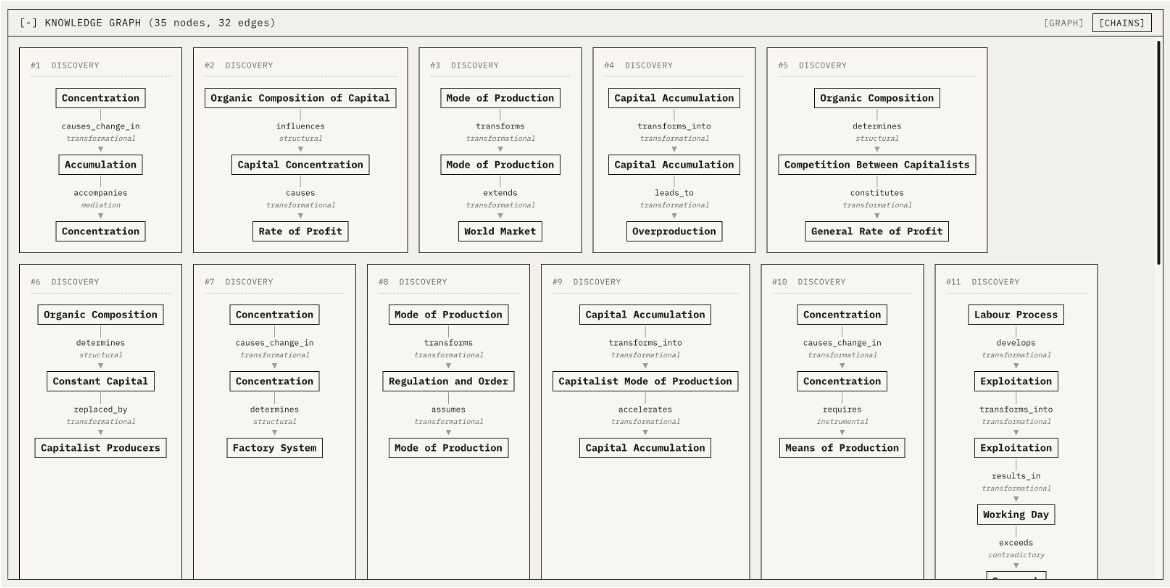
Discovery chains RedMarx traverses for Mariana’s question, from a knowledge graph of 35 concepts and 32 relations
The graph, a carefully constructed analytical map rather than a dictionary, is built and maintained by GSI’s domain experts to reflect the actual structure of the tradition. This is where expert labour is most concentrated, and two features deserve emphasis. The first is historical disambiguation: each concept carries a time-period annotation – a category traced ‘1844 → 1857 → 1867’, for instance – so the graph can distinguish the early formulation from the mature one instead of averaging them. The second is sense-splitting, when the same term appears in two distinct theoretical settings with little overlap in meaning. In such cases, the graph splits it into separate senses rather than fusing them, letting the system respect the dialectical movement of Marx’s vocabulary instead of erasing it. The impact of this expert curation was evident when GSI tried to extract concepts from a given source document. When guided by a generic, default ontology, the extraction pipeline drew only a handful of concepts while the purpose-built Marxist ontology helped draw several hundred concepts from the very same text.
This step matters because it makes the system’s analytical assumptions visible, allowing Mariana to inspect the skeleton before any retrieval happens and adjust it if a category is missing or misplaced. The graph is a working object, not a black box.
2.2 MetaRAG Retrieval: Going Back to the Original Texts
Once the skeleton is in place, RedMarx hands each of its nodes – each concept, each claim – to MetaRAG, configured here against a curated corpus of Marxist works. That corpus is itself an artefact of careful expert preparation. The source volumes are digitised through a two-pass vision-language reading process, with one model reading each scanned page and a second refining and cross-checking it. This allows tables, formulae, and the original printed page numbers to survive intact, so that every passage can later be cited back to the book and page it came from.
The instruction to MetaRAG is straightforward. For every concept and every position identified in the skeleton, locate the original passages in the corpus and return them with their chapter and section identifiers. Do not paraphrase. Do not summarise. The downstream analysis depends on having the real text in front of the system, not a synthesised approximation.
A second, subtler commitment operates here too. When RedMarx moves from finding a passage to analysing it, it does not reason from the isolated snippet. Chunks do the work of finding – they are how the system locates the relevant passage – but they are not the unit it then reasons over. Having used the chunk as a pointer, the system discards it and ingests the entire surrounding source document – the full chapter rather than the fragment – so that the author’s overarching argument frames the reading.1 This is the practical answer to the loss of conceptual context described in Section 1.1, since meaning is no longer artificially confined to the unit that happened to match the query.
This is where the difference between RedMarx and a generic chatbot becomes most visible. A generic system will produce fluent prose about Marx’s theory of ground rent without ever consulting Volume III of Capital (1894). RedMarx is constructed to refuse this shortcut. The retrieval step is the foundation, and everything downstream is built on direct engagement with the sources.
2.3 The Research Loop: Reading the Way a Scholar Reads
Faithful retrieval is necessary but not sufficient. As GSI’s early experiments showed, a system can hold the right passages and still interpret them carelessly. RedMarx therefore wraps retrieval in an iterative research loop – plan, harvest, analyse, synthesise – that works through a question the way a researcher like Mariana would: scoping it, gathering evidence, assessing whether the evidence is sufficient, and only then drafting.
Two things give this loop its rigour. The first is an embedded expert method. How RedMarx investigates a Marxist question – how to navigate the corpus, how to disambiguate a contested concept, how to read a passage against the consolidated scholarship rather than from first principles – is not hard-coded. It lives in editable instruction documents, distilled from the primary and secondary literature through retrieval work carried out with domain experts. These documents capture how an experienced scholar interrogates a Marx text. Because they are plain documents, a domain expert can revise the system’s method directly by adding an interpretive framework, which will take effect immediately.
This is also how the team corrected an early failure in which the system merely stacked retrieved points in a flat list, like a student reciting facts, instead of building the logical relations between them. Teaching the system, through these documents, to write as serious scholarship demands turned a stack of retrieved points into a genuine argument.
The second is a human checkpoint. After the system has scoped the question and surveyed the available evidence, it pauses for the researcher to review and approve the direction before committing to full analysis. The human is not a spectator at the end of an automated process but is in the loop at the decisive moment. Work in progress is preserved at every step, so the path from question to report stays auditable rather than opaque.
2.4 Synthesis: Faithful to the Text, Footnoted to the Section
The final stage takes the conceptual skeleton, the retrieved primary passages, and the researcher’s question, and produces a synthesised research report.
The synthesis is bound by a strict requirement that every substantive claim that rests on a source must carry a footnote that identifies the source down to the chapter and section. Because each retrieved passage arrives already tagged with its origin, citations are born with their sources rather than reconstructed afterwards. This removes the risk of the fabricated or mismatched citation that plagues generic tools. A single footnote in a RedMarx report resolves not merely to a book but through its full structure – Book → Part → Chapter → Section → Subsection – so that ‘Marx on the form of value’ becomes, concretely, a pointer to Section 3, ‘The Form of Value or Exchange Value’, in Volume I of Capital (1867). The reader of a RedMarx report, whether a colleague, a reviewer, or a critic, can follow each substantive claim back to the precise passage in the original work that grounds it.
For academic work, this satisfies the rigour that serious scholarship requires. For political work, it matters because claims about what Marx, Lenin, or Gramsci argued must be checkable, particularly when those claims are contested. A report whose footnotes resolve to chapter and section is a report that can be defended.
Traceability serves thought; it is not an end in itself. The footnotes exist so that a researcher can build on the sources with confidence, shifting energy from the hunt for passages to argument, judgement, and the dialectical work that is the point. On Mariana’s question, for instance, citation is only the starting point. What matters is the argument RedMarx is able to sustain: that the rising social productivity of labour is the very process through which labour is subordinated to capital. Where Marx’s texts leave that tension genuinely open, the system marks it as such, with sources on both sides, rather than forcing the corpus into a resolution it does not contain. That is the register RedMarx is built for.
3. Current Status: Evidence from Use
RedMarx is being trialled by GSI researchers, who have so far run it on 16 substantive questions of the kind reproduced throughout this article, across 29 logged sessions – five of those questions selected for the controlled four-system benchmark reported below, the other 11 developed as full research reports – and judged the results to be strong.
That judgement is not merely impressionistic. In a controlled benchmark, five expert-selected questions on Marxist political economy were scored by human evaluators against a six-dimension rubric – comprehensiveness, representation of contradictions, terminological precision, dialectical exposition, critical reflexivity, and analytic depth. Together, these produced 118 structured pass/fail checks per system.
RedMarx’s full configuration scored 118 out of 118, or 100%. A leaner configuration of the same system, running on the substantially cheaper Kimi K2.5 rather than a frontier model, scored 97.5%. Claude Opus 4.7 with no retrieval at all scored 83.1%, and NotebookLM scored 50.8%. The decisive gap appeared not in surface vocabulary, where every system could name the categories, but in the dimensions that test Marxist understanding: surfacing internal contradictions, maintaining critical and historical reflexivity, and sustaining analytic depth. There, the weaker tools produced clean taxonomies that sanded off Marx’s critical edge. NotebookLM’s result should be read as a mismatch of purpose rather than a simple failure: it is built to answer in seconds, where RedMarx is built for analyses that take 10 to 15 minutes. One difference did not need a rubric to detect: across the same five questions, the two retrieval systems produced 216 references resolving to a named chapter or section, and the two systems without retrieval produced none at all. The benchmark matters because it tests the difference between summarising Marxist vocabulary and reasoning dialectically with it.
These claims can be checked against the answers themselves. Four questions are published in full – each with RedMarx’s answer, the knowledge graph and discovery chains behind it, and a general AI tool’s answer to the same question – in GSI’s GitHub repository.
The benchmark was run on a restricted, canonical slice of Marx on which even an unaided model performed respectably. That performance is expected to fall away – and the value of retrieval and the knowledge graph to grow – as the corpus expands to Lenin, Mao, and lesser-known texts that demand reasoning across authors. That expansion is the subject of the next section.
The intention is not to keep RedMarx as an internal tool. The conditions that produced it – the difficulty of the Marxist corpus, the inadequacy of generic AI, the centrality of dialectical thinking, and the need for source fidelity – are not unique to one institution. RedMarx will prove useful to other research collectives, party intellectuals, popular educators, and independent scholars who work within or alongside the Marxist tradition.
4. The Road Ahead
A research system is never finished. Several directions of work are already underway, in rough order of immediacy.
Deepening quality and the research loop: The nearest-term work is on rigour itself. The aim is to mature the research loop so that the system can review its own draft, identify what is missing, return to the sources, and try again for a limited number of rounds before a human reviews the result. In other words, the system should begin to ask of its own work what a careful researcher would ask: is the argument complete, are the sources sufficient, and has anything important been missed?
Broadening the corpus: In parallel, GSI is steadily integrating further primary sources and well-curated secondary literature. Marxism is not a closed canon but a living tradition, with major contributions across languages, regions, and historical moments. GSI will continue to add carefully selected works, with attention to translation quality, editorial provenance, and licensing, scaling the corpus from the political economy core towards the wider canon of Lenin, Mao, and others, so that RedMarx’s retrieval reflects the full breadth of the tradition rather than a narrow slice. Because so much of that tradition lives in translation, expanding across languages is a central part of this work, not an afterthought.
Richer analytical frameworks and information-gathering strategies: Beyond the current knowledge graph, GSI is developing additional analytical frameworks – conjunctural analysis, world-systems decomposition, value-chain analysis, and social-formation analysis – that a researcher can invoke when the question calls for them. Each brings its own way of reading the corpus.
Cross-traditional and cross-temporal research methods: Some of the most important contemporary questions cannot be answered from inside a single theoretical school or a single historical period. RedMarx is being extended with methods that allow comparison across traditions – reading dependency theory and world-systems theory against each other on the same question, for example – and across time. These methods help trace how a category evolves from its classical formulation through its mid-century reconstruction to its contemporary use.
Connecting to deeper research: Finally, RedMarx does not have to work alone. A faithfully sourced, dialectically structured analysis of a theoretical question is exactly the kind of input that a larger research process needs. Work is underway to let RedMarx feed its grounded output into more comprehensive research systems, so that rigorous theoretical reasoning becomes a building block of larger investigations rather than an endpoint.
The deeper reason for building the instrument in-house, rather than waiting for commercial platforms to serve the field, is that ownership shapes possibility. When the system belongs to the institution that uses it, the methodology embedded in it can be the one that institution actually believes in. The researcher can ask the system harder questions, configure it for finer-grained work, and, most importantly, direct human attention to the questions that only humans can answer. The mechanical work of locating passages, cross-checking citations, and mapping conceptual relations can be entrusted to the system. What remains for the researcher is the harder and more valuable work of judgement, synthesis, and political imagination.
5. The System Retrieves; the Human Thinks
A tradition is kept alive not by being quoted but by being thought with. For a century and a half, the Marxist canon has demanded more of its readers than any single lifetime can give: more volumes than one scholar can hold in view, more contexts than one mind can keep straight, more debates than one career can master. The danger is not that the texts disappear, but that the collective capacity to read them as a whole begins to thin. RedMarx is built against that attrition.
It also matters who builds the instrument. The capacity to work with a tradition is not a neutral convenience; it is infrastructure. When the tools that mediate access to the canon are built on someone else’s terms and behind someone else’s paywall, they shape the questions researchers can ask and the sources they can reach. Building RedMarx is a way of refusing that dependence; it is a small act of reclamation that returns part of the means of reading the tradition to those who work within it and gives a movement more control over the conditions in which it thinks.
RedMarx is also built by people, for people. Movement leaders and cadre posed the political questions the system exists to answer; scholars chose the most authoritative sources; retrieval and domain experts shaped the dialectical framework together; those who know the tradition drew the knowledge graph by hand; and AI specialists engineered the research loop that binds it together. No part of RedMarx thinks on its own; every part extends someone’s thinking. The human is its origin and its end – the question begins in a real political need, as Mariana’s mandate from the MST did, and the answer is meant to be carried back into a real argument and put to work. What looks like a machine is, in truth, a collaboration among experts from different fields, each multiplying the others’ reach.
RedMarx should not be mistaken for magic, or for a substitute for the disciplined reading that serious scholarship has always required. It is not a shortcut around that labour but a tool for absorbing the mechanical work of locating passages, checking citations, and mapping conceptual relations. Ultimately, judgement, synthesis, and political imagination remain the domain of the researcher. The system retrieves; the human thinks. That division of labour is not a weakness of the tool but the reason for building it.
Researchers and organisations interested in RedMarx, or in adapting the approach to another body of work, can write to GSI at contact_gsi@thetricontinental.org.
Notes
1 Full-document ingestion processes a large volume of text for each answer, and so requires a model with a one-million-token context window. This currently restricts RedMarx’s full configuration to frontier models; the leaner configuration described in Section 3 runs on smaller models at significantly lower cost.
| | |
| | Author Chris Wang is an AI engineer at Global South Insights, where he works on interdisciplinary and cross-industry AI application development, bridging cutting-edge AI technologies and real-world value delivery. |
| | |
| | Editors Prasanth Radhakrishnan is an editor and researcher at Tricontinental: Institute for Social Research, whose work focuseson the political economy of media in the Global South and the intersection of technology and geopolitics. Mikaela Nhondo Erskog is the editor and researcher in the interregional office of Tricontinental: Institute for Social Research. |
From | Tricontinental: Institute for Social Research via This RSS Feed.
11
0
Scientists Sound Alarm on AI-Generated Biological Viruses Amid Unregulated Industry
(www.commondreams.org)

As scientists confirmed the first-ever biological viruses generated by artificial intelligence, experts warned Thursday that governments have failed to keep pace with a rapidly advancing and largely unregulated technology that, while having tremendous potential for medical breakthroughs, could also pose existential threats to humanity in the foreseeable future.
Research published Thursday in Science, available in full only to subscribers, describes how scientists at Stanford University and the Arc Institute used a genome language model, roughly the genetic equivalent of the technology behind AI chatbots, to generate hundreds of novel bacteriophage genomes—viruses that infect bacteria rather than humans. After synthesizing and testing the AI-generated designs, researchers found that 16 functioned successfully in laboratory experiments, infecting and killing E. coli.
While the researchers said that the new viruses pose no danger to humans because they only infect bacteria, experts have warned of the risks of AI creating novel bioweapons—either prompted by scientists or, in a future when superintelligent AI is achieved, independently—that could, in a worst-case scenario, threaten the existence of humanity.
"Although this is promising for life sciences applications, it also raises urgent biosafety and biosecurity questions," Johns Hopkins University School of Public Health Center for Health Security researchers Thomas Inglesby and Moritz Hanke wrote in a related article, also published Thursday in Science behind a paywall. "The ability to compose viral genomes using generative AI now exists; the governance to safely steer it does not."
The Stanford and Arc Institute study authors themselves noted the “important biosafety, biocontainment, and biosecurity considerations” accompanying such advances, urging researchers to “consult both safety and security professionals" during their work.
Calls for more robust regulatory guardrails have mounted in recent weeks amid revelations that one of ChatGPT maker OpenAI's models autonomously broke into the systems of other companies during testing. As AI advances to the point where it will likely outsmart humans, the challenge of ensuring that advanced systems reliably pursue goals that match what humans actually want—known as alignment—becomes increasingly difficult and, experts say, dangerous.
A misaligned, superintelligence could take uncontrolled autonomous actions at massive scale to achieve its goals, with industry pioneers warning of potentially catastrophic outcomes like AI-launched nuclear war or bioattack with existing or AI-generated pathogens.
While advocacy groups, the United Nations, and dozens of national governments are urging more robust regulation of AI development, the United States under President Donald Trump, the Republican-controlled Congress, and Big Tech’s army of lobbyists is strongly opposed to guardrails.
In fact, Trump—who Congressional Progressive Caucus Chair Greg Casar (D-Texas) on Monday accused of being "too busy cashing in" on AI—has rolled back regulations, including some meager steps taken during the Biden administration to bolster safety.
“There’s just a huge disconnect," Hanke told The New York Times on Thursday.
From Common Dreams via This RSS Feed.
12
13
0
'Get the Flock Out': Nationwide Backlash Grows Against AI-Powered Surveillance Tech
(www.commondreams.org)

Resistance is mounting across the United States against the increasing use of surveillance tech company Flock Safety's cameras, with a growing number of cities canceling contracts as the artificial intelligence-powered license plate readers are quietly being installed in thousands of locations nationwide.
State and local police departments first used the Atlanta-based company's automated license plate reader (ALPR) systems for standard law enforcement purposes, but they are now being employed for a much broader range of uses, including immigration-related searches and other actions supporting US Immigration and Customs Enforcement (ICE) during the Trump administration's deadly anti-immigrant crackdown.
“We have cameras that are used for everything from illegal dumping to drug houses to hotels that are just big problems,” Flock Safety engineer Kevin Cox told prospective customers during a demonstration of the company's Condor Camera, according to a Thursday report in The Washington Times.
“There are endless, endless uses for what we can do with these things," Cox added.
Those uses include spying on constitutionally protected protest activity and enforcing abortion bans by tracking pregnant people's travel across states—even ones in which the medical procedure is legal.
The ACLU—which recently launched a "Get the Flock Out" campaign to "fight creepy ALPR cameras"—says there are currently between 80,000 and 100,000 Flock devices installed nationwide that conduct more than 20 billion scans per month. More than 5,000 law enforcement agencies use the cameras, and some of them keep their locations a secret.
Automatic license plate readers track our every move and funnel our personal information into enormous databases that police can access to spy on us without a warrant.Surveillance company Flock Safety is the largest provider of these cameras — it's time we get all of them out of our communities.
[image or embed]
— ACLU (@aclu.org) June 28, 2026 at 11:15 AM
"Flock's ALPR cameras aren't like your normal traffic cameras," the ACLU explained. "This surveillance technology records and tracks every car that comes into view, and then an AI algorithm catalogs the make, model, color, license plate number, bumper stickers, and even scratches. This personal information is then uploaded into a nationwide database that any law enforcement agency with a Flock contract can search—with few regulations or oversight on how they use what they find."
The backlash against creeping state surveillance has even transcended the partisan divide.
“I think our country is in a kind of uniquely anti-surveillance environment right now, which is to say that, in a time where it seems there is nothing that is not partisan, opposition to government surveillance is nonpartisan," ACLU privacy and surveillance attorney Chad Marlow told The Washington Times on Thursday.
There is growing action—both legal and otherwise—to end the use of ALPRs across the country.
According to the public information project Ban Flock Cameras, 82 Flock contracts were terminated across 28 states between August 2021 and May 2026, with 39 of those cancellations occurring in the first five months of 2026 alone.
Even Amazon-owned Ring announced earlier this year that it would stop doing business with Flock Safety.
Susie O'Hara, a member of Santa Cruz, California's nominally nonpartisan City Council, told WBUR earlier this year that she grew increasingly concerned about local use of eight Flock cameras last year after learning that police were sharing data gleaned from the cameras with the company's national network without city officials' knowledge, a violation of state laws banning the practice.
O'Hara became increasingly convinced that Santa Cruz should cancel its Flock contract after an ICE agent fatally shot Renee Good, a US citizen, in Minneapolis in January.
"I have goose hbumps on my arms thinking about the absolute chaos that was happening in Minneapolis," she said. "And just the absolute insanity of what we were seeing... It was totally clear to me that we should in no way consciously be in this system at all—just no way."
Less than a week after Good's killing, the Santa Cruz City Council voted to terminate the city's Flock contract, becoming the first municipality in California to do so.
“For us, the threat to our civil liberties was greater than any benefit we could get from the flawed product,” Santa Cruz Mayor Fred Keeley told KQED at the time.
Chad Kemp, who represents District 32 on the nonpartisan Dane County Board of Supervisors in Wisconsin—which in April voted to stop funding two dozen cameras leased from Flock—told The Washington Times that “there’s a public safety issue here, but there is also a privacy issue."
"There are serious concerns about individuals who can be monitored without their knowledge, or if it is even constitutional or ethical to track people without a warrant," he added.
At the national level, US Reps. Robert Garcia (D-Calif.) and Raja Krishnamoorthi (D-Ill.) last year launched an investigation into the use of Flock cameras to track pregnant people across state lines for abortion care and to conduct unauthorized immigration enforcement operations.
Krishnamoorthi and Sen. Ron Wyden (D-Ore.) have also urged the Federal Trade Commission to investigate Flock Safety "for failing to implement cybersecurity protections, allowing Americans’ personal data to be exposed to hackers, criminals, and spies to steal."
Their demand came after the cybersecurity firm Hudson Rock revealed that hackers stole passwords and data from at least 35 Flock customer accounts.
In May, US Reps. Jesús "Chuy" Garcia (D-Ill.) and Scott Perry (R-Pa.) introduced a bipartisan amendment to a bill that would prohibit state and local governments receiving federal highway funds from using ALPRs for purposes other than electronic toll collection.
It's not just Flock. Axon, Vigilant Solutions—a subsidiary of Motorola Solutions—Genetec, PlateSmart, Innova Systems, Rekor, ELSAG, Perceptics, Jenoptik, and other firms market ALPRs to law enforcement agencies, private companies, and others.
"It doesn't matter which company has its creepy cameras in your neighborhood," the ACLU said, "they all have the same problems: a lack of transparency, oversight, and regulation into how they collect, store, and use our data, and how to hold public and private actors accountable if they abuse it."
From Common Dreams via This RSS Feed.
14
0
Astronomers Denounce Elon Musk-Led Plan to Pollute Earth's Orbit With 1.7 Million Satellites
(www.commondreams.org)

European astronomers on Wednesday urged the US Federal Communications Commission to block a plan led by SpaceX CEO Elon Musk to launch a total of 1.7 million satellites into the Earth's orbit, warning that the use of so many extremely bright satellites—partially to support artificial intelligence data centers—would have “devastating consequences for astronomy.”
SpaceX's Starlink telecommunications program has already rapidly increased the number of satellites orbiting the Earth, with the total now exceeding 14,000 since 2019.
Now the space exploration company led by Musk—a former special government employee under the Trump administration—has plans to send 1 million more satellites into space, which would "significantly alter the appearance of the sky," according to a new study by the European Southern Observatory (ESO).
Scientists found that 100,000 is the maximum number of satellites—ones that are faint enough to be invisible to the naked eye—that can orbit the Earth in order to allow astronomers to continue observing the sky with modern telescopes.
In addition to Musk's launches, the US startup Reflect Orbital has proposed launching a constellation of 50,000 "very large mirror-like satellites to provide sunlight at night," said ESO.
"These satellites would be the brightest ever in orbit, with damaging consequences for dark skies on Earth," said the observatory. "Seen from within a reflected beam, the satellite delivering sunlight would appear four times brighter than the full Moon. Even if no satellite points its beam directly at an observer, each would be as bright as the planet Venus, the ‘morning star.' From a light-polluted city, like Munich, Germany, these hundreds of satellites would be the only ‘stars’ visible in the night sky."
The startup E-Space and two Chinese constellations, CTC-1 and 2, would also add hundreds of thousands of satellites into orbit.
The companies' satellite project could hinder scientists' ability to observe far-away galaxies, Earth-like planets near other stars, and asteroids that could potentially endanger the planet.
"Satellites, illuminated by the sun, are much brighter than distant galaxies. When a satellite crosses what we observe, it makes a bright streak on our image, zapping whatever is behind it," said ESO astronomer Olivier Hainaut, who led the study.
Hainaut noted that the planned launches could have economic and ecological impacts on the planet and humankind as well as harming astronomy.
Extreme light pollution from the bright satellites could disrupt people's biological clocks and ecosystems across the planet, and the satellites could also directly impact air quality due to the numerous launches required to send them into space and the "atmospheric pollution caused as they burn up on reentry at the end of life."
ESO conducted the research as the FCC considers applications from SpaceX and Reflect Orbital regarding the satellite launches
“The FCC received over 1800 comments regarding Reflect Orbital and nearly 1,500 comments on the application by SpaceX,” said ESO institutional affairs officer Betty Kioko. “The ball is now in the FCC’s court, and we wait to see the determinations they make on both filings. For optical astronomy, this is an existential threat, and we hope that the regulators will share that view.”
From Common Dreams via This RSS Feed.
15
0
Privacy Advocates Raise Alarm Over Online Age Verification Provisions as House Passes KIDS Act
(www.commondreams.org)

Opponents of a bill that is purported to protect children online said Monday night, after the legislation passed in the US House, that laws are "urgently" needed to stop Big Tech companies from preying on kids' vulnerabilities.
"The KIDS Act is not that piece of legislation," said Rep. Pramila Jayapal (D-Wash.), who was one of 117 lawmakers who voted against the Kids Internet and Digital Safety (KIDS) Act, which passed with 267 votes, while 47 members of Congress did not vote.
The bipartisan bill requires online platforms to use new safety features and parental controls, restricts the use of minors' personal data to target ads, and establishes new restrictions for AI chatbots and online games.
But ahead of the bill's passage, the Electronic Frontier Foundation (EFF) was among the opponents raising alarm about other provisions "buried inside the KIDS Act" that would "push online services to verify all users’ ages, require government-directed moderation policies for online speech, and even create new rules about private and encrypted communications."
The legislation, drawing from portions of 14 different online safety bills, "is a mess, with different age-gating schemes for different services, using different standards," wrote EFF senior policy analyst Joe Mullin. "It’s a lot of complexity, and a lot of legal risk. Faced with that, many companies will conclude that the safest option is restrictive age-checking practices across their entire platforms."
As Mullin explained:
Throughout the KOSA section of the legislation, special protections, controls, messaging settings, and parental tools are required whenever a website or app “knows or should have known” a user is a child (defined in the bill as anyone under 13) or a teen (defined as anyone between 13 and 16 years old).
The problem is a website operator doesn’t need actual knowledge that a user is a minor to get in legal trouble. It applies when a platform “knows or should have known” a user’s age—a low, negligence-style standard of knowledge. If an online service gets it wrong, it’s going to be up to courts and regulators to decide, after the fact, if an online service “should” have known a user was 16.
To try to avoid liability, services will have to determine which users are teenagers and which are not. Most won’t be able to simply trust their users. They’ll have to collect more information about age, before any lawsuit or government action arises. Some companies may respond by requesting driver's licenses or passports. Others will rely on age-estimation systems that attempt to guess users' ages by looking at existing activity or doing facial scans.
At The Intercept, Caitlin Vogus of the Freedom of the Press Foundation and Aliya Bhatia of the Center for Democracy and Technology’s Free Expression Project warned ahead of the bill's passage that while the legislation is ostensibly meant to protect children, the age verification requirement could impact all users' ability to access social media platforms without revealing their identities—chilling anonymous speech and threatening would-be whistleblowers.
"Threats to online anonymity harm everyone, but one group is often overlooked: journalists and the sources who talk to them," wrote Vogus and Bhatia. "Age verification requirements will help the Trump administration carry out its vendetta against the press by creating new avenues to identify journalists’ confidential sources."
While the KIDS Act says it won't require online platforms to collect government IDs for age verification, they said, "at least some platforms will likely choose this route to comply with the law or offer it as a fallback approach when other methods inevitably fail."
Former Republican congressman Justin Amash, a libertarian, accused the lawmakers who voted "yes" on the legislation of betraying "the Constitution and the American people."
Other opponents of the legislation, including Jayapal, argued that the bill would allow tech companies to continue targeting children with algorithms that send harmful content to the youngest users.
The legislation omits a "duty of care" provision that was included in the Kids Online Safety Act (KOSA), which was passed by the US Senate in 2024—a requirement that tech firms "exercise reasonable care” to prevent harms to children.
Jayapal noted that the bill, which faces an uphill battle in the Senate, leaves "suicide, depression, addiction, substance use disorders, and eating disorders from the list of harms" that tech companies like Meta must address in their algorithms.
The "duty of care" provision has been criticized as too vague by several digital rights groups, while some child safety groups said its omission in the KIDS Act would "let Big Tech off the hook."
"We have seen time and again that these corporations cannot be trusted to put children's safety over their own profit margins," said Jayapal. "We cannot keep exposing our kids to platforms that are either completely indifferent to their safety or a direct threat to it."
The KIDS Act, Jayapal said, also includes provisions "that do not do enough to actually address the harms of" artificial intelligence.
"I voted no," said Jayapal, "because we have a real opportunity to pass bipartisan legislation that holds these companies to not just be transparent about the harms and mitigate them, but to actually prevent them."
From Common Dreams via This RSS Feed.
16

Despite being the world's most trafficked animal, the European eel receives surprisingly little sympathy. It lacks the mammalian charisma of the creatures whose plights dominate conservation campaigns; among them the shy, helpless pangolin and the stoically intelligent elephant. By contrast, the eel is viewed by many as a source of revulsion: a slimy, writhing reason to stay out of the water. Yet behind inscrutable eyes, it harbors many secrets. This is the story of how an elusive and often misunderstood fish found itself at the center of an international smuggling network.

From blog via This RSS Feed.
17
0
Calls grow for FIFA VAR official Shaun Evans to be removed after white supremacist sign
(www.thecanary.co)

FIFA’s discrimination monitoring team has called for World Cup VAR official Shaun Evans to be removed from duty after he appeared to make a hand gesture resembling a white supremacist sign during Germany’s 7-1 win over Curacao.
The moment was captured on the official broadcast when cameras cut to the VAR booth. Evans, an Australian official assigned to the match, briefly formed an “OK” gesture with his right hand near his leg, a symbol that has been co‑opted by white extremist groups.
The gesture was quick, but it was enough to trigger immediate concern from FIFA’s anti‑discrimination unit, which monitors all matches for offensive behaviour. The monitor formally requested that Evans be stood down from further involvement in the tournament pending review.
FIFA response
FIFA has not yet announced disciplinary action, but the governing body confirmed that the incident is under assessment. The organisation’s discrimination monitoring system, expanded for the 2026 tournament.
This is what it was designed to flag, any behaviour that could undermine the sport’s commitment to inclusivity. The call for Evans’ removal came directly from this unit, which has the authority to recommend sanctions or suspensions.
The match in question, Germany’s emphatic opening win over debutants Curacao, had already drawn attention for its lopsided scoreline. But the focus quickly shifted from the pitch to the VAR booth once the footage circulated.
The broadcast clip showed Evans standing alongside fellow officials as the camera panned across the VAR team. His right hand formed the “OK” sign this is the thumb and forefinger touching, three fingers raised.
The discrimination monitor’s concern centred on the potential interpretation of the gesture rather than any confirmed intent. There has been no public comment from Evans as yet, and FIFA has not indicated whether he has been interviewed as part of the review.
Wider context at the World Cup
The 2026 World Cup has already seen several officiating‑related talking points, including the use of advanced VAR technologies such as connected ball data and waveform detection, systems that played a role in other matches across the opening days.
But this incident has added a different layer of scrutiny. FIFA’s anti‑discrimination protocols were strengthened ahead of the tournament, with monitors assigned to every match and empowered to escalate concerns immediately. Their recommendation to remove Evans underscores the seriousness with which the organisation treats any gesture that could be interpreted as discriminatory or extremist.
The footage spread quickly among fans and analysts, prompting debate about intent, context and the responsibilities of match officials on the world stage.
While some argued the gesture may have been innocuous, others stressed that officials must avoid any action that could be misinterpreted, especially during a global event watched by billions.
Sky Sports’ reporting emphasised that the discrimination monitor acted swiftly, reflecting FIFA’s zero‑tolerance stance. The request for Evans’ removal is not a final ruling but a procedural step designed to protect the integrity of the tournament while the matter is reviewed.
Will FIFA do the right thing?
FIFA’s next move will determine whether Evans continues in his role. The organisation typically reviews broadcast footage, interviews involved parties, and consults its anti‑discrimination experts before issuing a decision. If the monitor’s recommendation is upheld, Evans could be replaced for the remainder of the tournament.
The incident also raises broader questions about training and awareness for officials. With global audiences and heightened sensitivity around discriminatory symbols, governing bodies face increasing pressure to ensure that all match personnel understand the implications of gestures, language and behaviour.
The World Cup is built on the idea of global unity, and FIFA has repeatedly emphasised its commitment to combating discrimination in all forms. Any incident that threatens that image, especially one based on a gesture openly declares ‘white power’ becomes a real risk.
By moving quickly, the discrimination monitor has signalled that vigilance is non‑negotiable. The coming days will reveal whether FIFA agrees that Evans’ continued involvement poses a risk to the tournament’s integrity.
The call to remove Shaun Evans marks one of many major off‑field controversies of the 2026 World Cup. While the investigation continues, the incident highlights the intense scrutiny placed on officials and the importance of maintaining clear, unambiguous standards of conduct.
FIFA now faces a decision that will set the tone for how it handles similar issues throughout the tournament, a reminder that, in the modern game, you won’t be accepted for being racist.
Featured image via Ian Walton/Getty Images
By Faz Ali
From Canary via This RSS Feed.
18

Israel has abducted the sister of Irish president Catherine Connolly during its criminal assault on the Gaza-bound humanitarian Global Sumud Flotilla (GSF). Margaret Connolly, a physician, is among eight Irish citizens kidnapped in international waters by the genocidal occupation.
President Connolly promptly condemned the abduction, describing it as “upsetting”, adding that:
I’m very worried about her, and I’m also very concerned about her colleagues on board.
Fifty GSF vessels were attempting to break Israel’s war crime, a brutal starvation blockade of Gaza. At least a dozen of the ships were attacked yesterday and their crews abducted. The Irish government condemned Israel’s actions as “wrong” and “unacceptable”.
UK citizens are also among the victims, but UK PM Keir Starmer has still kept silent about Israel’s crimes. Abductees in previous flotillas have been beaten and tortured, and at least one has been raped. The occupation regime regards rape as a weapon of war. Its routine and brutal rape of Palestinian prisoners has begun even to catch the attention of US ‘mainstream’ media, but is still mostly ignored by UK ‘msm’ – though a few have noted Israel’s threat to sue the New York Times for covering it.
Featured image via the Canary
By Skwawkbox
From Canary via This RSS Feed.
19

I took my first ride in a Chinese car recently. Not in the U.S., of course, since sky-high tariffs have made them almost impossible to import. I was visiting family in the U.K., and we rented a BYD Sealion SUV. And let me tell you: I saw immediately why American car companies are desperate to have these things kept out of this country. It was elegantly designed, incredibly comfortable, and a smooth ride.

From blog via This RSS Feed.
20
0
Flotilla Organisers Subjected to ‘Extreme Brutality’ in Extended Israeli Detention
(novaramedia.com)

Israeli soldiers beat and tortured flotilla organisers Saif Abukeshek and Thiago Ávila after abducting them in international waters near Greece in the early hours of Thursday morning, lawyers and diplomats have said.
After illegally intercepting 22 boats and kidnapping around 200 activists hundreds of miles from Gaza, Israel transferred the majority to Greek authorities, but refused to release Abukeshek and Avila. Instead, it transported them back to an Israeli desert prison, where Palestinians are routinely tortured.
Brazilian activist Ávila was dragged face down across the floor and beaten so badly he passed out twice, lawyers said, after they were finally able to visit him on Saturday. His wife, Lara Souza, said in a video that a Brazilian embassy official told her he had been temporarily blinded by his injuries, with his left eye remaining swollen shut, but he was being denied medical treatment. In a brief visit, where he was separated from the consul by a glass screen and not able to speak freely, he reported pain all over his body, especially in his hand and shoulder, and said that soldiers had threatened to throw him overboard and target his wife and two-year-old daughter.
Abukeshek, who had been sailing on an observer boat and did not intend to go to Gaza, was “in shock”, his wife Sally Issa said. He was forced to lie face-down on the floor of an Israeli warship for two days, lawyers said, blindfolded and with his hands bound behind his back.
Spain has demanded Israel release Abukeshek, who is Palestinian but has Spanish and Swedish citizenship. On Friday, prime minister Pedro Sánchez said he had been “illegally abducted by the Netanyahu government”.
Foreign minister José Manuel Albares later told a radio station the arrest was made “outside the jurisdiction of Israel”. “Of course, it is a kidnapping,” he said.
Hannah Smith, who runs the Global Sumud Flotilla’s media operation, said in a video that Abukeshek had Palestinian identity documents, “putting him in a legal context that we’ve never seen with participants before”.
“We do not know how the Israeli regime will handle his case,” she said, “they can try him just as they would any Palestinian.”
Adalah, the law firm supporting the two men, said they had reported being interrogated by Israel’s Shin Bet security service. Ávila said he had been told he would also be interrogated by Mossad, on suspicion of “affiliation with a terrorist organisation”.
On Sunday, both activists appeared in Ashkelon magistrates’ court, where a judge extended their detention by a further two days.
Adalah said the Israeli state attorney presented a list of suspected offences, including “assisting the enemy during wartime, contact with a foreign agent, membership in and providing services to a terrorist organisation, and the transfer of property for a terrorist organisation”.
No formal charges have yet been filed against either Ávila or Abukeshek, and Adalah said Israeli authorities had refused to provide details of any of the offences they are being interrogated over.
Lawyers demanded both men be immediately and unconditionally released, telling the court the entire process was “fundamentally flawed and illegal”, and describing Israel’s actions as a “retaliatory measure against humanitarian activist leaders”.
They challenged the state’s jurisdiction, arguing that there is “no legal basis for the extraterritorial application of offences to the actions of foreign nationals in international waters”.
In a statement, Adalah said: “The treatment of the two activists, including the use of isolation, prolonged blindfolding, and physical beatings, constitutes a grave violation of international law.”
Meanwhile, Smith, who was on one of the boats that was intercepted on Wednesday night, urged people to “mobilise” for Ávila and Abukeshek. “As someone who was thrown around, who was threatened to be killed, as someone who has seen two of my best friends taken, I ask the world: what kind of world do you want to live in?” she said. “And if you want to live in a better one than this one, you need to act, you need to mobilise.”
Ávila and Abukeshek have now been transferred back to solitary confinement in Shikma prison, where they are being held in windowless cells.
Both are on hunger strike, with Avila saying he will not accept release without Abukeshek.
From Novara Media via This RSS Feed.
21
0
Trump Cancels Kushner-Witkoff Trip as Iran Suggests US Not 'Truly Serious About Diplomacy'
(www.commondreams.org)

US President Donald Trump on Saturday abruptly canceled a planned visit by two of his administration's negotiators to the Pakistani capital for diplomatic talks to end his illegal war on Iran, complaining that the trip would be "too much work."
The president announced his decision after Iranian Foreign Minister Abbas Araghchi left Islamabad on Saturday, writing in a social media post that he relayed to Pakistani officials "Iran's position concerning a workable framework to permanently end the war on Iran." Araghchi added that he has "yet to see if the US is truly serious about diplomacy."
Iranian officials said repeatedly in recent days that they had no intention of engaging in direct talks with the Trump administration this weekend as long as the US naval blockade remained in effect. Despite clear statements from Iran's leadership, the Trump White House insisted that special envoys Jared Kushner and Steve Witkoff would be holding another round of direct negotiations with Iranian officials in Islamabad after earlier talks ended without a deal.
"This has happened repeatedly: Trump claims the Iranians are begging for talks, Iran says it is false," observed Drop Site's Jeremy Scahill. "The US says Iran is lying, and then it becomes clear Iran meant what it said."
In an assessment published before Trump canceled his envoys' trip, Scahill wrote that "there is no question it is the US that is seeking direct talks right now, not Iran."
"Iran still believes it is likely the US and Israel will resume the war and has indicated it has prepared new forms of retaliatory strikes and other actions, including in the Strait of Hormuz," Scahill added. "Its military commanders have said that while the US has moved more military assets into the region during the 'ceasefire,' Tehran has also taken this period to prepare its own weapons systems for more fighting."
Trump insisted Saturday that his administration—whose deeply unpopular and deadly war of choice has sparked a global economic disaster—holds "all the cards" and that Iranian leadership is in turmoil. But Sina Toossi, a senior fellow at the Center for International Policy, wrote that "Trump can’t hide exuding desperation for a deal."
"So he invents 'fractures' in Tehran to explain being repeatedly stood up," Toossi added. "Iran’s line is unchanged: demanding the blockade be lifted and holding on to its core red lines. They’re playing hardball. He’s spinning."
Trump's cancellation of the Kushner-Witkoff trip came hours after NBC News reported that "American military bases and other equipment in the Persian Gulf region suffered extensive damage from Iranian strikes that is far worse than publicly acknowledged and is expected to cost billions of dollars to repair."
"The Iran war was a tactical and strategic disaster," said Toossi. "Despite heavy efforts to control the narrative, it’s becoming clear just how much US bases and equipment in the region were damaged or destroyed. The war backfired and inflicted far more damage than its proponents want to admit."
From Common Dreams via This RSS Feed.
22

In an unprecedented action, more than 130 leading scholars and public figures are risking arrest on terror charges after writing an open letter to the Court of Appeal concerning Palestine Action.
The letter, dated 24 April 2026, simply reads:
We oppose genocide, we support Palestine Action.
The words that have become synonymous with the campaign to Lift the Ban.
Sally Rooney, Greta Thunberg, and Judith Butler were among the first to put their names to this defiant declaration. Joining them are prominent artists and musicians such as Nadine Shah, Brian Eno, Massive Attack’s Robert Del Naja, the actor Billy Howle, writers China Miéville, Lina Meruane and Tariq Ali, and political activists like Lindsey German of Stop the War and Vijay Prashad of the Tricontinental Institute.
The letter is on the Defend our Juries website. And there’s also a sign-on form that allows anyone who supports the scholars’ action to add their name.
Professors and researchers from University of Oxford, University of Cambridge, London School of Economics, Durham University, University of Warwick, University of Exeter and many other UK universities pledge their support for Palestine Action.
The list of signatories includes several senior professors of law: Yvette Russell from University of Bristol, Maria Aristodemou from Birkbeck, and Neve Gordon FacSS, Penny Green FacSS, and Hans Lindahl all from Queen Mary University of London.
Other prominent UK-based professors on the list are Nicola Pratt the president of the British Society for Middle Eastern Studies and Eyal Weizman the founding director of Forensic Architecture.
The letter exposes the paradox of terror charges
If the police proceed to arrest these scholars on terror charges, it’ll further expose the authoritarian nature of the ban. But if they don’t, the more than 3,000 previous arrests of people for saying precisely the same thing will appear not just unlawful but arbitrary and discriminatory.
Today’s action by the scholars is organised by a number of academic critics of the ongoing genocide in Palestine. Many of them are signatories to previous open letters hosted by the group Protest is not Terrorism.
Over the last couple of years Israel has destroyed all of Gaza’s universities and killed scores of Palestinian scholars. Given the UK’s increasingly authoritarian response to anti-genocide protest, the organisers of this letter did not circulate it among colleagues in the West Bank.
Nevertheless, Palestinian academic voices are still represented by Abdaljawad Omar (Birzeit University), Karma Nabulsi (University of Oxford) and Rashid Khalidi (Columbia University), author of perhaps the most widely read recent history of the century-long war against Palestine.
Many well known international figures and political thinkers have signed the letter in solidarity. These include Verónica Gago (Professor of Social Sciences at University of Buenos Aires), Michael Hardt (Professor of Literature, Duke University) and Jacques Rancière (Emeritus Professor of Philosophy, University of Paris 8).
The letter arrives just days before the government’s appeal to uphold its unlawful proscription of Palestine Action comes before the Royal Courts of Justice on 28-29 April.
With more expected to sign the letter over the weekend, the scholars’ defiance is further evidence that the public does not support the government’s attempts to ban legitimate and necessary action to prevent a genocide.
Signatories comment
Penny Green, Professor of Law and Globalisation at Queen Mary University of London, said:
It is both indefensible and revealing that peaceful protesters opposing genocide are being branded as terrorists while the Labour government, itself complicit in Israel’s state terror, avoids all accountability.
Neve Gordon, Professor of International Law at Queen Mary University of London, said:
Instead of meeting its legal obligations as set by the Genocide Convention and international humanitarian law, Keir Starmer’s government has been providing military and diplomatic support to Israel as it perpetrates atrocity crimes while simultaneously silencing the messenger by proscribing Palestine Action as a terrorist group.
The decision to appeal the ruling rendering the proscription unlawful is yet another sign of the government’s moral bankruptcy.
Catherine Rottenberg, Professor of Media and Cultural Studies at Goldsmiths University of London, said:
With the ongoing genocide and ethnic cleansing in Palestine and an illegal and horrific war raging in the Middle East, the insistence on proscribing a direct action group is not merely absurd, it is absolutely unconscionable.
In the name of defending freedom and democracy, our government is undermining both democracy and freedom. We the people must stand up and defend our freedoms, with Palestine Action as our most urgent test case.
Peter Hallward, Professor of Philosophy at London’s Centre for Research in Modern European Philosophy, said:
For anyone familiar with even a few strands of post-war European thought, it’s almost incomprehensible to think that we have so quickly forgotten a principle that once commanded universal and uncontroversial assent – that ‘never again’ really means what it says. Never, ever, anywhere. Especially not with our collusion!
The 1948 Convention remains categorically binding on us all, and it obliges us to ‘prevent and punish’ genocide by all the necessary means at our disposal.
If our government refuses to honour this obligation it is up to us to insist on it.
Başak Ertür, a Reader at Goldsmiths’ Centre for Research Architecture, said:
The use of the sharpest end of criminal law against people who inconvenience political power by acting with conscience is a textbook feature of authoritarianism. I’ve been wary of signing collective letters since I was put on trial in Turkey some years ago, along with hundreds of others, for adding my name to the Academics for Peace petition in 2016.
But the proscription of Palestine Action by executive fiat seems to me no less preposterous than what I have experienced, and therefore it feels exactly right that I now sign this letter, because indeed, I do oppose genocide and therefore support Palestine Action.
A spokesperson for Defend our Juries said:
The scholars who have signed this letter have spent their lives analysing complex political situations and moral problems and today have decided to put their liberty and reputations on the line because saving lives is not terrorism.
If the police start arresting these scholars on terrorism charges for peaceful expressions of political speech the state’s authoritarianism will be fully exposed. But if they don’t, the arrests of more than 3,000 people for saying precisely the same thing will be shown to be not just unlawful but also discriminatory.
We applaud the signatories of today’s letter in joining thousands of people who have publicly declared their support for Palestine Action.
Featured image via the Canary
By The Canary
From Canary via This RSS Feed.
23
military contractor Palantir is helping the IRS analyze dozens of different data sets on Americans to investigate a broad range of financial crimes, according to records shared with The Intercept.
Since 2018, the Internal Revenue Service’s Criminal Investigation division has used Palantir’s Lead and Case Analytics platform to aggregate and analyze a sprawling list of sensitive federal databases and data sets.
Public records detailing Palantir’s IRS contract, obtained by the nonprofit watchdog group American Oversight and shared exclusively with The Intercept, reveal the immense volume of data plugged into the military contractor’s software. The LCA uses both Palantir’s Gotham and Foundry applications to facilitate “analysis of massive-scale data to find the needle in the hay stack,” the contract paperwork says.
Documents indicate the IRS has paid Palantir over $130 million for these services to date.
Palantir’s LCA is ostensibly directed toward cracking down on fraud, money laundering, and other financial crimes. According to a 2024 agency privacy impact assessment, IRS “Special agents and investigative analysts … utilize the platform to find, analyze, and visualize connections between disparate sets of data to generate leads, identify schemes, uncover tax fraud, and conduct money laundering and forfeiture investigative activities.”
[
Related
Trump Wants to Put You in a Massive, Secret Government Database](https://theintercept.com/2026/03/17/government-surveillance-centralized-database-privacy/)
The IRS use of the software, launched under Trump’s first term and expanded under Biden, is now in the hands of an IRS Criminal Investigations office that has drastically scaled back its pursuit of tax cheats and pivoted, under Trump’s direction, toward investigating “left-leaning groups,” the Wall Street Journal reported in October.
“The real concern is the consolidation of vast amounts of sensitive personal data into a single system with minimal transparency — especially one built and operated by a contractor like Palantir, whose business model is premised on integrating data and expanding surveillance capabilities,” American Oversight director Chioma Chukwu said in a statement to The Intercept. “Its platforms have been used in deeply troubling contexts, from immigration enforcement to predictive policing, with persistent concerns about overreach, bias, and weak oversight.”
Palantir did not respond to a request for comment, nor did the IRS.
“The real concern is the consolidation of vast amounts of sensitive personal data into a single system with minimal transparency — especially one built and operated by a contractor like Palantir.”
The contract documents reviewed by The Intercept reveal that these “disparate sets of data” are vast. Palantir’s LCA allows the IRS to quickly search and visualize “connections from millions of records with thousands of links” between databases maintained by the IRS and other federal agencies. According to the contract documents, this data includes individual tax form and tax returns as well as Affordable Care Act data, bank statements, and transactions, and “all available” data compiled by the Treasury Department’s Financial Crimes Enforcement Network.
Its view apparently extends to cryptocurrencies including bitcoin, Ethereum, Litecoin, and Ripple. “The application would sit on top of a singular repository of identified wallets from seized servers utilizing dark web data obtained from exchangers such as Coinbase,” the documents note.
The program places an emphasis on mapping social relationships between the targets of an investigation. That includes analyzing a “network of people and the relationships and communications between them,” such as “calls, texts, [and] emails events.” The use of “IP address analysis” within LCA allows the IRS to “Identify suspects more easily” and “Establish (new) relationships among actors.”
These investigative functions are continuously updated, the materials say, through ongoing close work between Palantir engineers and IRS personnel.
[
Related
Palantir Will No Longer Profit Off of New Yorkers’ Health Data](https://theintercept.com/2026/03/24/palantir-new-york-city-hospitals-contract/)
The intermingling of sensitive data on millions of Americans comes at a time of increased global skepticism and opposition toward Palantir, which, despite its military-intelligence origins, has a thriving business with civilian agencies like the IRS. The use of Palantir software at the U.K.’s National Health Service, for example, has created an ongoing political controversy across Britain, while a similar contract with the New York City public hospital network was recently canceled following public protest.
The contract is also active at a time when IRS Criminal Investigations has been coopted to aid in the broader Trump administration’s aggressive agenda. In July, ProPublica reported that the agency was working with U.S. Immigration and Customs Enforcement to provide “on demand” data to accelerate deportations. Last year, the New York Times reported that Palantir, founded by Trump ally Peter Thiel, was central to an administration effort to increase data-sharing across federal agencies.
“The question isn’t just what it can do — it’s who it will be used against.”
The company’s right-wing politics and eagerness to facilitate U.S. and Israeli military aggression abroad, NSA global surveillance, and ICE deportations has also made many weary of its access to incredibly sensitive personal data. A recent post on the company’s Palantir’s X account summarizing a book by CEO Alex Karp triggered an immediate backlash from those unnerved by the manifesto’s fascistic bent. The bullet points extolled the virtue of arms manufacturing, argued the Axis powers were unfairly punished after World War II, called for a reinstatement of the draft, condemned cultural pluralism, and claimed that wealthy elites are unfairly persecuted.
“When the government can map relationships, track behavior, and generate investigative leads across data sets at this scale, the question isn’t just what it can do — it’s who it will be used against,” Chukwu said. “Entrusting that infrastructure to a company known for opaque, security-state deployments only heightens those risks.”
The post Palantir Is Helping Trump’s IRS Conduct “Massive-Scale” Data Mining appeared first on The Intercept.
From The Intercept via This RSS Feed.
24
25
0
Iran declares ‘historic victory’ over the U.S., says enemy forced to accept its proposal
(www.workers.org)

The following statement issued by Iran’s Supreme National Security Council in response to the MAGA president’s two-week “ceasefire” was published by Press TV on April 7. “Good news to the dear nation of Iran! Nearly all the objectives of the war have been achieved. * “The noble people of Iran . . .
From Workers World via This RSS Feed.
view more: next ›