_portrait.jpg)
this post was submitted on 04 Apr 2026
1320 points (92.3% liked)
Leopards Ate My Face
10403 readers
132 users here now
Rules:
- The mods are fallible; if you've been banned or had a post/comment removed, please appeal.
- Off-topic posts will be removed. If you don't know what "Leopards ate my Face" is, try reading this post.
- If the reason your post meets Rule 1 isn't in the source, you must add a source in the post body (not the comments) to explain this. If the reason is in the source but is tedious to find (e.g. in a lengthy video), you must add an explanation for where it is.
- Posts should use high-quality sources (for a rough idea, check out this list), and posts should retain the title (if one exists) from works like news articles, videos, etc. You may (but need not) edit your post if the source changes the title. (If you're only using an excerpt from an article that's otherwise not about LAMF, you can use the quote in the title.) Other types of posts should have a title which accurately, relatively neutrally describes their contents.
- For accessibility reasons, an image of text must either have alt text or a transcription in the post body.
- Reposts within 1 year or the Top 100 of all time are subject to removal. Within moderator discretion, this doesn't just include reposts of the exact same media but also includes e.g. a secondary source telling basically the exact same story as another that was already posted.
- This is not exclusively a US politics community. You're encouraged to post stories about anyone from any place in the world at any point in history as long as you meet the other rules.
- All Lemmy.World Terms of Service apply.
Also feel free to check out:
Icon credit C. Brück on Wikimedia Commons.
founded 3 years ago
MODERATORS
you are viewing a single comment's thread
view the rest of the comments
view the rest of the comments
Yes. Because what so many folks can't seem to get is that different people are different. And they have different ethics.
This is literally the entire point of the trolley problem. Yes, you can stick your fingers in your ears and say, "always pull the lever for the track with fewer people on it." But that's just not how ethics works. Utilitarian ethics is one way to live life, but utilitarians have this incredibly annoying habit of assuming that theirs is the only valid ethical system, and that you're a complete moron if you follow any other school of thought.
You're demonstrating a utilitarian sense of ethics. One who follows a respect-for-persons belief system would say that the ends don't justify the means. That it's not fine to pull the trolley lever, even if that would result in a net saving of lives. That it's fine to vote to hold people accountable, even if that will objectively result in net material harm. It's not always about the greatest good for the greatest number. Otherwise, for example, we would never put any research dollars into studying cures for rare diseases. Those dollars could always objectively do more good elsewhere.
Hell, even our criminal laws don't follow a utilitarian sense of ethics. You can't legally get out of consequences from killing someone by saying, "this on net saved lives." Even if you can objectively prove it, you're not legally allowed to kill people. It doesn't matter if your murder on net saves lives, you're still a murderer. If a gang kidnaps your two children and tells you, "you must go kill this other one person if you want them to live." If you do that, if you go and kill that stranger to save your own kids? You will be charged and convicted of murder. You're not allowed to kill one innocent person to save two innocent people.
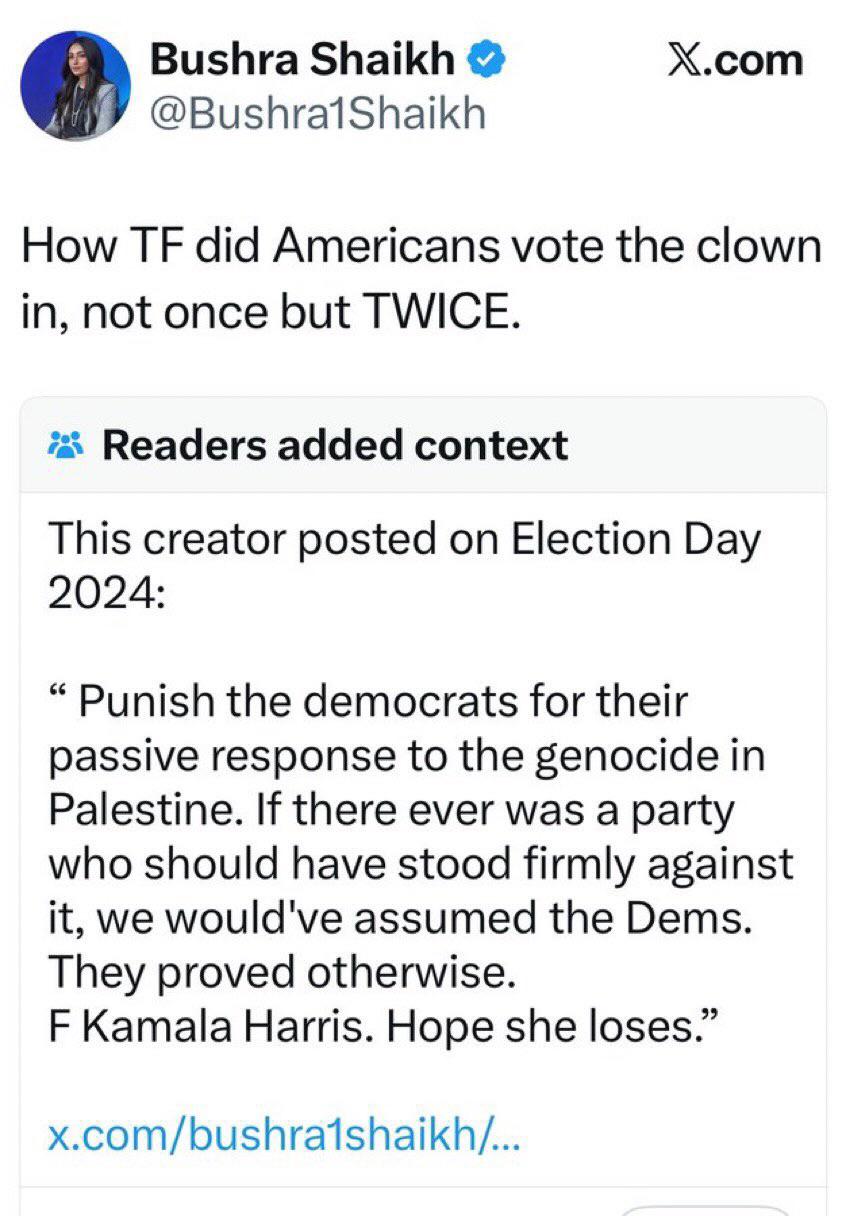
Many people voted against or refused to vote for Kamala because they were trying to punish her and the Democratic Party. Voting is the only way we have of holding politicians and parties accountable. Millions of voters saw the horrific haughtiness and barbarity of how the Democrats acted around Gaza, and they wanted to punish them for it. It was about holding them accountable. It was about justice. Many voted against Kamala to punish her for supporting genocide. And if the likely thing came to pass, if Trump supported genocide as well? Well those voters would vote against him for the same reason. They vote to hold people accountable for past actions, not to speculate on future ones. Maybe not how you vote, but again, people are different and can use whatever ethical system they want in choosing their vote.
Again, you can argue greatest good for greatest number, but that isn't the only system of ethics out there, and it's not even the system that defines the foundation of our legal codes.
And even more specifically, act utilitarian ethics. This incredibly narrow focus on the immediate effects of actions on the individual level which they treat as the only possible way of looking at things with absolutely zero examination.
I'd describe myself as a rule utilitarian, and from that perspective, the rule of "Don't support genocide, period" has a much stronger track record historically than, "Don't support genocide, unless you have a really good reason."
There is not one single time in all of human history that a stubborn refusal to support genocide has produced undesirable results. There are countless cases of people committing genocide because they see it as a "lesser evil" or "the only viable option." "If we don't kill them, they'll kill us, so we have no choice, this is the lesser evil." But not only are liberals utterly ignorant about moral philosophy, they're also ignorant about history, or they refuse to learn from it.
Modern American liberals are the ideological inheritors of the people who took the more "progressive" approach to indigenous people of subjugating and forcibly assimilating them, killing any who resisted, as opposed to the people who simply wanted to exterminate them all (who now live on through republicans). It's no wonder that they struggle to understand any perspective more progressive than "humane" genocide.
But this pretends that "not voting" is somehow a morally neutral inaction. It is a choice, the choice to support genocide EVEN HARDER.
This has very little to do with utilitarianism or deontology, and everything with retaining a feeling of moral superiority without having to actually do stuff.
You want a deontological take? Start bombing bridges or other infrastructure. Stop paying taxes, go to jail. Do literally anything that doesn't amount to "not doing stuff makes me better, akshually".
I voted third party. Voting for someone who opposes genocide is not "supporting genocide eVeN hArDeR" than voting for someone who supports genocide.
I could just as easily say that your decision to vote for a genocidaire is just about retaining a feeling of moral superiority without having to do stuff. The difference is that I subscribe to a moral framework that says genocide is bad.
The philosophy understander has logged on.
I'm not even a deontologist, dumbass. I literally just said that. Not that "bombing bridges" is remotely a "deontological take" to begin with.
The thing that really bugs me about y'all isn't just the fact that you're so ignorant, it's that you're so confident in your ignorance. You drop into intelligent conversations to not only spew a bunch of unexamined nonsense, but to tell everyone else how stupid and bad they are for not accepting your nonsense. It's like talking to a MAGA person tuned down like 10%.