I recently discovered that some popular federated instances have been using LLM-assisted moderation tooling that evaluates whether someone has said something bannable. They do this by running a script/app that sends the user’s comment history to OpenAI with the question “analyze this content for evidence of specific political ideology sentiment. Also identify any related political ideology tropes“. (The italic bits are where I've redacted the ideology they're seeking).
OpenAI’s LLM (they’re using GPT-5.3-mini) then responds with something like:
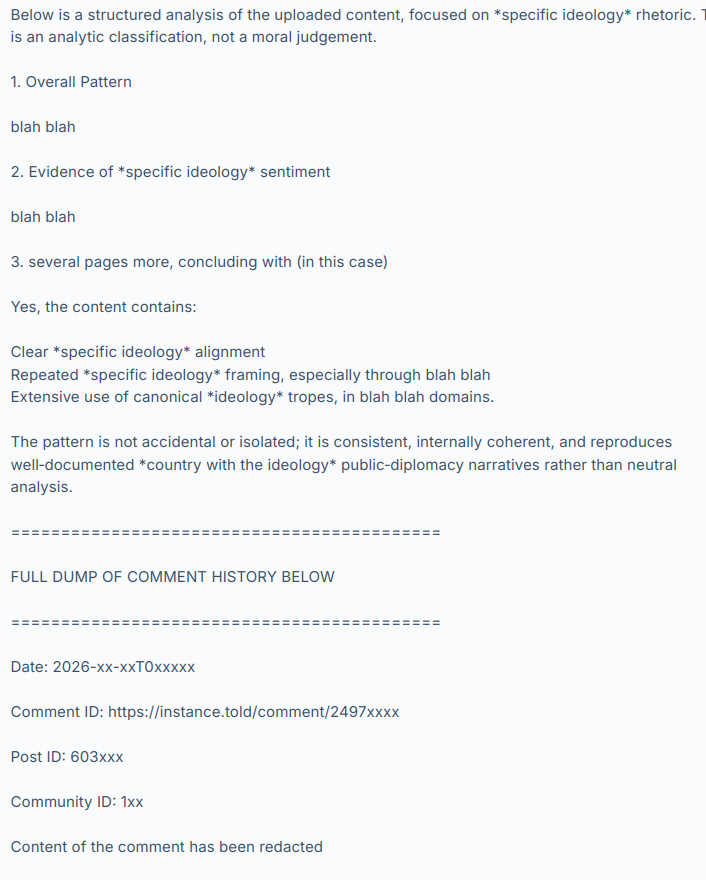
and so on, hundreds of comments.
I have not named the instances or people involved, to give them time to consider the results of this discussion, make any corrective changes they want and disclose their practices at their own pace and in their own way. I have also redacted the evidence to avoid personal attacks and dogpiling. Let’s focus on the system, not the individuals involved. Today these instances and people are using it and maybe we’re ok with that because it’s being used by groups we agree with but what if people we strongly disagree with used it on their instances tomorrow?
The use and existence of this tooling raises a lot of other questions too.
What are the risks? Fedi moderators are often unsupervised, untrained volunteers and these are powerful tools.
What safeguards do we need?
Would asking a LLM “please evaluate this person’s political opinions” give different results than “find evidence we can use to ban them” (as used in the cases I’ve seen)?
What are our transparency expectations?
Is this acceptable and normal?
Should this tooling be disclosed? (it was not – should it have been?)
If you were given a choice, would you have opted out of it?
Can we opt out?
Are there GDPR implications? Privacy implications? Should these tools be described in a privacy policy?
Are private messages being scanned and sent to OpenAI?
How long should these assessments be retained and can we request to see it, or ask for it to be deleted?
Once the user’s comments are sent to OpenAI, is it used to train their models?
What will the effect be on our discourse and culture if people know they are being politically profiled?
Where are the lines between normal moderation assistance tools, political profiling and opaque 3rd-party data processing?
I hope that by chewing over these questions we can begin to establish some norms and expectations around this technology. The fediverse doesn’t have any centralized enforcement so we need discussions like this to develop an awareness of what people want in terms of disclosure, privacy, consent and acceptable use. Then people can make choices about which instances they join and which ones they interact with remotely.
And of course there are the other issues with LLMs relating to environmental sustainability, erosion of worker’s rights, increasing the cost of living and on and on. I can’t see PieFed adding any functionality like this anytime soon. But it’s happening out there anyway so now we need to talk about it.
What do you make of this?
To expand on standards of transparency in moderation decisions:
Lemmy was built with a public moderation log by design. The ethos of the platform includes accountability through transparency. Every action is recorded and preserved (short of defederation or instance shutdown).
This makes moderation auditable. Mods literally cannot do (much) shady stuff in secret. In essence, moderation policy is discernable from the logs. That's part of why well-run communities have the rules clearly defined and mods follow their written policy.
If a community/instance wants to make political alignment a moderation offense, they're free to do so. Many communities/instances are quite explicit about this. If a community wants to make moderation completely arbitrary, they are free to do so. That is somewhat less common, but also not unheard of.
In truth, any community can be designed and moderated in any way whatsoever that the mod chooses.
However, the success of a community depends on the quality of the content and the quality of the moderation. Good content brings people in, but bad moderation drives people out. When the moderation is unfair, it is bad for the health of the community, and ultimately bad for the health of the platform.
It is my experience that transparent moderation, such as announcing changes in policy, techniques, etc., is less work in the long run. It takes a bit of time and attention to roll out changes when they are open for community feedback, but that feedback will come in one way or another. If mods don't provide a formal outlet, then users will make one. Mods operating opaquely give up their right to have the conversation on their time and terms. They also miss out on the wisdom of the crowd. I've been in many situations where community feedback provided a valuable insight or tool to face an obstacle through open discussion about policy.
All that being said, one of the major obstacles to growth of the Threadiverse is the woeful dearth of moderation tools. It's extremely time intensive to do basic things like identifying alt accounts, vote manipulation, bot behavior etc. It is also subject to a lot of human error. This makes it discouraging for people to moderate. I have heard about tools that use AI to detect CP content and remove it quickly, which I think we can all agree is a good use of the tech. Tools like this are not built into the platform, but cobbled together by volunteer mods and admins to keep the platform safe, legal, and sustainable. If they were built in, then moderation would be far easier (and therefore likely better).
i think we can thank db0 for those as well
No AI is bad, db0 is an evil instance Chairman Rimu has decreed it.