this post was submitted on 12 May 2026
1129 points (99.2% liked)
A Boring Dystopia
16636 readers
1282 users here now
Pictures, Videos, Articles showing just how boring it is to live in a dystopic society, or with signs of a dystopic society.
Rules (Subject to Change)
--Be a Decent Human Being
--Posting news articles: include the source name and exact title from article in your post title
--If a picture is just a screenshot of an article, link the article
--If a video's content isn't clear from title, write a short summary so people know what it's about.
--Posts must have something to do with the topic
--Zero tolerance for Racism/Sexism/Ableism/etc.
--No NSFW content
--Abide by the rules of lemmy.world
founded 2 years ago
MODERATORS
you are viewing a single comment's thread
view the rest of the comments
view the rest of the comments
CAFO "Factory Farms" in Minnesota used 2.3 billion gallons of water in 2017 and the number is going up
A typical Hog CAFO uses 5-10 million gallons per month, every month, all year long.
Dairy CAFOS use 10-20 million.
https://scholarworks.umt.edu/etd/11365/ https://www.elpc.org/wp-content/uploads/2024/03/MI-CAFO-Report-Section-1-ELPC.pdf
In Georgia where this data center is they have hundreds of these farms which not only drain the local aquifers but create shit lagoons that pollute mostly black neighborhoods.
It is the height of hypocrisy to complain about datacenters and support animal agriculture which is unnecessary.
https://www.gawater.org/wp-content/uploads/2017/11/GWC_Watering_GA_Report.pdf
The three named uses add up to 29.5 MLD, which is 129% the total capacity of the Lafayette water system production capacity. 😬
You do know that multiple things can be bad at once, right? Like, yes, agriculture uses an ABHORRENT amount of water, but we at least get food out of it. What do we get out of datacenters? Chatbots that drive people insane and endless worthless slop. Both are bad.
I agree both are bad. That is why you should be vegan. "At least we get food out of it" the food is bad for you and the environment and tortures living, feeling, sentient beings. You should absolutely stop this ASAP if you are that concerned about the environment.
Holy whataboutism, Batman! 🤦🏻
Let's say, for the sake of not getting bogged down, that it's an agreed upon fact that animal agriculture is wholly unnecessary.
That still doesn't make AI data centers necessary OR their monstrous misuse of increasingly scarce critical resources acceptable.
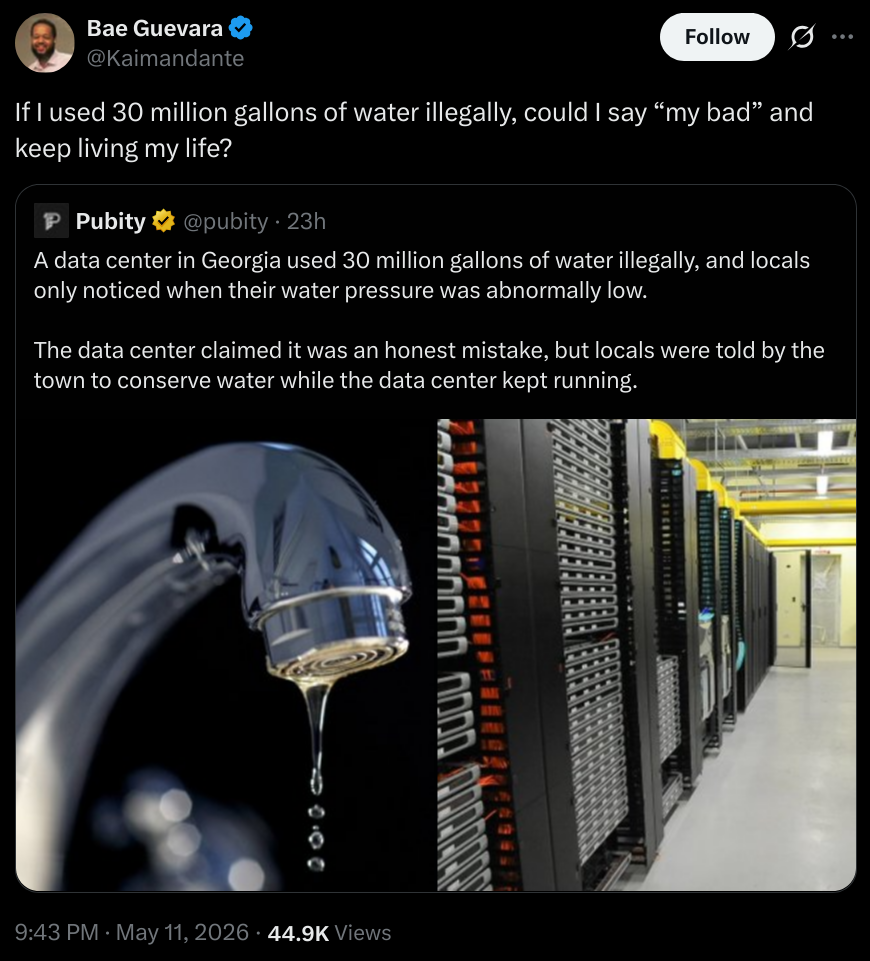
The datacenter is using enough water to lower the local water pressure. Defending them is honestly disgusting.
No one is defending them. Both are bad and you should stop eating meat if you are going to be using this as an excuse to be against data centers. Factory farms produce waste that give people cancer and destroy the environment. Optional animal agriculture causes 15% of all global emissions. You can stop today. Defending animal ag is honestly disgusting.
~30 ft subsidence at a California farm from extraction of the groundwater. Agricultural use is immense and wipes out historic rivers, lakes, even seas and slowly replenished groundwater reserves and something like 40% of water used is wasted because the sun just evaporates it before it used by the crops.
Everyone (agricultural or data center) would be far less wasteful if they had to at least pay for the true value of the water they’re extracting in their local area, i.e. a lot more if it’s scarcer/from slowly replenishing sources. Though that would probably result in a lot of economic relocation to wetter areas as many business models in dry areas become unviable.
It's not just agriculture and data centers either, manufacturing uses a lot too.
Hey, look, it's the Roman Polanski documentary Chinatown.
Currency is, itself, just an accounting construct. There is no "true value of the water" that people pay for because the thing they used to pay for it is predicated on rapid economic growth rather than efficient allocation of resources.
One might ask the question "What is material cost-benefit of 30' of subsidence?" Like, how is California worse (or better) off thanks to the harvesting of that groundwater? Given that the state is one of the most popular places in the country to live, I might suggest the 40M residents are better for that water harvesting than they would have been without it.
I might also suggest that a public sector dedicated to balancing the resident water demands and industry water-use demands could improve the rate/volume of consumption. But that would require a public voting base / private executive staff that valued the long-term health of the state rather than the short term economic growth of the local neighborhoods.
I think what most people are missing is that the water consumption was unmetered. Let me put it this way: the water plant knows how much water it's making at any instant, but there is a huge delay in knowing what the "revenue flow" is. There is always loss in the system between what is produced and what is billed.
I don't know this specific system, but if they couldn't detect the pressure loss without customer complaints, it wasn't some catastrophic increase in demand. As an example, water main breaks with uncontrolled lost flow are detected in the distribution system when pressure cannot be maintained or local pumping stations are running nonstop to maintain pressure. Low pressure is a safety issue so it gets investigated asap, and increased pumping will probably get flagged as suspicious or at least someone will need to explain why the electric bill is so damn high.. Utilities have leak detection tools they can use, and this would have been deployed if there was evidence of a sudden huge increase in demand because the symptoms would have been the same as a leak.
What is more likely is that the mismatch between production and billed flows was being audited and the local complaints about water pressure was the clue that helped them identify the culprit.
We can look at water loss reports here: https://epd.georgia.gov/watershed-protection-branch/water-efficiency-and-water-loss-audits
Their 2024 Infrastructure Leakage Index (ILI) was 7.02 with a validity score of 71, with the 2023 and 2022 results being 3.46 (70) and 3.37 (66). I'll bet that lit a fire under some bodies ass!
Articles on the topic contain statements like:
It really annoys me that this is shared without analysis. The instruction to stop water lawns is entirely unrelated to the data centers water use.
The systems planning documents show the water sources are sufficient for the projected demand in 2070, but the production capacity (treatment plants) needs to be expanded. Even though there were a lot of losses in 2024, the system was still opening in their capacity. Local pressure losses are a reflection of local bottlenecks, not overall system capacity issues.
Further, the water conservation is mandated by the Metro North Georgia Water Planning District and their Water Resource Management Plan which:
These restriction have been in place since at least 2007, according to my tired eyes.
Anways, I'm not trying to defend the data centre. I'm just annoyed with all the misinformation about this specific case. The root cause is likely administrative.
While not the case for this specific county, things like non municipal water supply for industries including animal agriculture are a massive risk to water sheds. These water users are subject to far fewer audits and checks, so if they are withdrawing more than permitted they are unlikely to get caught. Water tables drop and municipal supplies are impacted, but again without the means to identify the cause.
Attention on this specific case and all the misinformation about it is a distraction from other massive water users and their impact.
ETA: https://thecitizen.com/2026/05/11/behind-fayettes-qts-water-controversy-a-missed-meter-8000-workers-and-a-massive-construction-project/
Lol, it was a comms failure
People would love to live in a state with Mediterranean climate mostly year-round regardless of subsidence. You can say it would reduce agricultural jobs if charging for unsustainable water use put down farms dependent on it and that would make California less attractive economically. But even assuming the entire hulk of California agriculture was destroyed, that’s in the low single digit percentage of the state’s economic activity.
It’s not just a matter of that the soil went down. The water was extracted from a matrix of soil and water, and the soil sinks because the matrix of soil and air no longer stands up to the weight above it and gets compacted down. Less voids in the soil means that when rain comes in, instead of seeping down and recharging aquifers it piles up on the surface in sheets that then race down to lower elevations in floods that sweep away whatever is in their path. And with enough extraction and lessened recharge eventually the wells stop working and force the issue. Everyone suffers from natural disasters for the benefit of a few who just so happened to get water rights from early settlement.