It seems the fediverse is continuing and growing again. Line go up is probably good!
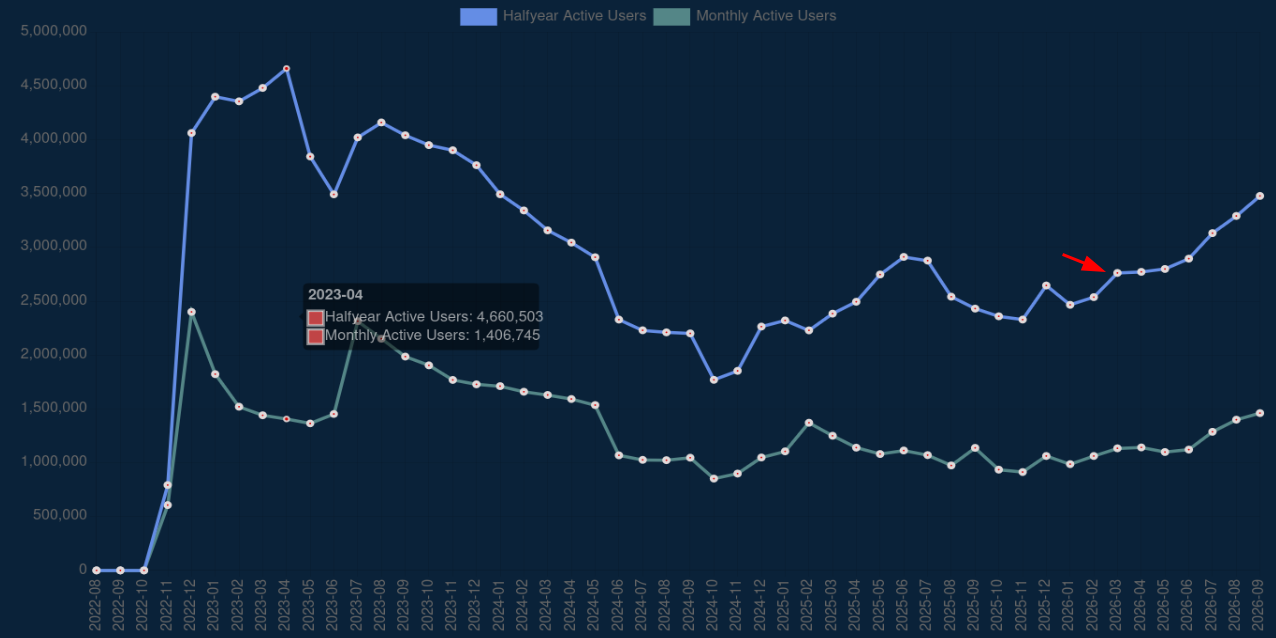
https://fediverse.observer/stats&months=50
Total users are huge now.
There are many websites out there that pull data from the fediverse. So take that with a grain of salt. But anecdotally I am seeing a small rise in people using the various platforms as each get more mature and servers somewhat stabilize.
This all sounds philosophical. How does this system actually solve problems in a society where scarcity exists? Do people still have property rights? Who enforces those rights? Who makes the decisions on where scarce resources are allocated? Our current system has answers for all of these questions, it's just contaminated by the influence of powerful scumbags. The thing is, the powerful scumbags are going to be scumbags in every system, and at least a decentralized market economy limits the ease with which they can exert control.
Philosophy is a core component of Marxism, just like it is of liberalism. Philosophy is essentially the worldview and methodology behind ideologies. Liberalism is generally metaphysical materialism, when science first overturned the feudal idealists. The philosophy of Marxism is dialectical materialism, which advances from metaphysical materialism through developing our understanding of interconnection, development, and processes.
Q: How does this system actually solve problems in a society where scarcity exists?
A: I don't see how scarcity is a problem. Production is already socialized and deeply interconnected, the problem is that distribution is based on individuals owning the means of production and distribution. Collectivizing private industry doesn't mean we suddenly forget how to produce and distribute.
Q: Do people still have property rights?
A: As a matter of course, private property is sublimated into social property gradually. The material base of marketized production is in decentralized, scattered production. The material base of socialized production is in large, centralized industry. Markets naturally move towards the latter, which causes a conflict between the new economic base and the old method of distribution.
Personal property is to be respected and understood as that which people themselves use.
Q: Who enforces those rights?
A: Before production has been collectivized fully, classes will still exist, and thus the state must be under the control of the working class in order to actually enforce this. After all production is collectivized and owned socially, the mechanisms of the state that only existed to protect this status cease to have a purpose, and fade into irrelevance.
Q: Who makes the decisions on where scarce resources are allocated?
A: Administrators, workers that have been selected through democratic processes to make such decisions, both at local and larger scale levels. Think local councils, with delegates to higher councils, and delegates to higher councils. The fewest rungs necessary for effectiveness and the greater the level of participation in all levels, the better, but this depends on the level of development of the material base.
Incorrect. Capitalism necessarily is run by capitalists. There can be no worker control in capitalism, because capitalists already dominate the base of society, the means of production and distribution. The state exists to reinforce the base, not outside of the class struggle. Further, capitalism itself runs into crisis, such as the tendency for the rate of profit to fall over time.
The longer capitalism goes, the more centralized and more disparity rises, the more it risks total collapse. Production increasingly gets socialized, while a smaller and smaller group of people keep the spoils. This is skyrocketing in recent years, but has been steadily and gradually accelerating since the inception of capitalism as a system.
It cannot be fixed by replacing people, because the problems of capitalism are core to how it functions. Billionaires will always control capitalism until capitalism itself collapses. There is no such thing as a "decentralized market economy" any longer. Markets have long surpassed the level at which they play a progressive role in the developed countries. A tiny minority of companies control the vast majority of total production. Free market capitalism died long ago.
We reached the imperialist stage of capitalism in the turn of the 20th century, when bank and industrial capital merged into financial monopoly. These monopolies expand outward, fighting each other over domination of the global south. This was the primary cause of World War I, and it extended into World War II. After World War II, the world began to be dominated by the US, the dollar, its millitary. After a crisis in profitability, Reagonomics unleashed neoliberalism, saving capitalism temporarily by privatizing the safety nets created by FDR and destroying worker organizing. This is now reaching its own crisis, accelerated by the AI bubble.
The capitalist system doesn't weaken the control of scumbags, it entrenches them to the highest possible degree, and ensures that over time it will only get worse as production continues to centralize and wealth concentrates in fewer and fewer hands. The only solution is collectivizing the economy and running it according to a coherent, scientific, collective plan.
It just seems like this system is capitalism with extra steps, but the extra steps involve replacing the exchange of money with the peddling of influence. The capitalists are replaced by administrators, the hierarchy of wealth is replaced by rank in the decision-making apparatus. I get that it's supposed to be democratic and protect the interests of the public, but so too is our regulated hybrid public-private system and we see how well that's going. It also seems like, where our market system began as distributed and decentralized, which was a strength, and began to be ever more concentrated as businesses consolidated and corrupted government, this new system starts consolidated and married to government. A lot of people would say this is too much power in the hands of the state, and ripe for theft by an autocrat. I'm not saying it's impossible for this to work, but the systems I have seen work best are those where the market does what it does and the government reigns in its worst tendencies when the motive of profit conflicts with the needs of people.
The key disconnect is that the state itself is a product of the base of society. Marxists do not posit that we should merely merge with existing government and take it over, but smash the state apparatus and replace it outright. The capitalist systems of today, despite having a public sector, are entirely controlled by capitalists. The socialist states of today and the future, despite having private sectors, are thoroughly controlled by workers. Look at Cuba, and what it's able to achieve despite incredible blockade and sanctions. Look at China, where the underdeveloped parts are marketized and the developed parts are public, they even have a handy chart on what socialist construction looks like:
This is where philosophy comes in. Right now, your analysis is metaphysical. You see that in the past the market was more decentralized, and now that it is highly decentralized, you are trying to work backwards. This isn't how human societies progress, though. This new economic base that capitalism has created is already compatible with planned, social ownership. There is no such thing as a static system that is not evolving into something.
Dialectics helps us understand that capitalism has already played its progressive role, and that now it's time for workers, who already run the world, to take charge of it and own it. Marxism is a more scientific way of viewing the world than liberalism allows for, because metaphysics traps us in outdated forms of science, just like evolution proved older, metaphysical forms of biological categorization to be incorrect.