Title text:
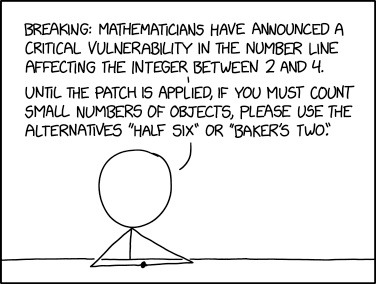
Other numbers are largely unaffected, but anyone using '4' for their certificate key is urged to upgrade to '5'.
Transcript:
Transcript will show once it’s been added to explainxkcd.com
Source: https://xkcd.com/3314/
A community for a webcomic of romance, sarcasm, math, and language.
Title text:
Other numbers are largely unaffected, but anyone using '4' for their certificate key is urged to upgrade to '5'.
Transcript:
Transcript will show once it’s been added to explainxkcd.com
Source: https://xkcd.com/3314/
"Half six" is fraught with peril. One slight misunderstanding and you'll have Germans and Dutch at your door when you least expect it and a bunch more people an hour later.
And the Danes will think you're talking about 50
*Puts on glasses* Akchually, that's only if you're counting 10's, since we count 1's as decimal and 10's in pairs of snes/snaes (20), hence fifty is half three snes or
3*20-0.5*20 = (3-0.5)*20 = 50.Or if you're talking 1's, aka. decimal, you'd just remove the snes part, since common math is in decimal anyway, so half 3 decimal would be
3*1-0.5*1 = 3-0.5 = 2.5.EDIT: Fun fact: 100, aka. "en hundrede/one hundred", can therefore also be called "fems" or "fem snes/five snaes". And then there's the ones who actually say "in twenty" instead of "snes", so it'd be "fem i tyvende".
I would really like to understand more, why do you simplify 320-0.520 as (3-0.5)*20? Is this system actually insightful into arithmetic? Is there a good tutorial about such and such?
Well, it is just arithmetics.
The left side of the equation is just the natural expansion of the paranthesis to signify and drive home the point that we're specifically talking half off 20.
The middle is how it's usually represented and follows best practices. Aka. Simplifying the equation without touching the variables and constants.
The right side is the result for calculating the equation.
I'm unsure of any tutorials regarding the danish counting system, though there's bound to be some. :)
Did I misunderstand the question?