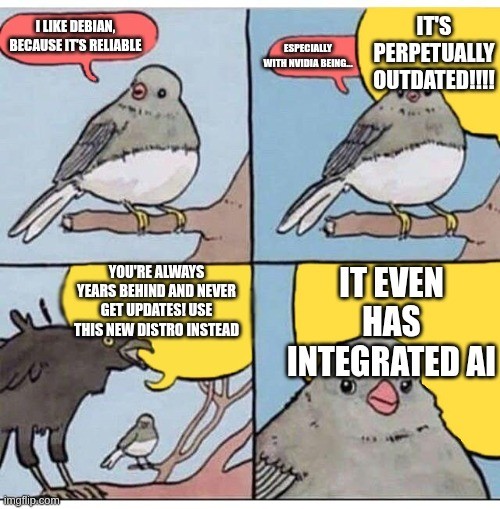
I used Debian for some years. My system was a patchwork of code in /opt and /usr/local hand-compiled or installed as AppImages for when I needed a version of something that wasn’t 18+ months out of date.
Hint: :q!
Sister communities:
Community rules (click to expand)
1. Follow the site-wide rules
sudo in Windows.Please report posts and comments that break these rules!
Important: never execute code or follow advice that you don't understand or can't verify, especially here. The word of the day is credibility. This is a meme community -- even the most helpful comments might just be shitposts that can damage your system. Be aware, be smart, don't remove France.
I used Debian for some years. My system was a patchwork of code in /opt and /usr/local hand-compiled or installed as AppImages for when I needed a version of something that wasn’t 18+ months out of date.
Hey, assuming your bottleneck isn't disk space, Flatpak is amazing for this
The inter-distro drama is really quite funny. The vast majority of Linux distros are, in fact, systemd distros. They use the same kernel, libc, userland, boot manager, etc. Some components and defaults are different, KDE over Gnome or Zsh over Bash, but really the only meaningful difference between Arch and Mint is the package management philosophy. There are some truly unique distros with fairly substantial differences in both philosophy and technology I love recommending. My two favorites are Nura (formerly PostmarketOS) and Chimera Linux with KaOS as an honorable mention. But these are such small and niche projects that no one really argues over them, it's more about the very similar Mint VS Arch. So why the fuck do Linux users argue over them? There's reasons for both, so why not argue over something productive like text editors? But not omarchy, fuck whoever is the "dev" of the project.
but really the only meaningful difference between Arch and Mint is the package management philosophy.
Don't forget the defaults.
Most people aren't looking to install a different desktop environment, and they'll stick with the distro that ships with what they like. If I want to use Cinnamon, it's infinitely easier to use Mint, which has it pre-configured.
I think people just want to feel validated in their choice, but as you said there really is no "best". There's just a bunch of choices, each with strengths and weaknesses, and a whole lot of unnecessary elitism.
Still on Bookworm.
Hey debian is alright for my raspberry pi desktop environment so it's good enough for me
I like Debian. Debian was my first choice when I built a new computer in 2025... only to find out that hardware can be too new for Debian.
I eventually landed on Linux Mint but I still choose LMDE for my laptops, for the stability combined with familiarity. I just have to lean on flatpak a little more than usual.
99.999% of the time it's just outdated GPU drivers which causes the problem.
Or in some cases, new ones lol
I had an issue where my DE was leaking ~18MB of VRAM every time I opened a window. I reported it, and it turns out it was the NVIDIA 610 drivers causing it. Downgrading to 595 fixed it immediately.
Mint is incredible
Yep, have used it for years.
I've dabbled with Debian, Ubuntu and Fedora for a while but always end up just continuing to use Mint.
I was considering LMDE. But i do like KDE, which sadly isn't an official part in Linux Mint. So far i had no major trouble with the hardware. I just had to include the nvidia repo to have the most recent driver. It would work perfectly fine without it, since the main gpu is an AMD, but i need it for some games.
I wonder if there's anyone who's running Mint but installed KDE anyway. It's theoretically possible and of the reviews in the Software Manager, the most recent gives it 5 stars. The older ones are less happy, but are from around 7 years ago.
I mean, it only matters if you have a recurring issue.
If you don’t, it ain’t broke.
If you are fighting your distro over a particular issue, though, that’s not good. There are definitely people in that category that should probably be informed they can switch.
Debian for servers but never for main
this is the way.
Nix fixes this.

In what way? Has Nix solved bugs forever?
It's a meme. At some point there were a lot if people on Twitter saying "Nix fixes this" to every technical problem to the point you could post a picture of a smashed laptop and receive that reply. Funny.
it's true, nix has helped me solve a staggering number of problems I would be completely clueless to approach otherwise
in fact it solves almost half as many problems as it creates
Nix makes it so everything breaks the same way on any machine.
Yes, they put up big zappers around the office. And the good ones too. Crispy.
Mmm, lunch is served!
famously stable unstable channel
I actually kinda wonder if my issues with Linux as a daily driver and not just for my server stuff was because I was always chasing the bleeding edge. I don't want my PC just to work, I like doing rad shit with it.
Then again, I first used Linux in 1993 (Slackware). Everything about it was bleeding edge.
I actually kinda wonder if my issues with Linux as a daily driver and not just for my server stuff was because I was always chasing the bleeding edge.
It's actually more simple than the way people usually explain it.
Each distro is made of thousands of components. Their interoperability needs to be thoroughly tested and the versions of the software need to be stabilised.
Debian's slow and steady release cycles not only do this, but make a guarantee that if the OS works on your system on release day, the OS will continue working there until the LTS window closes.
With faster release cycles, the interoperability and stability of the software is replaced with more up to date software without that kind of guarantee, and due to deprecations happening and being accepted, this further decays stability.
Recent examples that personally WOULD have affected me include KDEs X11 deprecation, and NVidia removing compatibility for my graphics card from their driver.
EDIT : Even with fedora's 6 month cycles, while inter-related software might work well together, they are still taking X.X versions , and the in between deprecations will still affect your system. Hooray, KDE got an incremental upgrade from 6.3 to 6.8 you have 3 new features. BTW I hope you were ready to stop using X11, because if not, have fun unbreaking your system and fixing every customisation you made that adjusted the settings of your system and programs to play with X11 the way you wanted it to.
Rolling releases are great for testing new versions of your software, since everything else is immediately preparing you for the future. For stable, "daily driver" systems, older or middling hardware, debian's long term stability is great.
If you have a bleeding edge system that has hardware that came out yesterday, you are developing something that depends on the newest version of a library, and you have all your essentials in a different machine, and you have a backup, and you want to participate in linux ecosystem actively, raising bugs as you see them, sure, definitely go for a rolling release system.
Also to reconfigure fucking everything constantly.
Yup. Linux really ceased having issues for me when I started using Ubuntu LTS around 2014-15. In fact my main machine hasn't been reinstalled since then.
Crazy when you start using LTS versions of software and that software... works.
That's why, after my experiences with Debian, i went for Nobara as a Fedora spinoff. Close enough to whatever is currently the bleeding edge, while curated for gamers.
Debian is pretty reliable, which is why I used it on my old home server. But the current one is fedora because debian on aarch64 mac hardware is not a very well supported usecase and what's most important for me is a solid and supported base