Happy birthday 🎊🎉 GNU/Linux.
Today GNU/Linux is 32 years old.
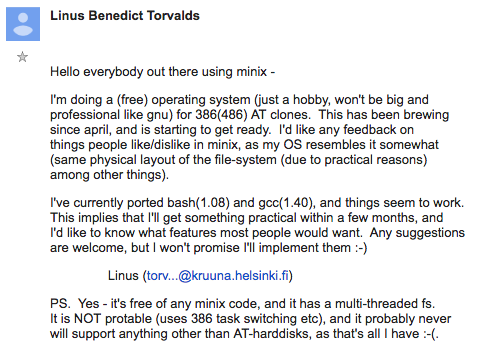
It was thankfully released to the public on August 25th, 1991 by Linus Torvalds when he was only 21 years old student.
What a lovely journey 🤍
From Wikipedia, the free encyclopedia
Linux is a family of open source Unix-like operating systems based on the Linux kernel, an operating system kernel first released on September 17, 1991 by Linus Torvalds. Linux is typically packaged in a Linux distribution (or distro for short).
Distributions include the Linux kernel and supporting system software and libraries, many of which are provided by the GNU Project. Many Linux distributions use the word "Linux" in their name, but the Free Software Foundation uses the name GNU/Linux to emphasize the importance of GNU software, causing some controversy.
Community icon by Alpár-Etele Méder, licensed under CC BY 3.0
Happy birthday 🎊🎉 GNU/Linux.
Today GNU/Linux is 32 years old.
It was thankfully released to the public on August 25th, 1991 by Linus Torvalds when he was only 21 years old student.
What a lovely journey 🤍
won't be big and professional like gnu
that didn't age well
And this:
and it probably never will support anything other than AT-harddisks
Sure it aged well. WAY WAY BIGGER than gnu.
That's debatable, since what people generally call "Linux" is more GNU than Linux anyway. "Linux" as the Linux fandom considers is it big and professional like GNU, because it is GNU (among other things).
Weight your words my friend! GNU's a behemoth !
GCC alone is almost as big as Linux. Add core/binutils, the Hurd, ... And you easily outclass the kernel itself !
~ $ du -sh linux-6.4.12/ gcc-13.2.0/ 1.5G linux-6.4.12/ 1.1G gcc-13.2.0/
Oh, and Emacs.
Speaking as someone that doesn't understand computers very well: is Hurd usable as a kernel nowadays?
Ahh the announcement that made my old PC actually run.
It is NOT portable (uses 386 task switching etc), and it probably never will support anything other than AT-harddisks, as that's all I have :-(.
Famous last words
*protable
Imagine making a typo and it continually being shared and highlighted for over 30 years.
Kinda makes me glad I'll never be famous for anything.
Well, Linux is 32 years old; GNU goes back to 1984, and Unix all the way back to 1970! The history of this OS is much older than Linus Torvalds's involvement; he "only" created and maintains the most popular kernel.
But yes, happy birthday to Linux. Many thousands have contributed to making this operating system what it is today and they all have my utmost thanks for it.
It is a happy coincidence that the evening before the 1970s began, at 4pm Pacific, they decided to invent UNIX.
The world didn't exist before 1970.
How so?
I think it's a joke about how UNIX timestamps work. They count milliseconds from January 1st 1970, 00:00:00 UTC, which is 4pm the day before in PST. So the happy coincidence is that they invented UNIX at the very millisecond when its clock starts.
There, ruined the joke.
Oh right, the UNIX epoch actually starts when UNIX was invented
Somehow, I didn't expect that...