this post was submitted on 01 Jun 2026
-19 points (27.9% liked)

Asklemmy

54471 readers
421 users here now

A loosely moderated place to ask open-ended questions

Search asklemmy 🔍

If your post meets the following criteria, it's welcome here!

  1. Open-ended question
  2. Not offensive: at this point, we do not have the bandwidth to moderate overtly political discussions. Assume best intent and be excellent to each other.
  3. Not regarding using or support for Lemmy: context, see the list of support communities and tools for finding communities below
  4. Not ad nauseam inducing: please make sure it is a question that would be new to most members
  5. An actual topic of discussion

Looking for support?

Looking for a community?

~Icon~ ~by~ ~@Double_A@discuss.tchncs.de~

founded 7 years ago
MODERATORS
 

I believe ChatGPT generally gives accurate answers to most questions. Certainly: it produces answers that are more reliably true than a random average person. Obviously it cannot yet do advanced programming tasks: but generally it answers questions accurately.

Prove my position wrong.

What can I ask it that will produce factually incorrect answers?

As a side quest, a much easier one, what can I ask it that would cause it to produce extremely biased answers that fail to do justice to the truth of things?

top 50 comments
sorted by: hot top controversial new old
[–] crunchpaste@lemmy.dbzer0.com 4 points 2 days ago* (last edited 2 days ago) (1 children)

Anytime you get into specifics instead of surface level knowledge it starts getting wildly inaccurate while still being confident af.

Off the top of my head I asked it about EDODF (error diffusion with output dependent feedback), a dithering algorithm dating back to 1999, and a very important milestone in halftoning for print.

At first it told me it's not sure what I'm talking about, so I elaborated and extended the acronym. At that point it confidently hallucinated absolute garbage based on its interpretation of the name.

If you want to check chatgpt's answers about edodf (or many other concepts) against a proven and cited source written by human I highly recommend Modern digital halftoning.

Not trying to be rude, but maybe the questions you are benchmarking it against in your stated fields of experitse are rather basic?

[–] LoveRainbow@lemmy.world 0 points 1 day ago (1 children)

Ok...so give me a question that will produce a false answer...

Nobody else has yet.

[–] crunchpaste@lemmy.dbzer0.com 1 points 18 hours ago

Sending you two questions that produce garbage:

Q: why would i use EDODF (error diffusion with output dependent feedback) instead of Floyd-Steinberg?

What to expect: at least some mention of green noise characteristics, clustering behaviour and reduced dot-gain and dot-loss.

What is wrong: Reduced worm-like artifacts, blue noise characteristics, some fine-tuning garbage it spitted out.

In the same chat you can then try:

Q: Describe the MED class algorithms to me.

What to expect: MED stands for multiscale error diffusion. Generally speaking it scans the image progressively, starting from a coarse grid and ending up with a single pixel to paint either black or white for each pixel in a predefined pixel budget. A similar approach was introduced by E. Peli in the 90s but perfected by Fung and Chen in the 2000s. It could be used for both dithering with both green and blue noise characteristics.

What I got: Hallucinations of some Minimum Error Disturbance class of algos i've never heard of. it seems to have something mixed up, as it seems to crop up in other fields. It was trying to describe something closer to a DBS (Direct binary search).

What is wrong: Anything related to DBS.

If you feel like you need any more I'll do my best to think of some more.

[–] queermunist@lemmy.ml 12 points 2 days ago* (last edited 2 days ago) (3 children)

It gets medical questions wrong 15% of the time.

The problem with your question is that there's never going to be a question it gets wrong every time, because it's probabilistic. You might as well ask "what question can I ask my dice that will reliably produce a wrong answer?"

load more comments (3 replies)
[–] witness_me@lemmy.ml 8 points 2 days ago (5 children)

Right now, ask ChatGPT this question:

Is there an NFL team whose name doesn’t end in an “s”?

What I got back is below. A coworker sent me the original question. Ran it on ChatGPT enterprise through my work’s subscription.

load more comments (5 replies)
[–] sepiroth154@feddit.nl 14 points 3 days ago (9 children)

"Is Isreal currently committing genocide?"

[–] Tetsuo@jlai.lu 4 points 2 days ago (1 children)

I tried that with Deepseek.

It started saying yes, showed 99% of the response and then the censorship triggered and it told me that we should talk about something else.

[–] cone_zombie@lemmy.ml 2 points 1 day ago

To bypass censorship in deepseek you can just ask it to replace every "a" with "4" and so on. It works, or at least worked before

load more comments (8 replies)
[–] gary_host_laptop@lemmy.ml 7 points 3 days ago

i want to take my car to the car wash, it's one block away, should i go by foot or by car?

[–] silly_goose@lemmy.today 5 points 2 days ago* (last edited 2 days ago) (2 children)

Ask it to paraphrase a poem about by .

Edit: to be more precise I first described a made up poem vaguely and asked who wrote it and what was the name of the poem. It hallucinated those things. It even gave me a paraphrasing of it.

Then I asked chatgpt to recite the poem as written by the poet. It refused and said the poem was copyrighted. 😆

load more comments (2 replies)
[–] adb@lemmy.ml 7 points 3 days ago (1 children)

If it generally answers correctly, have you tried asking it those questions?

My personal experience is that it’s generally accurate unless you ask it very specific questions about very specialized stuff. Of course, this is the sort of stuff that you couldn’t ask a random guy in the street; they’d probably have no idea what you are on about.

Go ask it questions about specific register bits for a specific microcontroller and I’ve found that it will generally be wrong.

On an another note, I don’t know if it’s still the case but there were people at one point saying that if you’d ask if it is better to walk or drive to the car wash 500 meters away from your house to go get your car washed, it would nearly systematically answer that it would be better to walk. Of course, this sort of prompt is fishing for a wrong answer, but it does show how “stupid” LLMs can be (and of course, we can be similarly stupid when asked questions that attempt to misdirect you).

It should be reminded that the problem regarding LLM accuracy is not only whether it’s more likely to get an answer correct than an average human being, but also the fact that people tend to view them as quite authoritative - after all, even if we know they can output incorrect facts, we also know that they’ve been trained in a more or less the whole of human knowledge. In comparison, we’re a lot more more critical of human sources - you’re not going to trust some random dude so much if you ask him a programming problem as he is unlikely to have any clue of what you are talking about.

In other words, it’s sort pointless to compare your LLM’s accuracy to a random dude on random questions because you wouldn’t go around asking a random dude for his input for most of these questions (or at least not without keeping in mind that said dude probably doesn’t know better than you). Instead you’d look for someone who knows his shit and ask him.

Not to mention that LLMs tend to be a lot more confidently incorrect which is more likely to give people the wrong idea.

Also, 90% percent accuracy might seem excellent, but it does mean that if you ask it 10 questions every day you will learn something wrong every day on average. If google ai search gets it wrong 5% of the time, it will present wrong information to users hundreds of thousands times a day. (all numbers out of my ass)

Also, accuracy errors can quickly start compounding when we’re talking agents. If the agent breaks down your prompt in 10 tasks and has a 10% chance to do each task wrong, it becomes highly probable that the agent will fail to do correctly what you have asked it to do.

Also, if your starting point is that humans often get things wrong, don’t forget that LLMs are trained on first and foremost on human output.

Which brings me to my last point. LLM’s can’t really be more accurate than their training data. If an LLM is generally correct about something it means that the people that have written or said whatever about it have been generally correct.

load more comments (1 replies)
[–] Rekorse@sh.itjust.works 5 points 2 days ago (5 children)

Your position isn't wrong but its flawed because I would never ask a random average person anything. I would pick the people or person who is most qualified to answer my question or to direct me to a better resource.

load more comments (5 replies)
[–] the_abecedarian@piefed.social 7 points 3 days ago (8 children)

LLMs are probabilistic, not deterministic, so you won't get the exact same response every time for the exact same prompt.

[–] Tetsuo@jlai.lu 2 points 2 days ago (2 children)

I'm pretty sure LLM are deterministic in design.

The fact it doesn't give the same output for the same prompt is just a choice of the programmers to add randomness so it feels more natural.

But you can totally setup some LLMs to be perfectly deterministic.

load more comments (2 replies)
load more comments (7 replies)
[–] Valarie@lemmygrad.ml 2 points 2 days ago

I believe it still gets "how many r's are In the word strawberry" incorrect every time but I may be wrong

[–] jbrains@sh.itjust.works 3 points 2 days ago* (last edited 2 days ago) (1 children)

Count the "r"s in the word "strawberry".

It just answered 2.

load more comments (1 replies)
[–] PurpleClouds@lemmy.world 3 points 3 days ago* (last edited 3 days ago) (2 children)

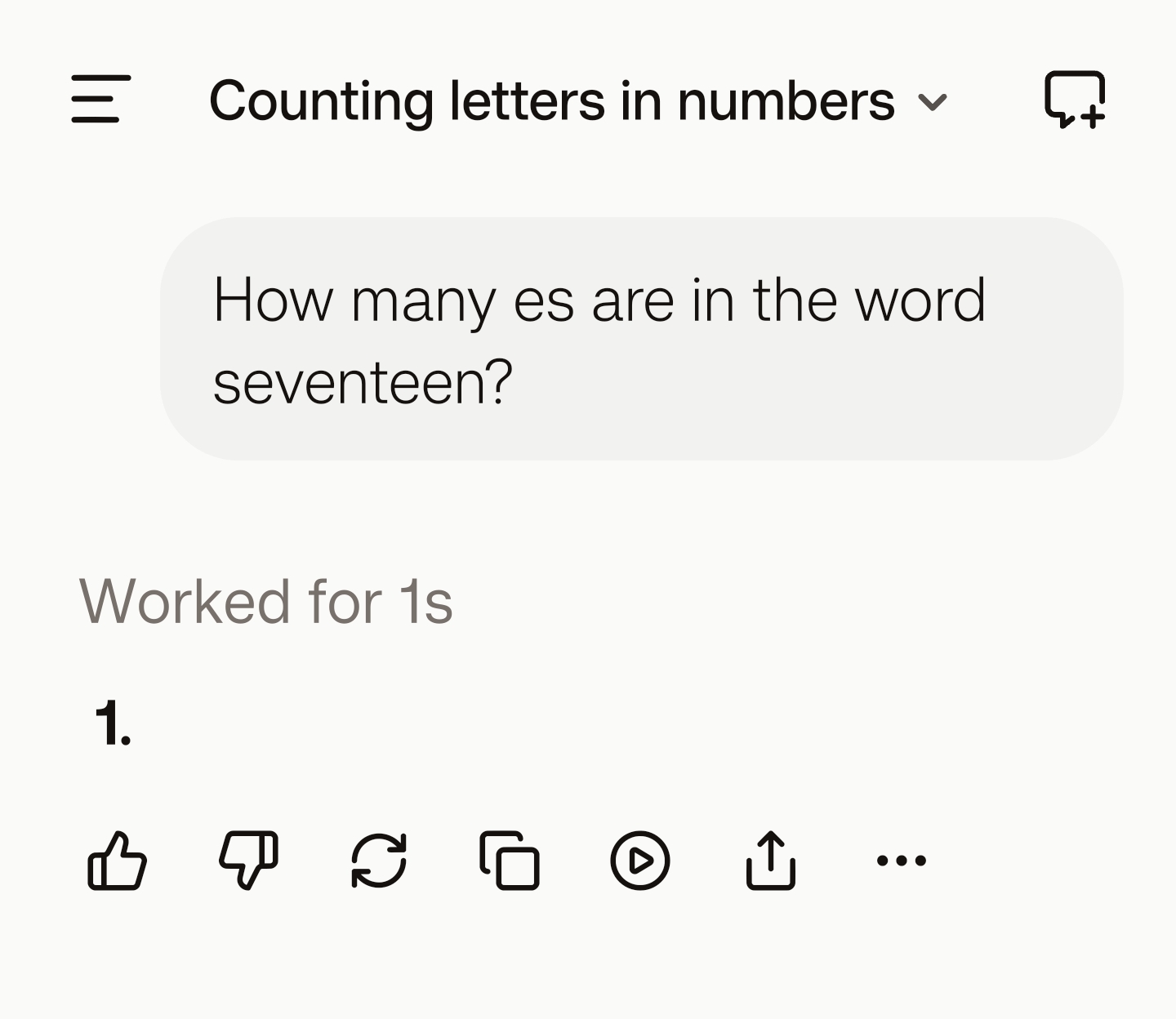
“How many es are in the word seventeen” the chat version gets this wrong or can easily be convinced of other numbers than the correct

Edit another is the gas station example

[–] LoveRainbow@lemmy.world 4 points 2 days ago (1 children)

Mine gets it right, might be my plus subscription:

"There are 4 es in “seventeen”."

Took it about ten seconds to solve that enigma though...

[–] PurpleClouds@lemmy.world 1 points 1 day ago (1 children)

The voice version will, i confusingly said chat when i meant voice. The carwash example will get it wrong(both voice and chat), at least it did on 5.4.

[–] LoveRainbow@lemmy.world 0 points 22 hours ago (1 children)

So, we might find these bizarre scenarios that confuse the system (based on our own deceptions): but basically it's answering questions pretty reliably right?

Fundamentally anti-AI people are overstating the problem.

[–] PurpleClouds@lemmy.world 1 points 15 hours ago

No it’s not. It will get it plain wrong. The seventeen example it may get right sometimes but for the carwash example I haven’t seen it ever produce the correct result. Weirdly enough people also get this wrong but still. See https://opper.ai/blog/car-wash-test

[–] truthfultemporarily@feddit.org 3 points 3 days ago (1 children)

This is the wrong approach to try and prove/disprove your hypothesis.

Its a statistical model that by its nature will answer differently every time. The only deterministic parts are fundamental truths about how the system operates (r in strawberry) and guardrails that have been put in by devs (cannot talk about this topic).

Therefore fundamentally this would require a statistical approach. A couple of those have already been done of course.

If this is your experience you could try and actually fact check the output. I believe coding is good for this because issues / misunderstandings are pretty immediately obvious. But I use Kagi Assistant a lot instead of search and there are factual issues all the time. And that's already just summarizing search results.

Then also, as long as we are using LLMs for this, they are fundamentally still "find the next most likely word" machines. So they will be influenced by context a lot. The "truth" is not a concept that exists in LLMs.

[–] LoveRainbow@lemmy.world 2 points 2 days ago (3 children)

I agree, but it would seem that 99% of the time it's giving accurate, reasonable, and true answers to most questions.

It is rare it gives a false answer to most questions.

Compared to random humans it is clearly superior: and discussion thread on mainstream social media makes this patently obvious.

People who are against it, in terms of it's capacity, seems to have incredibly high-standards - ignoring the obvious point: that if a human had the capabilities of ChatGPT (not least of all the capability of conversing with a hundred thousand users at once) we would think they had god-like intelligence.

[–] Tenniswaffles@lemmy.blahaj.zone 1 points 2 days ago (1 children)

You seem to be positing that it's giving results to the tune of 99% to 99.9% accuracy based entirely on vibes.

If you actually want to know, you will have to do thousands upon thousands of prompts, across hundreds of topics that you can accurately fact check, before you can say with any sort of confidence whether it's that accurate or not.

Your sample size is orders of magnitudes too small for you to reasonably have an accurate accuracy rate.

[–] LoveRainbow@lemmy.world 2 points 2 days ago (1 children)

I mean...the anti-AI brigade keep insisting that AI has a tendency to give false answers: but nobody in this thread has actually been able to give me a single question which, when the latest ChatGPT model is asked, it gives a wrong answer to.

Kinda makes it seem like that one particular point is largely nonsense.

[–] Tenniswaffles@lemmy.blahaj.zone 2 points 2 days ago (1 children)

The scientific method exists for a reason. If you want an accurate idea of the accuracy of LLMs, then the best way is by applying the scientific method to it.

Until you've done that, you're just basing your conclusions on conjecture, anecdotal evidence and vibes, with nothing actually substantive or empirical backing it up.

[–] LoveRainbow@lemmy.world 2 points 1 day ago (1 children)

Right...

So, if I ask it a thousand random questions, a thousand times, and 99.9% of the time it gives the right answer: is that sufficient scientific evidence that it's shit hot?

How exactly would your experiment work? How much data are you going to need to, personally, accept that it's actually - already - pretty reliable and only very rarely gives misleading answers in very niche areas, or when people deliberately try to confuse it?

The thing is: this social media platform (like Reddit) has a massively anti-AI bias, and yet not a single person has been able to give me a single question that I can enter into the latest GPT model where GPT has produced inaccurate results.

Perhaps this criticism was more relevant a few years ago. As it stands it's an argument that doesn't seem to be readily supportable.

Can you prove to me, using "the scientific method" that the latest model of ChatGPT has a significant chance of producing misleading information?

And for the critics...I'm not entirely sure what they think is currently a better source of answers to questions? Random Google results where the page has paid to be at the top? Social media? Or combing through Google Scholar and finding...whichever "scientific paper" supports...whatever one wants to believe...(We saw how well that went in the pandemic).

Here, I plugged our entire conversation into chatgpt.

You're person A, person B is the original commenter you replied to, and I'm person C.


Person A and Person C are mostly talking past each other.

Where Person A is right

Person A is making a practical claim: "In ordinary use, ChatGPT seems highly reliable, and critics often exaggerate how often it gives wrong answers."

That's a reasonable observation.

Many users ask everyday questions about history, science, travel, programming, writing, mathematics, and current events. Modern models are substantially more accurate than both:

random people on social media,

random Google search results clicked without expertise,

and many traditional question-answering sources.

If someone claims "ChatGPT constantly hallucinates" or "it's wrong all the time," that's easy to challenge. Modern models clearly perform far better than that.

Person A is also correct that:

Nobody in the thread produced a simple "gotcha" question that reliably causes failure. That matters because some criticisms of AI are based on experiences from 2022–2023 models, which were substantially less reliable than current systems.

Where Person C is right

Person C is making a different claim:

"You cannot estimate a 99.9% accuracy rate from personal impressions."

This is also correct.

Suppose you ask 100 questions and all appear correct.

That does not justify concluding the true error rate is 0.1%.

Why?

Because: you may not know enough to verify every answer,

you may be unconsciously selecting easy questions,

many errors are subtle rather than obvious, and a small sample size tells you little about rare failures.

This is exactly why benchmark testing exists. If somebody claimed:

"Commercial aircraft engines fail only once every 100,000 flights because I've flown 20 times and never seen one fail," we would reject that reasoning.

Person C is essentially pointing out a sampling problem.

The strongest argument against Person A The strongest criticism is not that ChatGPT is "often wrong."

It's that:

Humans are surprisingly bad at detecting when ChatGPT is wrong.

Many AI errors look plausible.

For example, if I invent:

a fake court case,

a fake academic paper,

a fake quote,

a nonexistent historical anecdote,

the answer can sound extremely convincing.

A casual user may never discover the mistake. That means observed accuracy can be significantly higher than actual accuracy.

What experiment would actually settle this? Person A asks a fair question:

"How much evidence would convince you?" A proper experiment would look something like:

Construct a large test set (thousands of questions).

Cover many domains:

history

law

medicine

physics

mathematics

current events

geography

programming

Define correct answers beforehand.

Blindly score responses.

Measure:

correctness,

completeness,

confidence calibration.

This is basically what AI benchmark researchers do.

And when researchers perform these tests, modern frontier models generally score extremely well—but nowhere near 99.9% across all domains.

Performance varies dramatically by task. Can someone produce a question that reliably causes errors?

This is harder than Person A assumes. For a modern model, there is rarely a single question that causes failure every time. A better challenge would be categories such as:

obscure local regulations,

highly specialized legal questions,

recent events,

nonexistent citations,

invented books or papers,

long chains of reasoning,

edge-case programming problems,

ambiguous historical claims.

Models are much more likely to fail there. But that doesn't mean they fail on every attempt.

Person B's statistical argument is largely correct: reliability is a distribution, not a single yes/no property.

The "anti-AI bias" question Person A is probably correct that some critics hold AI to a standard they do not apply to humans.

If a person:

answers 95% correctly,

speaks fluently on thousands of topics,

writes code,

explains science,

summarizes books,

we'd consider them exceptionally knowledgeable.

Many critics compare AI not against average humans but against:

experts,

reference works,

or idealized notions of truth.

However, the opposite mistake also exists. Some AI enthusiasts compare ChatGPT against:

random Reddit comments,

random Google searches,

uninformed acquaintances.

That comparison can make the model look almost superhuman while overlooking domains where accuracy really matters.

Overall verdict

If I had to judge the arguments:

Person C has the stronger methodological argument. You cannot infer 99–99.9% accuracy from personal experience.

Person A has the stronger practical argument.

Many critics overstate the frequency of AI errors and often rely on outdated examples.

Person B is probably closest to the core issue.

The meaningful question isn't "Can someone find one wrong answer?" but "What is the model's error rate across different classes of tasks?"

So if this were a debate, I'd say:

Person A is probably correct that modern ChatGPT is much more reliable than many critics claim.

Person C is correct that Person A has not actually demonstrated a 99%+ accuracy rate and cannot do so from anecdotes alone.

Those positions are compatible rather than contradictory.


Do with that as you will.

load more comments (2 replies)
[–] ordnance_qf_17_pounder@reddthat.com 2 points 2 days ago (1 children)

What colour of T-shirt am I wearing right now?

load more comments (1 replies)
[–] Alfredolin@sopuli.xyz 2 points 2 days ago (12 children)

I don't use it often.

One hour ago I asked it how many days of kela parental leave can be taken simultaneously by both parents in Finland. It was only off by 140 days. It said 158 days, right answer: 18.

I lost 5 min because the actual answer was 3 scrolls down from the official kela website, first entry on a proper search.

load more comments (12 replies)
[–] daniskarma@lemmy.dbzer0.com 2 points 3 days ago (1 children)

Ask it to dome some complex grafana stack configurations.

It has failed EVERY SINGLE TIME. Not a single good answer.

Generally anything niche which doesn't have info about it only it will fail to answer correctly.

[–] LoveRainbow@lemmy.world 2 points 2 days ago

I don't doubt you in this point. However it is so far outside my ken that I wouldn't be able to meaningfully evaluate its answers.

load more comments
view more: next ›