Thanks for your useful and actionable feedback that clearly explains the problem. So trustworthy /s
PeriodicallyPedantic
joined 2 years ago
Lightweight and flexible: Bitwarden lite self-host deployment is now generally available | Bitwarden
Lightweight and flexible: Bitwarden lite self-host deployment is now generally available | Bitwarden
No, my problem is that I need my password manager to access my backup, and I need my backup to get my password manager.
Lightweight and flexible: Bitwarden lite self-host deployment is now generally available | Bitwarden
I don't trust my setup for something like this.
My server and NAS go down in a fire, and I'm not gonna have the key I need to get the backup so I can restore my password manager lol
I'm gonna pick up a few of these I think.
That NoteDicovery looks pretty slick. Its exactly what I was looking for a few months ago, and I'd absolutely pick it up if I didn't just fall in love with the silverbullet's ability to execute code embedded directly in the markdown; a feature that I expect to use almost never, but atotally smitten with.
As a side note, all these email archiving projects almost do something I want, maybe folks here can help me:
I've heard that self-hosting email is not worth the pain, but I also don't want to leave my email history in the hands of these megacorps I don't trust. These archive projects solve that problem, but they're not email clients. I don't want to archive and delete an email just to find out actually I need to reply to it like a month later.
What do you recommend for this usecase?
Using an AI is a great way to get learning materials tailored specifically to you.
But after you've learned from it, before you move on to another topic, you HAVE to verify your understanding against more trustworthy sources that you previously couldn't understand. Ideally with an online course that actually gives you a test.
Outside of VPS firewalls settings and fail2ban, is there anything else you'd recommend to harden the VPS?
Idk about audio but they rate limit video pretty quickly. Audio might be low enough bandwidth for them to not care, but be cautious
Is there a reason not to use pangolin for the public stuff too?
I'm just about to make the switch from CloudFlare to pangolin on VPS, and I wanna make sure I'm not missing anything
They do basically what I'm describing, just not as well because they don't have as much of an incentive. Are end users willing to pay for these more advanced models?
Well there you go. It could be authoritarian, except an authoritarian govt isn't subsidizing it. Exactly like I described.
Governments, however, are willing to pay that amount. Why?
You keep walking straight into the points I'm making.
That, in itself, isn't authoritarian
Wrong. Setting up a super invasive surveillance system is inherently authoritarian, even if they initially happen to use it for reasons that don't typify authoritarianism. You have to bend over backwards so hard to keep it from becoming authoritarian, that it will just naturally corrupt any entity that deploys it, even making the monumental assumption that an entity that deploys this didn't have the intention to use it for nefarious purposes from the start.
it's only authoritarian of there's some enforcement arm to enforce obedience or punish disobedience.
Is a rather clumsy piece of mental gymnastics. Not only have you said it before. You can use this argument, coupled with your earlier "it's constituent parts aren't authoritarian" to argue that nothing is authoritarian.
Again, I disagree. Something is only political when used for political ends.
And again this is just the pro-gun argument. Fine on paper, useless in reality.
I'm making the argument that it is possible for software to be political even if it wasn't created as such. I only need to show that a single case is possible.
You are making the argument that it is impossible, and you keep trying to prove it by example.
Again, in theory in a vacuum, I agree. But I disagree that anything you describe could actually be both commercially viable and deployable without authoritarian involvement
In your example do you not see all the gymnastics and bending over backwards you need to do to avoid the inherent nature of the system? I'd go so far as to say that the people in your theoretical HOA are analogous to supporters of a authoritarian regime.
You're making a pro-gun argument here, and it's not convincing for similar reasons: products are more than the sum of their parts, and the actual application of a product matters more than the theoretical use. If it is nearly impossible to meaningfully use apolitically, then it is not apolitical.
Surveillance has a lot of use cases outside of government. Palantir could have sold its services to non-profits like the ACLU as a check on local, state, and law enforcement agencies.
In theory, yes. In practice no.
ALCU could not roll a system like that out; never mind securing the resources needed to deploy this meaningfully; using it would go against their ethos, because using it would make them authoritarian, or adjacent.
Similarly, even if HOAs could deploy a system like that, that'd make them authoritarian.
Mass surveillance products like these don't have a lot of non-authoritarian uses. Even if you could find such a use (of which I'm skeptical), it'd almost certainly need to be subsidized by an authoritarian customer. We're not talking about security cameras around you personal property, here.


To be clear, not talking about this community, obviously 😛.
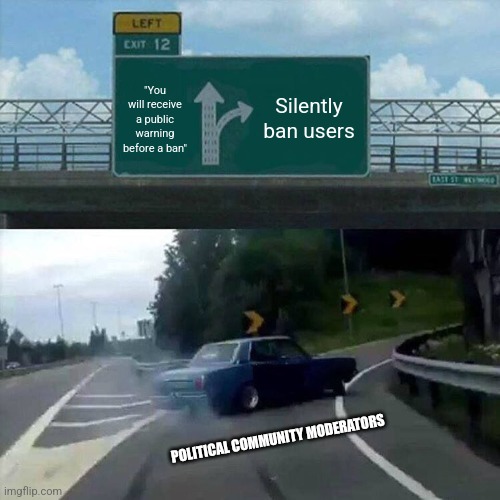
What's the point of writing down rules, if mods just do what they want? But I suppose that's the risk you take when you call someone a liar in a small community; they might be a mod.
Edit: I'm not trying to say that mods suck, they perform a useful and often thankless job. Just that it can be difficult for small communities to get a healthy number of good mods, which can become a problem.
view more: next ›
That's good, if at least one surviving synced device survives then you still have access. Still a big "if" in a catastrophe, but a much better proposition.
What is the data retention policy for the local vaults?