Solarpunk technology

3618 readers
20 users here now

Technology for a Solar-Punk future.

Airships and hydroponic farms...

founded 3 years ago
MODERATORS
1


cross-posted from: https://lemmy.sdf.org/post/45406669

Archived

Longi Green Energy posted a net loss of AUD180 million (USD 116 million) in the third quarter of 2025, narrowing from $272 million a year earlier as weak demand and price pressure weighed on margins. Revenue fell 9.8% year on year to $3.9 billion. For the first three quarters, revenue totaled $11 billion, down 13.1%, while net losses narrowed 47.5% to $739 million.

The company shipped 38.15 GW of wafers and 63.43 GW of cells and modules during the period. BC-series shipments reached 14.48 GW, with HPBC 2.0 modules accounting for 23% of total deliveries. Operating cash inflow was $390 million.

JinkoSolar recorded a net loss of $220 million in the third quarter of 2025 as revenue fell 34.1% year on year to $3.5 billion. Cumulative module shipments for the first three quarters reached 61.9 GW, including more than 200 GW of total N-type Tiger Neo deliveries, while energy storage system shipments exceeded 3.3 GWh.

The company maintained its 2025 full-year shipment guidance at 85–90 GW for modules and 6 GWh for storage systems.

JA Solar registered a net loss of $210 million in the third quarter of 2025, reversing a profit in the same period last year, as revenue fell 34.1% year-on-year to $2.7 billion.

Cumulative module shipments for the first three quarters reached 52 GW, including 18.17 GW in the third quarter. The company expects full-year module shipments of 70–75 GW in 2025 and anticipates faster growth in its energy storage segment.

Flat Glass Group said unaudited revenue for the third quarter ending Sept. 30 was $1 billion, with profit attributable to shareholders totaling $81.3 million. Revenue for the first nine months of 2025 reached $2.69 billion, down 14.6% year-on-year, while profit fell 50.8% to $137 million.

Xinte Energy posted a net loss of $113 million for the nine months ending Sept. 30, 2025, with revenue of $2.5 billion attributable to shareholders of the listed company.

...

2
1
submitted 1 month ago* (last edited 1 month ago) by oeuf@slrpnk.net to c/technology@slrpnk.net


Cross-posted from fediverse user @peachy@goto.micromail.me

Is there such a thing as a configurable full-body input controller for computers? Is anyone working on that? I know there is work on controlling computers directly with the brain, which will be ace for people with full paralysis, but what I’m interested in is something that goes in the other direction - using more of the body. Think Tom Cruise’s interface in Minority Report but better. Sitting, or even standing, to work at a computer takes its toll on the body, especially the back. Our bodies didn’t evolve to be so static while we’re awake. Emerging from a flare-up of a slipped disc, it has got me thinking of better ways to interface with machines.

Imagine the following:

You come to see me in my studio to see how I and my colleagues do image editing and graphic design in GIMP 4.0. Some of us are stood in front of large displays but no one seems to be using a keyboard, mouse or graphics tablet. I appear to be doing a dance routine from a music video... As I bounce my knee up and across my body you see that the Move tool has been selected. As I raise my left fist above my head it is as though I am holding shift to toggle “Pick a layer or guide”. I draw my right hand across my body with my thumb and forefinger pinched and the selected layer moves with me. Finally, I quickly raise both hands, like I'm flipping over a table and my project is saved and closed. Now that I’ve stopped moving around so energetically you notice that my stylish and comfortable cotton loungewear and gloves have small sensors dotted around them. I explain that the position of these sensors relative to each other and to the space have been mapped to traditional keyboard and mouse inputs via my operating system.

Moving to the next workspace you see my colleague Babs. Her white hair pokes out above a VR headset and she has a number of small cameras tracking her movement to the soundtrack of Chinese classical music. She is an elder and a veteran and even contributed some of the code that makes this stuff work, back in the day. She says it was no big deal; she mostly just connected up different programs, some of which Hollywood has been using since the 1990s. Her movements are slow and smooth. It looks like she’s doing Qi Gong or Tai Chi or something. Raising a hand in front of her heart you see the Filters menu open and lowering it slowly the menu scrolls down to Enhance. Gracefully stepping sideways and lowering her hand further, Heal Selection is highlighted in the submenu. Turning her hand palm-up launches the plugin. She tells you that one of her first contributions to the interface was to make the body position tolerances configurable by the user in their desktop settings.

Lastly you watch my cousin Tommy at work. When we met I told you about how a head injury had left him partially paralysed and unable to speak. He too is using a VR headset, but instead of having cameras pointed at him he has a HD sonar array. His disability was caused by an error in the police’s facial-recognition software and understandably he’s had a thing about cameras ever since. The bad guy got away and he never caught the bus he was running to catch. Every couple of days he asks whether Nancy’s cameras are still disconnected from the network, which they always are. Tapping his ring-finger once on the armrest of his wheelchair selects the Text tool. Turning his head to the side, he purses his lips and sweeps his face back around to make his text box. You see his mouth moving but there is no sound. “Hi, nice to meet you” appears in his projects new text layer. “You too” you reply. Twitching his right shoulder you see his text layer is duplicated, blinking twice and nodding his head replaces the text with what you just said. He must have used speech-to-text to record your words to his desktop clipboard and then pasted them into the text field. Pressing his index finger against the arm rest and looking toward the ceiling brings the new text layer to the top of the stack. Running the same sequence of movements again, a third text layer becomes visible onscreen. “I’d never edited a picture in my life until I got into this tech as part of my physiotherapy treatment. My cousin ended up offering me this job and now I can work faster than anyone else here, especially Babs. I’m pretty sure she’s just here for fun but none of us mind.”

#tech #health #disability #GIMP #solarpunk

3


Video of the sailboat and interview with Neoline CEO: https://www.youtube.com/watch?v=dUdaBnJ58jI

Informative comment by /u/thatjoachim:

Especially in France, the industry is very innovative. Here are some of the wind-powered cargo ship companies:

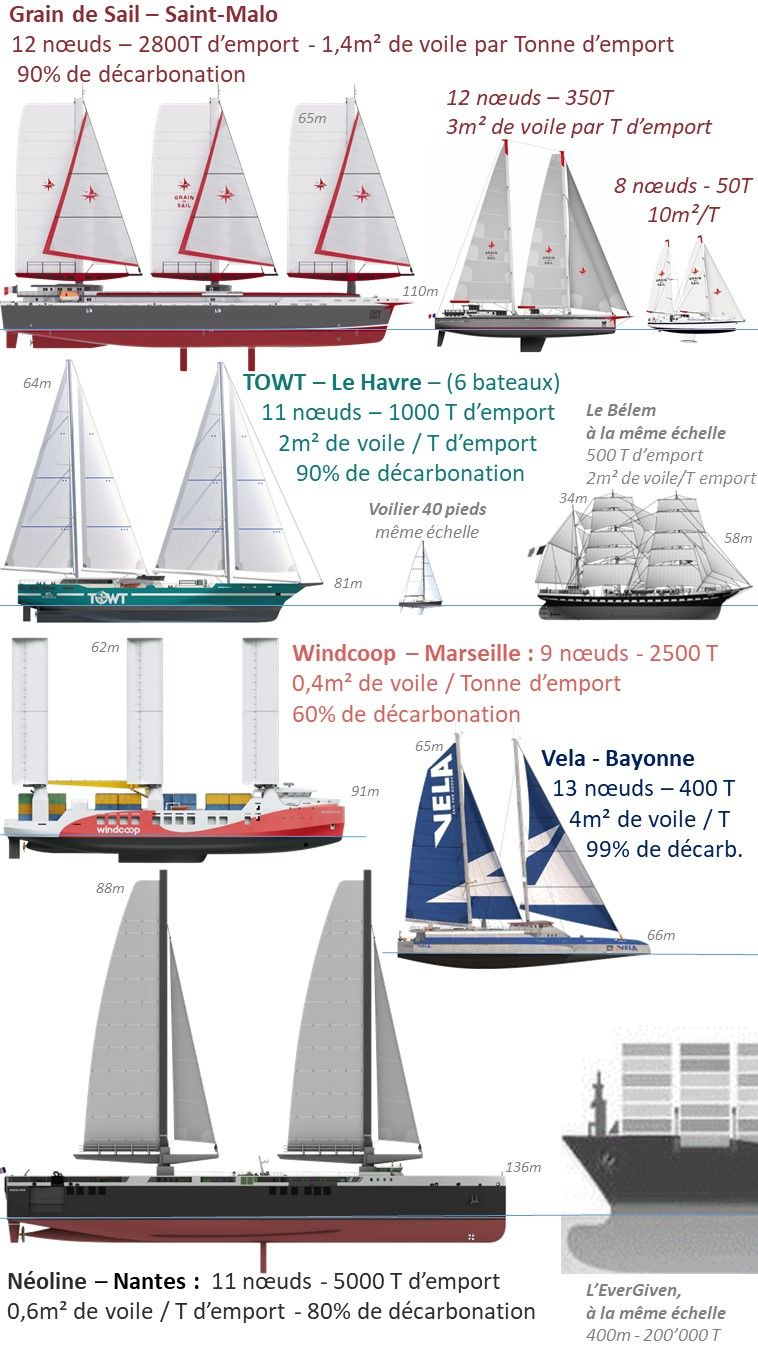
  • Néoline (based in Nantes), one ship (which we see on the video), more are yet to come

  • Vela (based in Bayonne), 5 ships are expected to be launched between 2026 and 2028

  • TOWT (based in Le Havre), 2 ships since 2024, 6 more are being built

  • Windcoop (based in Marseille), expected launch of their first ship in 2027

  • Grain de Sail (based in Saint-Malo), 3 ships, their chocolate is delicious

    some other names, though I don’t know as much about >them: Hisseo, Fairtransport, Bourlingue et Pacotille, Heol Sailing

If you want to see their respective sizes, here’s a diagram showing the ships side by side with a famous sail ship (the Bélem) and the famous cargo that blocked the Suez Canal, the Evergiven

Some more info about wind powered and wind assisted cargo ships around the globe:

https://www.wind-ship.org/vessel-list/

https://velic-consulting.com/?page_id=309

In fact in Paris I can buy coffee that is specifically transported by wind power: https://www.fcco.fr/

4
5


Electric aircraft are quickly becoming a reality, it is bewildering to keep track of all the innovation, this article does a good job!

6
7


cross-posted from: https://feddit.org/post/20437303

This is Akkudoktor's (Andreas Schmitz) home energy management and optimization system. Some people will know Andreas by his YouTube channel @akkudoktor in which he discusses DYI home energy systems. That channel was born out of a frustration how unnecessary technical and regulatory hurdles, as well as lack of good system integration were obstructing the energy transition in Germany. Among other things, Andreas showed that one can build a home battery from refurbished cells with a fraction of the cost of commercial systems - provided that one has solid engineering knowledge - and he is a control engineer.

So, because just before, I did post a link to the evcc project, I should explain what are the differences between evcc and Akkudoktor's EOS:

evcc is mainly concerned with charging electrical vehicles (EVs) from home solar or dynamically priced power from the grid.

  • it is set up to be easy to use with phone interfaces etc.
  • it already supports a wide range of hardware
  • it is comperatively mature
  • it is limited in optimization capabilities
  • it is written in Go language

Akkudoktor EOS has the top priority of high level optimization - getting the most bang out of each buck

  • it is a rather new project in alpha stage. So, it might be more interesting for people looking to contribute - or scratch their own itch.
  • it tries to optimize home photovoltaics, home batteries, heat pumps, grey water heat pumps, other heating and manageable devices, and the remaining household demand
  • electrical vehicles are supported (and currently, they are an important economical use case because batteries are still expensive and the only other large type of consumers are heat pumps).
  • Such an optimization is complex because it requires predicting renewable generation (both in the home and as wind power from the grid), electric power price prediction (if dynamic or day/night prices are used), and also the individual consumption (which could depend on the forecasted weather, time of the day, day of the week, or time of the year). Things like the insulation of the house modify the impact of the weather. Also, usage pattern of components such as heat pump or battery can have influence in their life time. So that's a complex optimization problem.
  • And a good optimization also requires sufficient input data. This also needs to observe data privacy aspects (I guess you don't want to give a burglar info on when nobody is at home)
  • The interface is a REST service.
  • The targeted integration is via Home Assistant, or HA.
  • written in Python

Oh, last not least, there is also a (mostly German-language, but engineers do speak English) forum on home energy systems which is also used to discuss the software:

https://www.akkudoktor.net/

8
9
10


It's green washing at its best, but I'm a big fan of these wood building initiatives.

That said, it's still fuck Amazon!

11
12
13


We’re happy to announce the release of the Eco-Libre Life-Line version 2025.10.

Eco-Libre Life-Line v2025.10 Release Announcement

Who is Eco-Libre?

Eco-Libre is a volunteer-run project that designs libre technology for sustainable communities.

Eco-Libre's mission is to research, develop, document, teach, build, and distribute open-source technology that sustainably enfranchises communities' human rights.

We aim to provide clear documentation to build low-cost machines, tools, and infrastructure for people all over the world who wish to live in sustainable communities with others.

Contribute to Eco-Libre

If you'd like to help Eco-Libre reach our mission to enfranchise sustainable communities' human rights with libre tech, please contact us to get involved :)

Join Us
eco-libre.org/join

Cheers,
The Eco-Libre Team
https://www.eco-libre.org/

14
15
16
17
1
submitted 2 months ago* (last edited 2 months ago) by poVoq@slrpnk.net to c/technology@slrpnk.net
 
 
18
19
20


cross-posted from: https://ibbit.at/post/56217

A Meshtastic node has been one of the toys of the moment over the last year, and since they are popular with radio amateurs there’s a chance you’ll already live within range of at least one. They can typically run from a lithium-ion or li-po battery, so it’s probable that like us you’ve toyed with the idea of running one from a solar panel. It’s something we have in common with [saveitforparts], whose experiments with a range of different solar panels form the subject of a recent video.

He has three different models: one based around a commercial solar charger, another using an off-the-shelf panel, and a final one using the panel from a solar garden light. As expected the garden light panel can’t keep an ESP32 with a radio going all day, but the other two manage even in the relatively northern climes of Alaska.

As a final stunt he puts one of the nodes out on a rocky piece of the southern Alaskan coastline, for any passing hacker to find. It’s fairly obviously in a remote place, but it seems passing cruise ships will be within its range. We just know someone will take up his challenge and find it.

From Blog – Hackaday via this RSS feed

21
22


Hey there! So I'm currently studying CS & IT and I'd like to know more about how developers & computer nerds alike are reflecting the values of solarpunk into their work.

Are solarpunk values part of your thinking process when you decide which software you are going to be making (for personal projects for example), or which company you will be working at? Are they part of the production process (like which tools or technologies you're using)? How much? And, maybe in a broader sense, is hoping to work on projects aligned with solarpunk values realistic?

23
 
 
  • With Bangladesh’s growing economy and city dwellers’ purchasing capacity, the tendency to gather for parties and serve food has also increased in the country.
  • With concerns for environmental protections, many of them are choosing biodegradable tableware instead of single-use plastic.
  • A few local entrepreneurs are now producing tableware like plates and straws from biodegradable and locally available materials like areca leaves for plates and rice bran and jute for straws.
  • However, entrepreneurs are struggling with production costs and are looking forward to the policy support that industries producing environment-friendly products usually receive in Bangladesh.

archived (Wayback Machine)

24
 
 
  • Recently, Bangladesh successfully developed lotus silk — a biodegradable luxury fabric — using lotus stems, merging ancient tradition with modern sustainability science.
  • Unlike conventional textiles, lotus silk is produced without water, chemicals or fossil fuels — making it one of the most eco-friendly fabrics in the world today.
  • With high prices, lotus silk is attracting top fashion houses internationally, giving Bangladesh an opportunity to gain a premium place in the ethical fashion market.
  • In some villages, lotus silk is creating new jobs for women who are now skilled in producing this high-value, global product; it’s reviving Bangladesh’s artisanal legacy.

archived (Wayback Machine)

25


I am looking for a small solar panel setup, ideally to be connected to the grid and reduce electricity bill. I have heard of the Ecoflow system but I would like to know if there are alternatives out there.

If anyone has experience and can recommend any products, please comment :)

view more: next ›