Ocean Conservation & Tidalpunk

775 readers
9 users here now

A community to discuss news about our oceans & seas, marine conservation, sustainable aquatic tech, and anything related to Tidalpunk - the ocean-centric subgenre of Solarpunk.

Posts and comments from Meta or X will be removed. See this post for more info.

founded 3 years ago
MODERATORS
1


link to open access paper https://www.nature.com/articles/s43247-026-03943-9
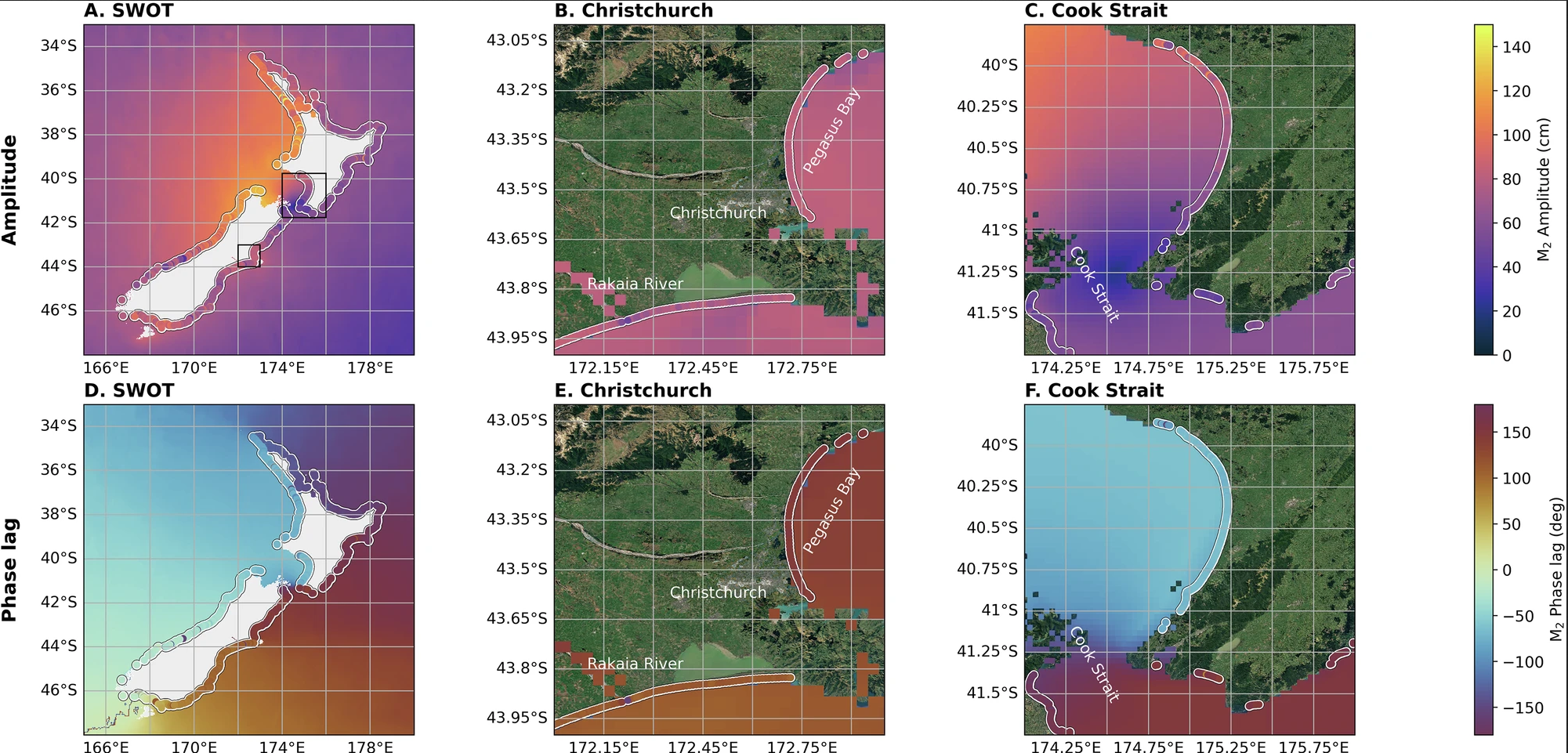
The amplitude (A) and phase lag (D) of the M2 tidal constituent derived from SWOT and the shoreline imagery. Shoreline estimates are outlined in white. Two regional assessments are presented around Christchurch (B and E) and the Cook Strait (C and F).

"phase lag" meaning compared to a baseline tidal cycle -> how behind and out of sync is that spot of shoreline/water from the overall regional tidal cycle? 180 degrees of course meaning the tidal cycle in that spot is opposite of what it is regionally/when viewed from a zoomed out perspective
2
3
1
submitted 1 month ago* (last edited 1 month ago) by supersquirrel@lemmy.ca to c/tidalpunk@slrpnk.net


link to open access paper https://onlinelibrary.wiley.com/doi/10.1111/rec.14169

This is a restoration success story. Despite being eradicated from the mainland, this restoration has shown that this functionally extinct ecosystem still has a heartbeat. Seeded by larvae supplied by the few remaining individual oysters, hectare-scale recovery is demonstrably possible when appropriate substrate is deployed in alignment with recruitment events (McAfee & Connell 2020). Many marine organisms possess traits that can enable rapid ecological change; e.g. short life histories and larval stages characterized by broad dispersal and high propagule supply (Carr et al. 2003). This means that coastal seas can be a soup of larvae dispersing without the physical barriers that restrict movement on land (e.g. roads and fences), so even degraded sites may still receive a high propagule supply from neighboring areas. These traits suggest that marine restorations are well placed to deliver rapid successes that provide optimism for repairing the sea (Duarte et al. 2020). Importantly, the success of this restoration rests with the main non-human collaborators, the oysters themselves. Indeed, it is the surprising resilience of these oysters, their capacity to endure centuries of exploitation and mismanagement, that provides inspiration and hope for restoration programs that can support a more sustainable future.

Such optimism for marine restoration must also be grounded in reality; marine systems are highly complex and ever-changing. Not all restorations will succeed, and many may require lengthy periods to achieve their goals. For example, a similar oyster reef restoration within the same gulf has developed comparatively slowly, possibly due to spatial competition from other rapidly colonizing organisms (i.e. McAfee et al. 2021b) or spatial variability in environmental conditions (e.g. food availability and water quality) that influence oyster performance (Leong et al. 2022). Additionally, it remains uncertain what impact the high density of these restored oysters may have on pathogen prevalence (Buss et al. 2019), and whether limited parent stock seeding of these reefs may create a genetic bottleneck among the restored population (Reynolds et al. 2012). And for restorations of ecosystems that were degraded before extensive study or recent social memory, limited knowledge on the historical community structure and function challenges decision-making, such as which species combinations and ecological services to prioritize.

4
5
6
7
8
9
10


With the Blue Marine Foundation, MRR launched an educational campaign over social media: #FishForTomorrow. Their goal was to broadcast information about the important ecological roles of the different species that were starting to show up in markets. They posted facts about parrotfish life spans, the amount of sediment they produce, and how they help make room for baby coral.

The community campaign went viral on social media, Hashim told Mongabay. Community members began posting videos with the hashtag of them releasing parrotfish that accidentally ended up on their lines; local scientists spoke out in support of the campaign; fishers began reaching out to Hashim’s NGO to thank them for their work. An online poll from MRR garnered 27,000 responses in the final days of the four-week campaign: Around 70% of responders supported the legal protection of parrotfish.

“It was really exciting to see that other people were appreciating what we were trying to do, and they were willing to join for free, voluntarily,” Hashim said.

The onslaught of positive local support for the campaign drove the Ministry of Fisheries, Agriculture and Ocean Resources to pass a new law in 2020, banning the “taking, catching, harvesting and killing” off all species of parrotfish within Maldivian waters. It had been years since the last fishing ban was passed in 1995, for the Napoleon wrasse (Crassilabrus undulatus).

Hashim said the ban put a stop to a worrying trend, preventing a commercial market from gaining traction in the local economy. Beyond that, she said the ban represented a rare success in species conservation.

11
12
 
 
  • The International Seabed Authority (ISA), the U.N.-associated organization that oversees deep-sea mining activities in international waters, held a council meeting July 13 to 24 in Kingston, Jamaica.

  • During the meeting, the council extended a deep-sea mining exploration contract for a subsidiary of The Metals Company (TMC), despite the company actively pursuing mining exploration and exploitation permits for the same areas through a U.S. government agency.

  • In addition, the council once again failed to finalize the rules needed for commercial seabed mining to commence, with many issues remaining unresolved.

13
14


In response to increasing coastal hazards, there is growing interest in nature-based solutions (NbS) to provide flood and erosion protection while maintaining ecosystem services and public beach access in California (Council, 2025, California Coastal Commission, 2025). Beach and dune nourishments are increasingly sought as sediment-based defenses capable of attenuating wave energy and reducing runup through dynamic sediment exchange (Myers et al., 2023, Grimes et al., 2025). However, despite widespread use and policy support, substantial scientific uncertainty remains about the long-term effectiveness and resilience of dune-based adaptation under extreme storms and SLR (Houser et al., 2015, Barnard et al., 2021, Griggs, 2024).

link to open access article https://www.sciencedirect.com/science/article/pii/S0378383926001043?via=ihub

15


Established in 2015, the Harbor Branch Seagrass Nursery cultivates native seagrasses in land-based tanks to populate depleted areas of the Indian River Lagoon. Urban development has eroded the coastal environment, resulting in the loss of seagrass, mangroves, and other coastal plants. These native species contribute to a healthy habitat, filtering water running off into the ocean and providing nursery grounds and homes for fish species and other marine life—such as stone crabs and oysters—which contribute to commercial fisheries. Mangroves provide a barrier against storm impacts and coastal erosion.

16


During a narrow spawning window that occurs just once each year, scientists will collect elkhorn coral (Acropora palmata) gametes released and fertilize them under controlled conditions. The resulting juvenile corals will be raised for future restoration efforts, helping preserve genetic diversity and strengthen the long-term resilience of Florida’s coral reefs. Once the dominant coral species on many shallow reefs, elkhorn coral plays a critical role in providing habitat for marine life and protecting coastlines from wave action.

The project, funded through NOAA’s Re5 (Resilient Reef Research, Rescue and Restoration) initiative, will result in juvenile corals from the wild being fertilized and raised in coral facilities for future restoration efforts.

17
18


A new study published in Frontiers in Marine Science tested five species to assess their potential for use in the restoration of degraded harbor habitats. Among the species chosen was the chicken liver sponge Chondrosia reniformis, which demonstrated an outstanding ability to adapt to these challenging conditions and thrive.

A grizzled old coral walks into the bar and sits next to a younger elkhorn

"Kid where I grew up..." the old corals fronds shake with coughing "...you had to be tough as the harbor sludge that descends on you every day".

19
20
21


Radioactivity is all around us. On land there are radioactive isotopes in vegetation, soil and rocks. In the ocean some of the places they accumulate are the seafloor massive sulphides of hydrothermal vents, the polymetallic nodules of the deep abyssal plains, and the sediment of the ocean floor. Because radioactive isotopes are safely bound up in mineral structures, marine life has successfully adapted to the ocean’s natural background levels of radiation.

Deep sea mining would crush and fragment nodules and sulphide deposits, dispersing debris for extensive distances. The outer layers of nodules (most likely to be disrupted) are particularly enriched in radioactive alpha particles. These have form as extremely dangerous wrecking balls for cells, protein and DNA. They can build up in tissues of marine life, and similarly to mercury, can amplify their way up food chains that eventually reach our plates.

The report: Critical Questions about the Risks of Radiation Toxicity from Deep Sea Mining

22


A single monitoring network [...] can simultaneously track earthquakes, water behaviour, human activity and whales, providing a comprehensive picture of what’s happening in, under, and at far distances from the water.

The researchers said the results show how a single network can capture multiple types of data, with potential applications for conservation and marine policy.

23
24


Researchers have uncovered a hidden feature beneath the Pacific Ocean that helps explain why Japan's devastating 2011 earthquake and tsunami became so destructive. The discovery also offers new clues that could improve forecasts of future megaquakes and tsunamis.

25
view more: next ›