No comment from me
This is a Dengist community in favor of Bashar al-Assad with no information that can lead to the arrest of Hillary Clinton, our fellow liberal and queen. This community is not ironic. We are Marxists-Leninists.
See this GitHub page for a collection of sources about socialism, imperialism, and other relevant topics.
This community is for posts about Marxism and geopolitics (including shitposts to some extent). Serious posts can be posted here or in /c/GenZhou. Reactionary or ultra-leftist cringe posts belong in /c/shitreactionariessay or /c/shitultrassay respectively.
We have a Matrix homeserver and a Matrix space. See this thread for more information. If you believe the server may be down, check the status on status.elara.ws.
Rules:
No comment from me
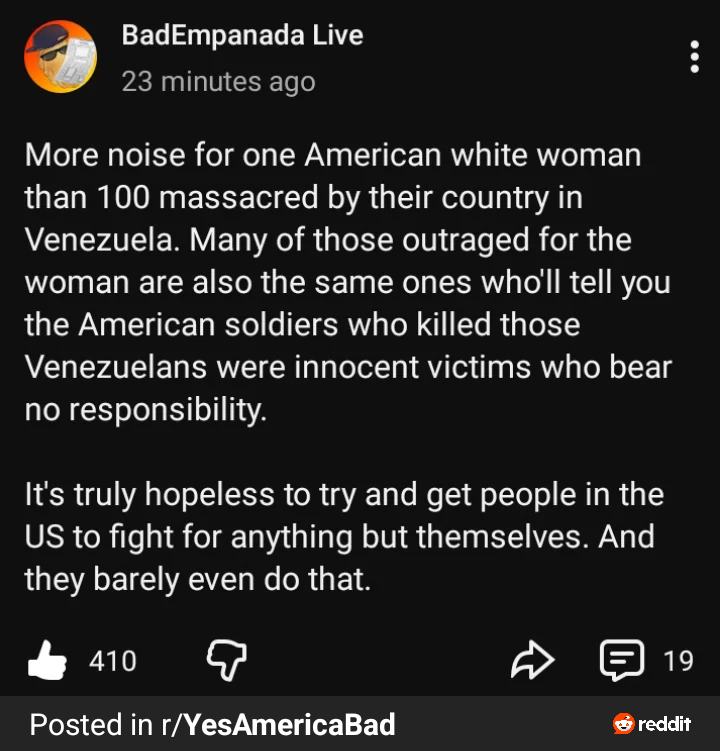
This is such a banger of a comment that if you ever get the chance please flesh it out into a post/substack/essay series etc and also with what you propose should happen from a dialectical materialist perspective (with citations etc). Only if you ever get the chance/time.
(If the person you're replying to reads this: please don't take this personally from me against you. I too am still learning and your posts are always an interesting read.)
Thank you for your reply I would like to go much more in depth at some point as I find it to be a very interesting topic but for now I think I'll simply point to a book and an essay that I feel each encapsulate part of the issue.
First is Guy Debord The Society of the Spectacle, this I feel brings to light the issue in advanced capitalist countries for spectacle to replace real action and interaction.
Second is Jones Manoel Western Marxism, the Fetish for Defeat, and Christian Culture, which I feel succinctly explains in some way why even the western left falls prey to the spectacular yet materially ineffectual parades and riots as opposed to real organized protest with mass organisation, concrete demands and an escalation plan.
As for “what is to be done,” as much as I'd love to simply say form a maoist guerilla force and overthrow your overlords, I don’t think the real answer is that interesting or that novel a concept even in the west. Politically meaningful protest (even in the West) has historically depended on mass organization, clear material demands, and a credible threat of escalation. During the civil rights movement, disciplined organizations like the NAACP and CORE coordinated sustained action, while local militant currents, such as the Deacons for Defense, made repression costly and instability plausible. Later organizations, including the Black Panther Party, built on these lessons, demonstrating how escalation coupled with strong organization could influence political outcomes. Without comparable structures, leverage, and escalation potential, protest tends to collapse into either brief outbursts or sanctioned displays, both of which the state can safely absorb.
Second one I am familiar with but the first I am not; thanks for the recommendation
For What Is To Be Done: I don't think we collectively we have an answer that does not end up being waiting for Global South spearheaded accelerationism but the latter is not good enough from a Westerner perspective - a materialist political movement also has to come from within as well. But as marxists we should make/stake claims in theory, even with the risk of being "wrong", and feel the response/heat we get from it to fine tune our practice (ie dialectics).
Lemmygrad is still susceptible to westernism (despite it being arugable one of, if not the best, reddit-like forums on the anglosphere. And I too am guilty of this) and comments like yours are excellent analyses of symptoms.
In the end the synthesis of theory and practice to sharpen and refine each other should be the main aim as highlighted by every successful revolutionary from Stalin to Ho to Chairman Mao. All I can realistically currently do for the Western left is wish them luck and provide critique and observation from a hopefully at least somewhat novel perspective.