Title text:
Imagine you could ride alongside a sound wave. It would probably be pretty cool, right? We're putting in a departmental budget request to buy a really fast plane so we can check it out.
Transcript:
Transcript will show once it’s been added to explainxkcd.com
Source: https://xkcd.com/3238/
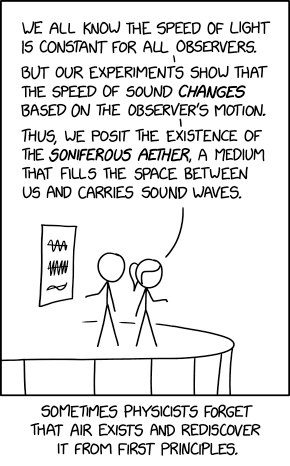
The soniferous aether was known as akasha in ancient vedic philosophy. Akasha was the tattwa of "space" and functioned like a quintessence in that system, basically being the first tattwa produced by the exhalation of Brahman, from which the other four tattwas are subsequently formed.
The tattwa of air was vayu, the odoriferous aether
Then there were also apas, prithivi, and tejas (water, earth, and fire); each aether assigned to a different sense (taste, touch, and vision).
Basically, the way akasha would form into the other aethers was by slowing down vibrationally (the snake was a common symbol for vibration, especially in the Kashmir region, and is very much associated with the iconography of Shiva the Destroyer). So if akasha was the fastest vibration, next was tejas, then vayu, then apas, and finally prithivi.
Akasha was said to be egg-shaped, tejas triangular, vayu circular, apas crescent-shaped, and prithivi square. Thinking about how each state of matter behaves, this makes sense as far as early intuitions go.
So even though from the standpoint of modern science, we know these are not the real building blocks of the universe, I find they are surprisingly close to accurate for something that was theorized thousands of years ago. Closer than their western counterparts, certainly, although there are some interesting similarities if you want to pick those apart (try starting with Plato's Timaeus, for instance).
But ultimately, even though they didn't have electron microscopes to actually confirm or disprove their theories, they got a few things right: 1) Atomism, or the basic building blocks of the universe being tiny, unseeable particles that everything else is constructed from; 2) States of matter are made from the same materials, only vibrating at different rates; 3) The five main human senses are determined by interactions with matter as a medium of energy transference.
There are probably more, but these are the main ones. For instance, when you dig into the shapes of the tattwas you see how the spherical nature of vayu gives it the properties of taking on the size and shape of its container; the tetrahedral shape of tejas causes it to rise and expand; the crescent shape of apas causes it to fall, cohere, form droplets, and take on the shape of its container; the square shape of prithivi causes it to hold its form, stack and tumble, and generally behave as solids do.
The shape of akasha is a bit more of a mystery because how do you truly describe the shape and behavior of empty space? But ultimately it makes sense within the system, because space is the "cosmic egg" within which the embryo of the universe is nurtured (theoretically, when it "hatches," this is like Vishnu waking up from the dream; cosmologically similar to the "inhalation of Brahman," when everything returns to Source).
Atomism wasn't correct though. Atoms aren't indivisible and they're not the smallest unit reality has.
"States of matter are made from the same materials, only vibrating at different rates."
Well yes, but they only identified one material correctly, water. And us being mostly made of it and our planet being quite blue, and water being water, quite obvious.
That's a common myth, but it's a misconception stemming from history and not anything any actual neuroscientist believes. We don't have 5 senses. We have like 10 to 20, they're still arguing about it. But here's the main six and theyre thresholds (ofc everyone knows these ones but the thresholds seem quite interesting, and believable, like in a "yeah I could do that" way)
And a bit of copypaste from Reddit where someone has nicely listed these...
So yeah I read some of your comment, I can see how those can be interesting metaphors when you're into that literature, buuut... that's about it.