Title text:
Imagine you could ride alongside a sound wave. It would probably be pretty cool, right? We're putting in a departmental budget request to buy a really fast plane so we can check it out.
Transcript:
Transcript will show once it’s been added to explainxkcd.com
Source: https://xkcd.com/3238/
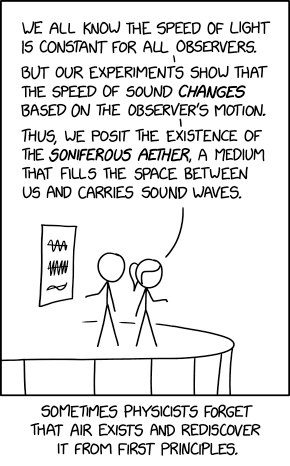
Not really. Yes of course that is a relevant effect. But photons travel as slower speeds in different materials. Thats what the refractive index indicates of a material.
Edit wait I meant to post this to the other dude, sry. I'm just gonna literally double down.
In 1999, she led a Harvard University team who, by use of a Bose–Einstein condensate, succeeded in slowing a beam of light to about 17 metres per second, and, in 2001, was able to stop a beam completely.[2] Later work based on these experiments led to the transfer of light to matter, then from matter back into light,[3] a process with important implications for quantum encryption and quantum computing.
https://en.wikipedia.org/wiki/Lene_Hau
Not to split hairs here, but that's also kind of the same thing.
Like what does "refractive" mean? Does it mean moving slower or bouncing around?
Well the name refers to the relative incident and internal angles because that's what scientists first measured. The light slows down due to interactions with the electrons (mostly) in the material. It causes them to move which drags the light. You can model this as an interference from the light produced by the resulting electron movement. I don't see that as bouncing, especially not like the bouncing on the internal surfaces of fiber optics. But obviously it's not like anything we can tangibly understand, so whatever mental model works for you is cool.
That's fair. Nearly everything at that scale is up for interpretation. I find that nothing in physics works the way it intuitively seems like it should.
In 1999, she led a Harvard University team who, by use of a Bose–Einstein condensate, succeeded in slowing a beam of light to about 17 metres per second, and, in 2001, was able to stop a beam completely.[2] Later work based on these experiments led to the transfer of light to matter, then from matter back into light,[3] a process with important implications for quantum encryption and quantum computing.
https://en.wikipedia.org/wiki/Lene_Hau