this post was submitted on 12 May 2026
1129 points (99.2% liked)
A Boring Dystopia
16636 readers
1282 users here now
Pictures, Videos, Articles showing just how boring it is to live in a dystopic society, or with signs of a dystopic society.
Rules (Subject to Change)
--Be a Decent Human Being
--Posting news articles: include the source name and exact title from article in your post title
--If a picture is just a screenshot of an article, link the article
--If a video's content isn't clear from title, write a short summary so people know what it's about.
--Posts must have something to do with the topic
--Zero tolerance for Racism/Sexism/Ableism/etc.
--No NSFW content
--Abide by the rules of lemmy.world
founded 2 years ago
MODERATORS
you are viewing a single comment's thread
view the rest of the comments
view the rest of the comments
Where does the water go afterwards, and it's it usable still?
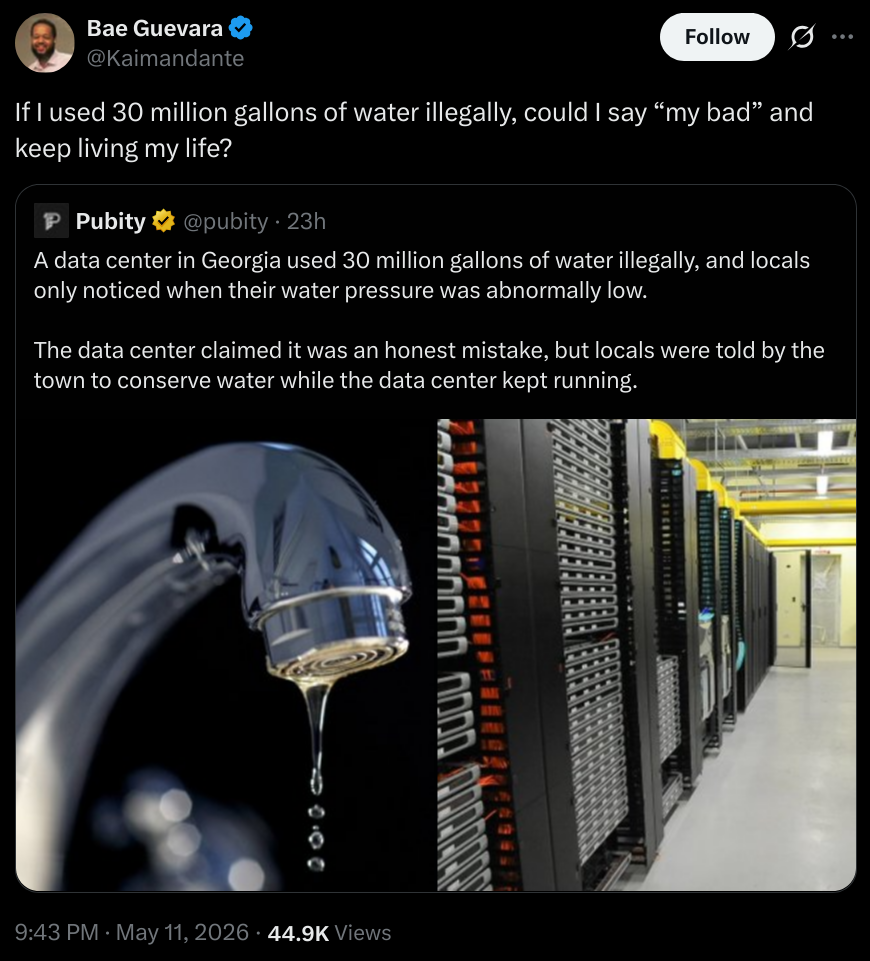
This was actually used during construction work. This particular data centre is closed loop and won't use much water at all once it's built.
From the actual article:
Data centres with evaporative cooling can use huge amounts of water. Whether that's bad/dangerous depends on the location and the water supply. That does go back into the water cycle, it's not like fossil fuels where the resource gets destroyed but there are places where data centres are contributing heavily to droughts or water shortages and causing water prices to rise and are dumping hot water into waterways which kills wildlife and encourages things like algal bloom and bacterial growth etc.
Usually that's in places where there are regulatory failures and underfunded environmental protection. Usually the same places you find mass runoff of agricultural phosphates, PFAS and similar polyflural dumping from chemical plants etc. Where corporations pay their way into regulatory capture.
It's a real serious issue that's nuanced. Not every data centre is being built for AI (a huge amount is for video encoding and streaming all these tiktooks, reeliess, tubes and netting flixes) and not every data centre is an ecological disaster. A lot are also building their own solar and batteries because in some places its cheaper long term than paying for the grid. There's also a bunch building/buying shitty gas or coal plants for the same reason.
The electricity generation can also eat more water because power plants need cooling too. Again, the ecological impact of that is hugely dependent on the location.
Essentially, it's a big nasty problem that is complex and situational and different in different areas, that is easy to simplify to "AI is destroying all our water!" in order to get quick clicks and outraged interactions.
"Evil AI Data Centre Steals Town's Water Supply!" Is a much snappier headline that gets shared much farther than "Construction Site Screws Up Their Pipes and Water Meters then Pays Their Water Bill!"
You may trust them.
Very few places recycle the heated water. Warm climates can't cool it at all. It takes more energy to cool down the warm water so they usually send it down the drain.
I have never heard of the water being reused like this in practice. The majority of datacentres I have seen in Europe have a closed glycol loop and a large air based cooling array (i.e., air handling units), the remainder have adiabatic cooling.
Ah yes, the modern version of polluting rivers.
Or maybe they should do something that doesn't waste a ton of energy to rip off people's work and poison the internet.