Title text:
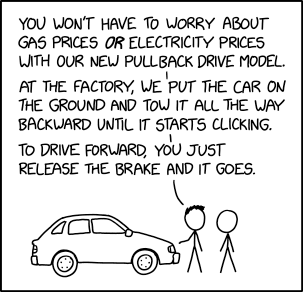
"How does the spring not run out almost immediately?" "We pull it back REALLY far."
Transcript:
Transcript will show once it’s been added to explainxkcd.com
Source: https://xkcd.com/3244/
A community for a webcomic of romance, sarcasm, math, and language.
Title text:
"How does the spring not run out almost immediately?" "We pull it back REALLY far."
Transcript:
Transcript will show once it’s been added to explainxkcd.com
Source: https://xkcd.com/3244/
I heard about a version that used springs as well. Basically a pull-back car: When you break, it puts tension on the springs, then it releases that tension when accelerating. Apparently it was very good for city-driving, since you get an absurd number of cycles with very small "charges", which makes it very good when you do a lot of start/stop driving in slow traffic. I'm not sure why I haven't heard any more about it in more recent years.
*brake*
Idk about you, but I usually build tension when I break.
I build tension before I break, but maybe I'm weird.
That's right the actual moment of breaking usually releases tension, but the overall process of breaking includes building it up!
Maybe its some sort of human degradation fuel system, as you break down it powers the car?
Bcz springs wear out is my guess. That's the first thing I'd worry about in the design is how many cycles can it handle before performance is degraded. Might be a lot, but even if it's a couple years, people aren't going to be happy when their car performance suddenly drops off right after they finish paying the thing off.
You're probably right, at the same time, a spring that isn't overloaded can usually take an absurd amount of cycles: Just think about how long the suspension on a car typically lasts compared to a lot of other parts.