It seems the fediverse is continuing and growing again. Line go up is probably good!
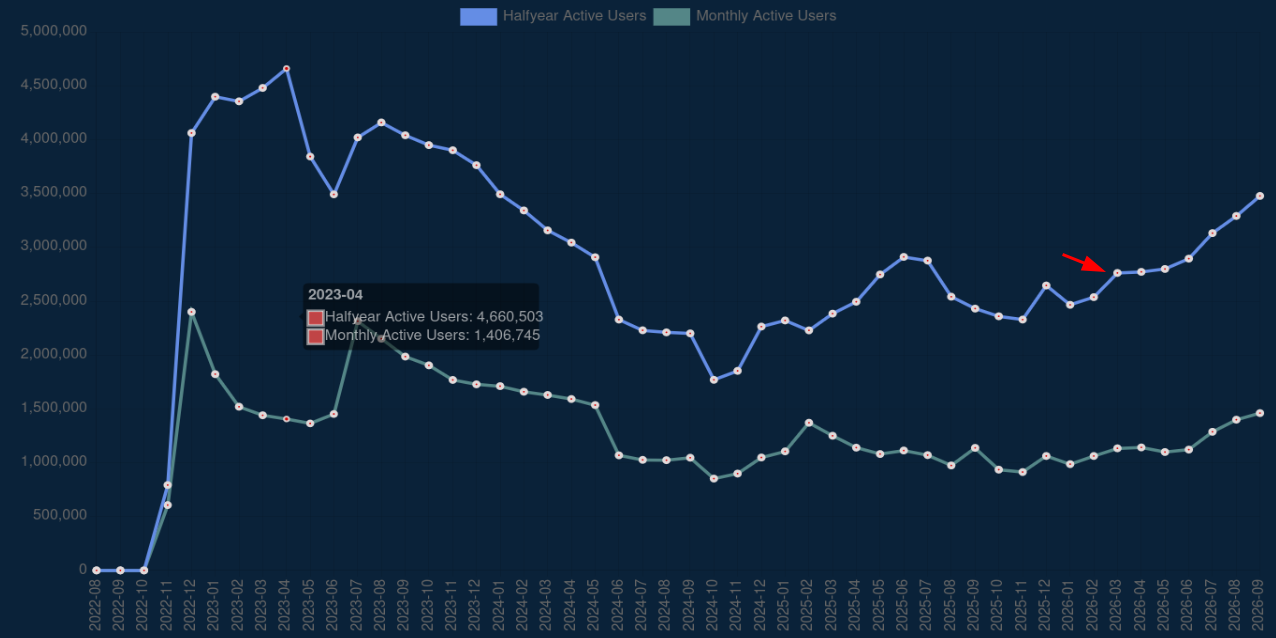
https://fediverse.observer/stats&months=50
Total users are huge now.
There are many websites out there that pull data from the fediverse. So take that with a grain of salt. But anecdotally I am seeing a small rise in people using the various platforms as each get more mature and servers somewhat stabilize.
Yeah, you can tell, way more conservative liberals on here than there used to be.
Isn't that an oxymoron? How can you be both conservative and liberal?
You can't. He's trying to use liberal as an epithet when he means neoliberal. If we're being pedantic, liberal refers to the full gamut of people who think there should be an open and free society, which usually includes a market and certain property rights. The conservatives use liberal as an epithet to decry the left and now the left is using it to decry the middle.
It would be funny if it wasn't being used to convince naive progressives to sit out elections and let fascists seize power because the center left "only" wants 85% of what they want. You're seeing it really ramp up because the US is closing in on a big election, and convincing dipshits to sit out elections is easier than convincing anyone the right can govern.
This isn't really accurate. Liberalism and private property rights are fundamentally tied, that was how it historically emerged. Neoliberalism is a subset of liberalism that emphasized privatizing the welfare states that emerged throughout the 20th century as these states ran into crisis of profitability.
The left has opposed liberalism as soon as socialism began to truly take form, especially around the time of Karl Marx and the first international. Saying that the left and progressive liberals want "85% of the same things" is not true at all, the left wants to fundamentally change the entire base of society into a socialist one, not merely expand the welfare state in capitalism, because the main critique from the left is that capitalism itself is unsustainable and incapable of fulfilling the needs of the working class.
Leftists also support revolution over reformism, and do so year-round, every year. It's not that the left gets louder around election season, it's that those that see voting as their sole means of political action tend to notice the left more around election season. This in turn leads to more conversations around reformism vs. revolution, the nature of the capitalist system, and the role of the DNC and GOP in protecting imperialism and capitalism. The US is run by billionaires, it has never been run by the people, because the base structure of society is one where a tiny number of people own and control the means of production and distribution.
This all sounds philosophical. How does this system actually solve problems in a society where scarcity exists? Do people still have property rights? Who enforces those rights? Who makes the decisions on where scarce resources are allocated? Our current system has answers for all of these questions, it's just contaminated by the influence of powerful scumbags. The thing is, the powerful scumbags are going to be scumbags in every system, and at least a decentralized market economy limits the ease with which they can exert control.
Philosophy is a core component of Marxism, just like it is of liberalism. Philosophy is essentially the worldview and methodology behind ideologies. Liberalism is generally metaphysical materialism, when science first overturned the feudal idealists. The philosophy of Marxism is dialectical materialism, which advances from metaphysical materialism through developing our understanding of interconnection, development, and processes.
Q: How does this system actually solve problems in a society where scarcity exists?
A: I don't see how scarcity is a problem. Production is already socialized and deeply interconnected, the problem is that distribution is based on individuals owning the means of production and distribution. Collectivizing private industry doesn't mean we suddenly forget how to produce and distribute.
Q: Do people still have property rights?
A: As a matter of course, private property is sublimated into social property gradually. The material base of marketized production is in decentralized, scattered production. The material base of socialized production is in large, centralized industry. Markets naturally move towards the latter, which causes a conflict between the new economic base and the old method of distribution.
Personal property is to be respected and understood as that which people themselves use.
Q: Who enforces those rights?
A: Before production has been collectivized fully, classes will still exist, and thus the state must be under the control of the working class in order to actually enforce this. After all production is collectivized and owned socially, the mechanisms of the state that only existed to protect this status cease to have a purpose, and fade into irrelevance.
Q: Who makes the decisions on where scarce resources are allocated?
A: Administrators, workers that have been selected through democratic processes to make such decisions, both at local and larger scale levels. Think local councils, with delegates to higher councils, and delegates to higher councils. The fewest rungs necessary for effectiveness and the greater the level of participation in all levels, the better, but this depends on the level of development of the material base.
Incorrect. Capitalism necessarily is run by capitalists. There can be no worker control in capitalism, because capitalists already dominate the base of society, the means of production and distribution. The state exists to reinforce the base, not outside of the class struggle. Further, capitalism itself runs into crisis, such as the tendency for the rate of profit to fall over time.
The longer capitalism goes, the more centralized and more disparity rises, the more it risks total collapse. Production increasingly gets socialized, while a smaller and smaller group of people keep the spoils. This is skyrocketing in recent years, but has been steadily and gradually accelerating since the inception of capitalism as a system.
It cannot be fixed by replacing people, because the problems of capitalism are core to how it functions. Billionaires will always control capitalism until capitalism itself collapses. There is no such thing as a "decentralized market economy" any longer. Markets have long surpassed the level at which they play a progressive role in the developed countries. A tiny minority of companies control the vast majority of total production. Free market capitalism died long ago.
We reached the imperialist stage of capitalism in the turn of the 20th century, when bank and industrial capital merged into financial monopoly. These monopolies expand outward, fighting each other over domination of the global south. This was the primary cause of World War I, and it extended into World War II. After World War II, the world began to be dominated by the US, the dollar, its millitary. After a crisis in profitability, Reagonomics unleashed neoliberalism, saving capitalism temporarily by privatizing the safety nets created by FDR and destroying worker organizing. This is now reaching its own crisis, accelerated by the AI bubble.
The capitalist system doesn't weaken the control of scumbags, it entrenches them to the highest possible degree, and ensures that over time it will only get worse as production continues to centralize and wealth concentrates in fewer and fewer hands. The only solution is collectivizing the economy and running it according to a coherent, scientific, collective plan.
It just seems like this system is capitalism with extra steps, but the extra steps involve replacing the exchange of money with the peddling of influence. The capitalists are replaced by administrators, the hierarchy of wealth is replaced by rank in the decision-making apparatus. I get that it's supposed to be democratic and protect the interests of the public, but so too is our regulated hybrid public-private system and we see how well that's going. It also seems like, where our market system began as distributed and decentralized, which was a strength, and began to be ever more concentrated as businesses consolidated and corrupted government, this new system starts consolidated and married to government. A lot of people would say this is too much power in the hands of the state, and ripe for theft by an autocrat. I'm not saying it's impossible for this to work, but the systems I have seen work best are those where the market does what it does and the government reigns in its worst tendencies when the motive of profit conflicts with the needs of people.
The key disconnect is that the state itself is a product of the base of society. Marxists do not posit that we should merely merge with existing government and take it over, but smash the state apparatus and replace it outright. The capitalist systems of today, despite having a public sector, are entirely controlled by capitalists. The socialist states of today and the future, despite having private sectors, are thoroughly controlled by workers. Look at Cuba, and what it's able to achieve despite incredible blockade and sanctions. Look at China, where the underdeveloped parts are marketized and the developed parts are public, they even have a handy chart on what socialist construction looks like:
This is where philosophy comes in. Right now, your analysis is metaphysical. You see that in the past the market was more decentralized, and now that it is highly decentralized, you are trying to work backwards. This isn't how human societies progress, though. This new economic base that capitalism has created is already compatible with planned, social ownership. There is no such thing as a static system that is not evolving into something.
Dialectics helps us understand that capitalism has already played its progressive role, and that now it's time for workers, who already run the world, to take charge of it and own it. Marxism is a more scientific way of viewing the world than liberalism allows for, because metaphysics traps us in outdated forms of science, just like evolution proved older, metaphysical forms of biological categorization to be incorrect.
Yeah the leftists war against liberalism started recently [checks date] oh I didn't know we are living in 1845.
Person below is using an incorrect understanding of liberalism too (economic).
When I say liberal, I'm referring to the political philosophy of liberalism, which is rooted in individualism and capital, and emerged through the cisheteropatriarchal and white supremacist system of settler-colonialism. People perceive of this as meaning "progressive" or "freedom" because much of the early rhetoric surrounding liberalism (such as the early republican era in the Americas) involved a claim to moral righteousness under the guise of individual freedoms. Liberalism is the philosophy of capitalism as an economic system (which the other commenter here misidentified as liberalism), but it would be distortive to not recognize the specificities of either respectively.
Since liberalism has been the proponent of capitalism and EuroAmerican imperialism for the past couple centuries, it has developed a durability through the appropriation and subsequent assimilation of potentially challenging political movements; such as those based in social justice. Consequently, liberals have effectively coopted the language of equality and progress as natural elements of its politics, despite it consistently disarming and presently continues its genocidal campaign against vulnerable groups.
Conservatism is less a cohesive set of politics than it is the rhetoric of liberals with grievances about the failure of the system to deliver the privilege they feel entitled to, and which this system does assure them. So, a conservative liberal may vaugely subscribe to the notion of "anti-racism" but will inevitably subscribe to racist values that are more consistent with the imperatives of a white supremacist system than they are challenging of it.
Most people in Europe and North America subscribe to liberalism. Most liberals lack a level of political literacy to identify how they subscribe to it, and many mistake themselves as "leftists" or non-liberal "conservatives," even though their values are actually closely aligned. Since I genuinely do not subscribe to liberalism, many liberals on Lemmy self-report when they take issue with some genuine anti-racism, or any anti-bigotry in general when it doesn't align with their comfort level (most of which have been Canadians or Euros who feel free to openly express these views with the confidence that they're "better than Americans").
I really do not get your point of tying liberalism with colonialism. Fact is that colonialism was done by European monarchies which weren't liberal states at the time. The power structures were feudal. They were only beginning to transition into liberal democracies.
I'm sorry, could you explain how colonialism was confined to, based on what you're saying here, at latest the eighteenth century? Even then, you're saying you don't understand how a political system that emerged in the exact places colonialism benefitted represents a political system that emerged out of colonialism?
Colonialism peaked in 19th century when countries doing it werent liberal democracies. Universal suffrage for men became thing only at the end of century. But widespread demands started in 1848. Before that voting was restricted to income/tax/property.
Not all european liberal democracies had colonies. But it is true that those countries that had them, didn't decolonize after liberalization.
Oh, lying. Well, that makes the most sense, really.
No, liberalism ("liberal democracy" is a bit of a misnomer) did not only emerge at the end of the nineteenth century just because you want to pretend it only counts as liberalism when it includes you. As I said in my original comment, liberalism has always used the rhetoric of freedom and equality while enforcing fundamentally unequal and oppressive systems of power. No, it doesn't start being "real" liberalism when non-property owning men get the right go vote (which, source on thar weirdly specific and inaccurate 1848 date? Go look up Jacksonian Democracy in the 1820s and -30s,, it was something widely demanded from the beginning of the United States). By this merit, there is no such thing as liberalism today, because it isn't an idealized version of itself yet; literally a rationalizing narrative to construct the violence of liberalism not as an inevitability or necessity of this system, but an unfortunate failure of it to live up to the "real" liberal values.
I could tell this was some Euro pro-imperialism narrative before you got to that second section too. This is the kind of historical revisionism they typically deploy to make this brutal system seem coincidental with rather than emergent from the violence they inflicted on the world. No, liberalism does not only need to exist in states that we associate with colonialism (even if it did, it wouldn't be accurate to act like borders stopped material interests in a system of colonialism). Liberalism came from systems that did rely on settler-colonialism for a reason, which is the same reason why the system of knowledge production on race, gender, ability, ethnicity, and humanity that we are forced to engage with happens to construct human life around the imperatives of that system. Could you explain how you're conscious of colonialism while only discussing its system in terms of its most privileged benefactors?
To others who come across this, this user is the exact kind of liberal conservative I'm talking about, and go figure, they're a Euro like I said they'd be.
Conservatives are a subset of liberals.
So are almost all progressives.
Sure, at least those that call themselves progressives. The left begins at anticapitalism, which is a hard break from liberalism.
I wouldn't say that. Conservatism, at its core, is about preserving a specific way of life, while liberalism is about finding a balance between a laissez faire form of governance and having an ordered society. They aren't congruent in terms of political policy.
https://en.wikipedia.org/wiki/Liberalism
Conservatism depends on the context within the nation, but Anglosphere conservatives at a minimum work within a liberal democratic context. Everything listed under ideological liberalism is something "conservatives" used to claim as their values.
Used to. That "conservatives" are openly embracing fascism as their "third way" is reflected in that very Wikipedia article which has been radically changed from it's state even from last year as I recall.
That the article has been changed to claim the "three main ideologies" of the past century as "liberalism, socialism, and conservativism" is some straight up scary revisionist nonsense. Just ask yourself which of those three fascism belongs to and you'll understand why.
Churchill was a Conservative. The Australian Liberal Party are conservatives, etc etc etc.
In other words, there is the ideological definition of liberal, of which conservativism is supposed to be a branch, and there's the casual usage that means "right winger" and that is contextual and rapidly coming to mean fascist.
This is basically it. Classic liberalism is everything from Margaret Thatcher to Bernie Sanders. The MAGA movement has regressed to fascism--a form of corporate authoritatianism.
I don't think that means that conservatives are liberals, I think that means that they're liberals who changed their minds or abandoned their values.
Liberalism is a conservative ideology. Conservative meaning maintaining the status quo, which liberalism does for economic, foreign, and social policy
Edit: down vote all you want but it is true. The last time liberalism was progressive was when the divine right of kings was law of the land.
Political ideologies can broadly be categorized as reactionary (supports a real or perceived status quo ante), conservative (supports maintenance of status quo), and progressive (supports developing new systems). There are the axes of social views, economic views, etc that we apply these to. The major political parties in the US are centered around variants of liberalism, the ideology of individual rights and private property, which is focused on the status quo of imperialism, discriminatory social hierarchies, and capitalism. There are those who think these systems don't go far enough in their repression, especially but not exclusively within the GOP. They are reactionaries. Progressive ideologies only find any foothold on the very fringes of the DNC, but they are fighting against the policies and institutions of the party itself, not really influencing it fundamentally.
liberalism refers purely to economic policy everywhere except for the united states, and that is very much compatible with conservative views on social issues.
Liberalism is a right-wing ideology. Completely capitalist and authoritarian. It's a major source of overt fascism.
Oxymoron the pimple cream for idiots!
No, it’s the worst kind, half in and half out