this post was submitted on 22 Oct 2026
468 points (98.3% liked)
pics
30175 readers
624 users here now
Rules:
1.. Please mark original photos with [OC] in the title if you're the photographer
2..Pictures containing a politician from any country or planet are prohibited, this is a community voted on rule.
3.. Image must be a photograph, no AI or digital art.
4.. No NSFW/Cosplay/Spam/Trolling images.
5.. Be civil. No racism or bigotry.
Photo of the Week Rule(s):
1.. On Fridays, the most upvoted original, marked [OC], photo posted between Friday and Thursday will be the next week's banner and featured photo.
2.. The weekly photos will be saved for an end of the year run off.
Instance-wide rules always apply. https://mastodon.world/about

founded 3 years ago
MODERATORS
you are viewing a single comment's thread
view the rest of the comments
view the rest of the comments
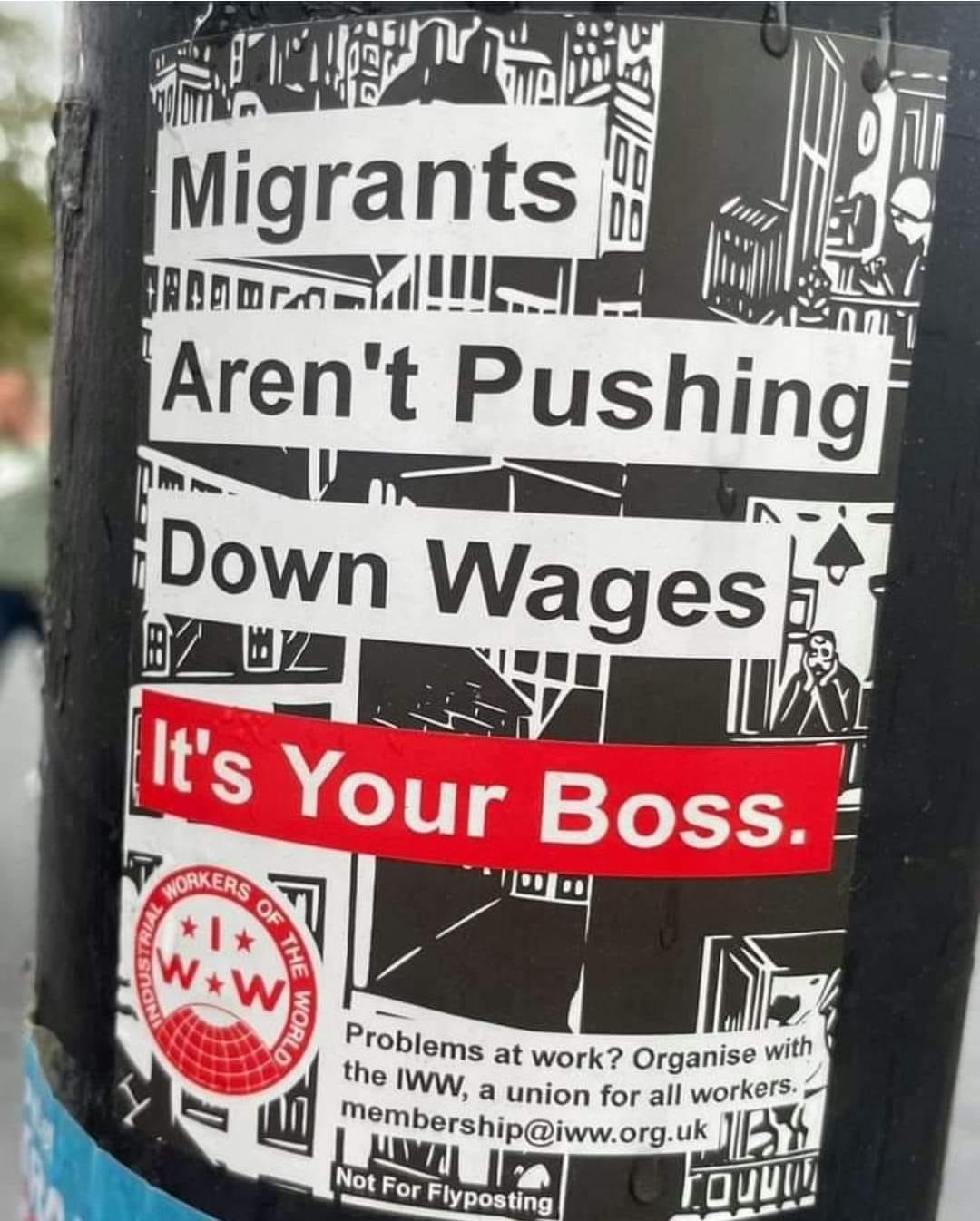
It is most certainly in the business's interest to pay the absolute minimum possible
But is this not basic supply and demand? More people wanting a job pushes the price down, migrants are more people
More people isn't just more supply, it's also more demand. More people means more customers.
What about when they're temporary, and go back home with their money?
What about when they come from a country so desperate and poor that they're terrified of being forced to go back, and so they'll do anything for work, even work half of minimum wage? You don't think that might drive down wages?
What if they're so terrified that they won't form a union? Shouldn't the IWW care about that?
What if this is all a trick by the capitalists themselves?
There are very few businesses that increase staffing 1:1 proportionally with customers
And? I'm talking broadly about the economy, not one particular business.
That's just deflecting from the fact that more people job seeking means lower wages, without even considering that people moving from poorer countries will typically work for less
How is that a deflection? It's a direct refutation of your central point.
When a person moves in and takes a job at a grocery store, they aren't just a customer for the grocery store. They are a customer for clothing stores, movie theaters, appliance stores, barbers, restaurants, mechanics, etc.
To simplify things to "basic supply and demand" levels: if you have 20 businesses in town which each staff at a 1:20 ratio, 20 migrants moving into town and shopping at those businesses, increases supply exactly in proportion to the increase in demand.
It's reductive, but then "basic supply and demand" is itself extremely reductive. It's a drastic simplification to illustrate basic concepts, like frictionless surfaces and spherical cows in Physics 101. "Basic supply and demand" is not how economies actually work, it's a simplified model for Econ 101.
But then you're being reductive, because that person could very well just be taking their money back home with them. Because as you say, it's not just as simple as that. The person above you has a point.