Not many scientific studies sound like a Bond film, but ours really does involve lasers, sharks and doctors (of research, not the evil kind).
From Biology News - Evolution, Cell theory, Gene theory, Microbiology, Biotechnology via This RSS Feed.

Israeli soldiers beat and tortured flotilla organisers Saif Abukeshek and Thiago Ávila after abducting them in international waters near Greece in the early hours of Thursday morning, lawyers and diplomats have said.
After illegally intercepting 22 boats and kidnapping around 200 activists hundreds of miles from Gaza, Israel transferred the majority to Greek authorities, but refused to release Abukeshek and Avila. Instead, it transported them back to an Israeli desert prison, where Palestinians are routinely tortured.
Brazilian activist Ávila was dragged face down across the floor and beaten so badly he passed out twice, lawyers said, after they were finally able to visit him on Saturday. His wife, Lara Souza, said in a video that a Brazilian embassy official told her he had been temporarily blinded by his injuries, with his left eye remaining swollen shut, but he was being denied medical treatment. In a brief visit, where he was separated from the consul by a glass screen and not able to speak freely, he reported pain all over his body, especially in his hand and shoulder, and said that soldiers had threatened to throw him overboard and target his wife and two-year-old daughter.
Abukeshek, who had been sailing on an observer boat and did not intend to go to Gaza, was “in shock”, his wife Sally Issa said. He was forced to lie face-down on the floor of an Israeli warship for two days, lawyers said, blindfolded and with his hands bound behind his back.
Spain has demanded Israel release Abukeshek, who is Palestinian but has Spanish and Swedish citizenship. On Friday, prime minister Pedro Sánchez said he had been “illegally abducted by the Netanyahu government”.
Foreign minister José Manuel Albares later told a radio station the arrest was made “outside the jurisdiction of Israel”. “Of course, it is a kidnapping,” he said.
Hannah Smith, who runs the Global Sumud Flotilla’s media operation, said in a video that Abukeshek had Palestinian identity documents, “putting him in a legal context that we’ve never seen with participants before”.
“We do not know how the Israeli regime will handle his case,” she said, “they can try him just as they would any Palestinian.”
Adalah, the law firm supporting the two men, said they had reported being interrogated by Israel’s Shin Bet security service. Ávila said he had been told he would also be interrogated by Mossad, on suspicion of “affiliation with a terrorist organisation”.
On Sunday, both activists appeared in Ashkelon magistrates’ court, where a judge extended their detention by a further two days.
Adalah said the Israeli state attorney presented a list of suspected offences, including “assisting the enemy during wartime, contact with a foreign agent, membership in and providing services to a terrorist organisation, and the transfer of property for a terrorist organisation”.
No formal charges have yet been filed against either Ávila or Abukeshek, and Adalah said Israeli authorities had refused to provide details of any of the offences they are being interrogated over.
Lawyers demanded both men be immediately and unconditionally released, telling the court the entire process was “fundamentally flawed and illegal”, and describing Israel’s actions as a “retaliatory measure against humanitarian activist leaders”.
They challenged the state’s jurisdiction, arguing that there is “no legal basis for the extraterritorial application of offences to the actions of foreign nationals in international waters”.
In a statement, Adalah said: “The treatment of the two activists, including the use of isolation, prolonged blindfolding, and physical beatings, constitutes a grave violation of international law.”
Meanwhile, Smith, who was on one of the boats that was intercepted on Wednesday night, urged people to “mobilise” for Ávila and Abukeshek. “As someone who was thrown around, who was threatened to be killed, as someone who has seen two of my best friends taken, I ask the world: what kind of world do you want to live in?” she said. “And if you want to live in a better one than this one, you need to act, you need to mobilise.”
Ávila and Abukeshek have now been transferred back to solitary confinement in Shikma prison, where they are being held in windowless cells.
Both are on hunger strike, with Avila saying he will not accept release without Abukeshek.
From Novara Media via This RSS Feed.
Dinosaurs are among the most majestic and iconic animals to have ever walked on our planet. While they are now extinct, they are estimated to have inhabited Earth for over 165 million years.
From Biology News - Evolution, Cell theory, Gene theory, Microbiology, Biotechnology via This RSS Feed.
In February, the United States Department of Agriculture announced two proposed changes to federal rules governing the rate of production in meat processing plants — a move advocates say would endanger workers, public health, and the environment. One proposed amendment would raise the maximum line speeds in poultry slaughter from 140 birds per minute to 175 for chicken and from 55 birds per minute to 60 for turkey. For swine slaughter, the agency is proposing there be no cap on line speed at all.
Last week, the public comment period for the proposed amendments came to a close. If finalized, these changes would “lower production costs and create greater stability in our food system” as well as help “keep groceries more affordable,” said Secretary of Agriculture Brooke Rollins back in February.
The proposals are in line with other Trump administration policies that encourage higher meat consumption among Americans — like the revised food pyramid with its emphasis on eating more protein. But despite the promise of lower costs and higher efficiency, experts say these proposed rollbacks pose more risks than benefits to the public.
“This is doubling down on an already broken and polluting food system,” said Dani Replogle, staff attorney at Food and Water Watch, an environmental nonprofit that submitted public comments against the proposed rules.
The USDA will need time to review the tens of thousands of comments submitted, but the United Food and Commercial Workers, or UFCW, a union that represents workers along the food supply chain, estimates that over 22,000 comments oppose the poultry rule, along with over 20,000 oppose the pork rule.
The union — which successfully sued and blocked the USDA from enacting a similar change to swine line speeds in 2021 — stresses that increasing line speeds in meat processing will result in more injuries for workers. While various parts of the line in these facilities are automated, the beginning of the line — where animals are corralled into the plants — is notoriously backbreaking and dangerous work. For chickens, workers who hang the birds by their feet often end up covered in fecal matter; in swine slaughterhouses, workers on the “kill floor” move pigs into stunning chambers. In both scenarios, unlike climate-controlled segments of the line, workers are exposed to the elements and face heat stress on very hot days.
Read Next
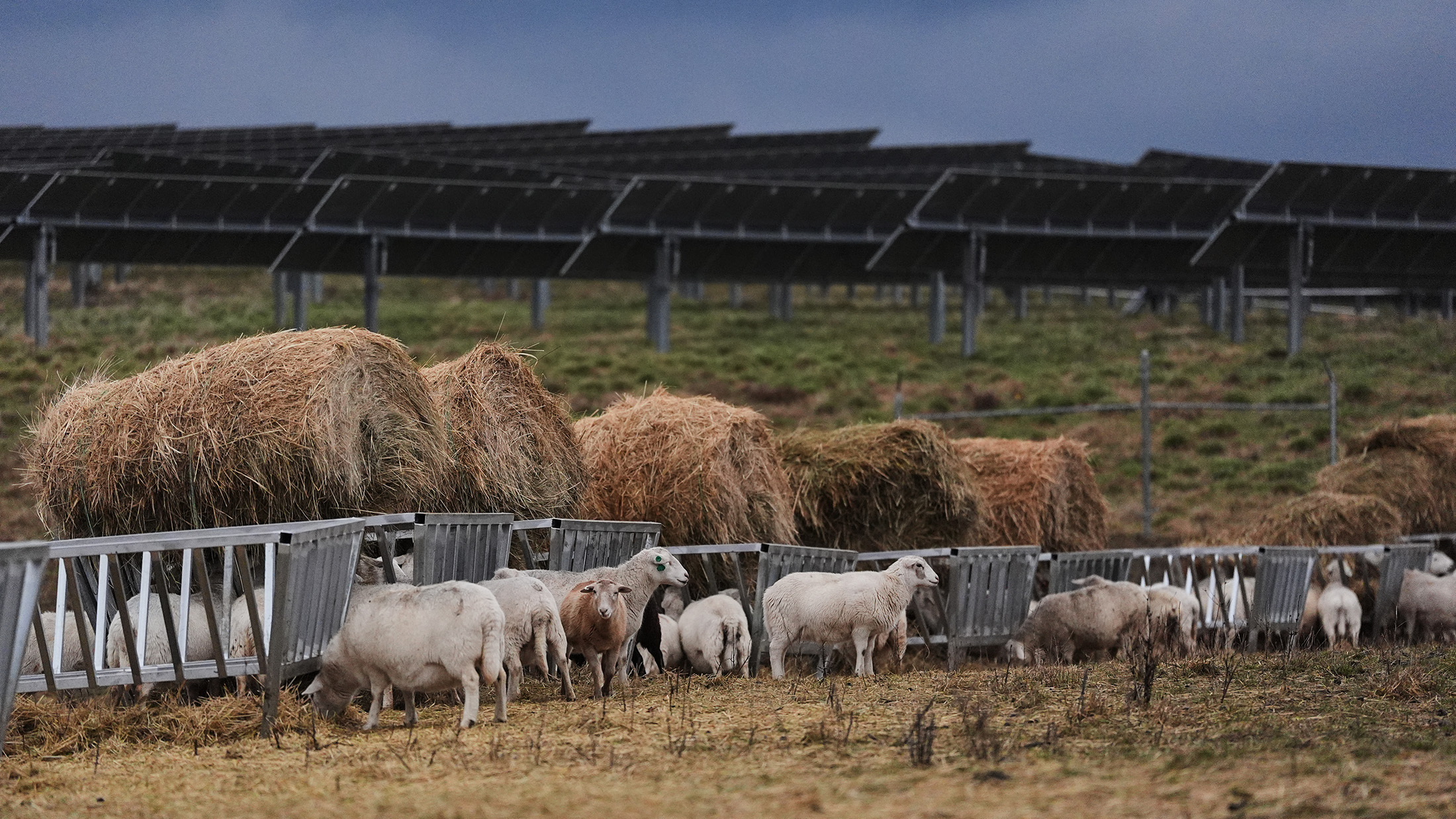
American farmers bet on solar. Then Trump changed the rules.
Ayurella Horn-Muller, Melina Walling, Clayton Aldern, & M.K. Wildeman
Further down the line, workers handle knives and often labor shoulder-to-shoulder. They make repetitive motions for hours at a time, making the same cuts over and over to process hundreds or thousands of birds and swine. This workforce already runs the risk of developing carpal tunnel syndrome and enduring lacerations and amputations. Research has shown injury rates go up when line speeds increase.
The USDA contests this finding. In its proposed rule for poultry slaughter, the USDA states that a study funded by the agency’s Food Safety and Inspection Service determined that increased line speeds during the evisceration segment of the line — where internal organs are removed from dead animals — “are not associated” with a higher risk of musculoskeletal disorder. The study’s authors, however, have since said that the proposed rule **“**fundamentally misunderstands and mischaracterizes the scope and results” of their research.
“The potential for injury to these workers, it’s just something people can’t deny,” said Mark Lauritsen, who leads UFCW’s food processing, packaging, and manufacturing division. “Quite honestly, line speeds are too fast now.”
In response to a request for comment, a spokesperson from the USDA said, “Decades of data prove that plants can run at higher speeds while maintaining process control and meeting every federal food safety standard.” They also added that federal inspectors in meat processing plants are still able to slow lines down if they discover a problem.
Ultimately, the spokesperson said, “The USDA’s legal authority is strictly limited to ensuring food safety and process control; we do not have the power to regulate piece rates or how private companies manage their staff.” (Piece rate refers to the number of items — such as whole birds or parts — handled by a worker per minute.)
When it comes to meat processing, going faster “is not good for the environment either,” said Lauritsen.

Packages of chicken at a supermarket in Texas. Ronaldo Schemidt / AFP via Getty Images
Slaughterhouses are incredibly water-intensive operations, due in part to the need to regularly spray down these facilities in order to maintain sanitary conditions while processing animals. In turn, they also produce a lot of waste — in the form of, yes, contaminated water, but also blood, guts, and fecal matter from animal carcasses. Both labor and environmental advocates argue that increasing the line speeds in slaughterhouses will necessarily increase the amount of water used and the amount of waste discharged into local ecosystems.
In written comments submitted to the USDA, the Center for Biological Diversity stated: “Increasing line speed slaughter rates will increase slaughter capacity […] and lead to further damage to the environment, wildlife, animal welfare, worker safety, and public health (including food safety).”
Replogle, the attorney at Food and Water Watch, also believes that if slaughterhouses go faster, then factory farms will decide to raise more animals. These farms, known as confined animal feeding operations, or CAFOs, are “another gigantic source of water pollution in particular and nitrate pollution,” said Replogle, as well as greenhouse gas emissions. Across the U.S., CAFOs are also linked to higher levels of air pollution in uninsured and Latino communities.
In its proposed rule for poultry slaughter, the USDA states that increasing line speeds “would not affect consumer demand for the establishments’ products,” and that only “expected sales of poultry products […] would determine production levels in establishments.” But demand for meat in the U.S. is already quite high, with most Americans eating more than 1.5 times the daily protein requirement.
It’s also unclear that increasing line speeds would actually lower the price of chicken and pork at the grocery store. Agricultural economist David Ortega, a professor at Michigan State University, said increasing slaughter capacity would only result in lower poultry and pork prices at the grocery store if slaughterhouses pass on their savings “through the supply chain.” That outcome, Ortega said, would run counter to the slaughterhouses’ economic incentives.
For some workers, the proposition of increased line speeds has already been made real. Magaly Licolli is a labor organizer based in Springdale, Arkansas, where Tyson Foods, the largest U.S. meat corporation, is headquartered. She said that poultry workers in Northwest Arkansas, at companies she did not name, say they have already been told to work faster. “We had a meeting with workers from different companies. And all of them stated that the line speed had increased,” said Licolli.
The USDA spokesperson said, “The safety and well-being of the workforce are essential to a stable food supply; however, worker safety is overseen by the Department of Labor, not USDA. The law is very clear on this.” They also added that meat processing plants have long been able to receive line speed waivers, which allow the facilities to operate at higher speeds — and that this may explain what workers are reporting to Licolli.
Debbie Berkowitz, a worker safety and health expert at Georgetown University, argued that increasing line speeds ultimately puts profits above all else. “I think the line speed issue is not about selling more chicken or pork, but being able to exploit workers and get them to work even harder and faster. That is how the companies save money,” said Berkowitz. In cases like this, Berkowitz argues that workers and the environment are treated as expendable. “It’s just churning through workers,” she said. In other words: “Exploitation 101.”
This story was originally published by Grist with the headline Trump’s plan for ultra-fast meat processing would be a disaster for workers and the environment on Apr 30, 2026.
From Grist via This RSS Feed.
A new study led by University of British Columbia researchers has found that pet cats allowed to roam outside unsupervised carry infectious diseases at rates comparable to feral cats, even when they receive veterinary care, regular meals, and shelter.
From Biology News - Evolution, Cell theory, Gene theory, Microbiology, Biotechnology via This RSS Feed.
Biologist Erik Cordes has spent much of his career studying cold-water reefs — coral systems typically found in chilly, dark waters far below the ocean’s surface. But his latest project took him by surprise when he and a group of colleagues discovered what might be one of the world’s largest deep-sea, cold-water reefs. Over the course of two expeditions aboard the research ship R/V Falkor (too) — first in July 2025, and then in December 2025–January 2026 — Cordes and a team of scientists explored a previously undocumented cold-water coral reef system along a 900-kilometer (560-mile) stretch of Argentina’s territorial waters, about 1,000 meters (3,300 feet) below the surface. Globally, cold-water reefs can be found in depths as shallow as 50 m (164 ft) and as deep as 4,000 m (13,100 ft). Just one of the coral mounds — underwater hills made up of coral skeletons topped by living coral that take thousands or even millions of years to form — stretched out over an area of 0.4 square kilometers (0.15 square miles), nearly the size of Vatican City. The expeditions, mounted by the U.S.-based Schmidt Ocean Institute, identified many more of these mounds across the 900 km that it mapped, leading the researchers to believe the corals could be part of one of the most extensive cold-water reefs in the world. “It still amazes me when we can discover something this size still on our planet,” Cordes, a professor of biology at Temple University in the U.S., told Mongabay.…This article was originally published on Mongabay
From Conservation news via This RSS Feed.
In the creeks and rivers of southern Illinois, a school of bigeye shiners darting along the edge of a stream is a sign of healthy water. The freshwater fish, which is on the state’s endangered species list, has managed to survive despite habitat loss driven by decades of construction and industrial farm runoff. But an ongoing dispute between two state agencies over state species protections is testing how the tiny fish will endure.
Last summer, the state’s top wildlife regulators faced resistance from the Illinois Department of Transportation, or IDOT, when trying to protect the shiner. The Illinois Department of Natural Resources, or IDNR, recommended that the transportation agency crews mapping out construction at a site in Union County should first survey the area and find out if the shiner was present. If so, IDNR would ask them to apply for a permit to minimize impacts to the paper clip-sized fish before proceeding.
IDOT declined. The department’s reason, among others, was simple: “Fish swim away.”
The standoff between the two agencies, outlined in internal documents obtained by WBEZ and Grist, is at the center of an ongoing clash that broke out last year after the transportation department repeatedly ignored recommendations from state experts to pursue permits designed to protect imperiled species during road, bridge, and other transportation work. The transportation department, which is the state’s largest public landowner, may have overridden Illinois’ Endangered Species Protection Act in 11 cases in the past year, according to public records.
Endangered species laws are meant to shield imperiled animals and plants from publicly funded projects. The federal Endangered Species Act, which was passed in 1973, currently safeguards nearly 1,700 species in the United States and has saved close to 300 species from extinction. Almost every state has its own version of the law for protecting critters within its borders. The Illinois Endangered Species Act, which predates the federal act, operates similarly, protecting 513 species, including federally listed species like the rusty patched bumblebee, piping plover, and gray wolf. The safeguards, often criticized as slow and pricey, block crews from breaking ground on nearly any project until they first minimize harm to listed species.
Despite massive popularity, the federal law, which has been credited with resuscitating the bald eagle, grizzly bear, and gray wolf populations, is under attack by Congress and the Trump administration. On Earth Day last week, House Republicans tried and failed to pass a bill that would’ve shredded those protections at the federal level. Weeks earlier, after Iran closed the Strait of Hormuz, President Trump convened the “God Squad,” a committee of high-ranking officials across his administration to bypass the Endangered Species Act entirely and open the Gulf of Mexico for oil drilling. The Trump administration also recently unveiled a proposed rule to revoke the federal law’s definition of “harm” to species.
Read Next
Trump’s ‘God Squad’ blocks endangered species protections in the Gulf of Mexico
Species protections aren’t just breaking down on the federal level. States like Illinois are also failing to keep up with local rules to protect species from disappearing forever.
In response to the transportation department’s handling of species protections, IDNR ended a decade-old agreement with the agency last fall that allowed it to fast-track environmental reviews. The agency’s impact assessment manager, Bradley Hayes, pointed to “IDOT’s apparent automatic response to decline ITA recommendations” in his cancellation letter obtained by WBEZ and Grist.
An ITA, or incidental take authorization, is a permit that allows for the accidental harm of a protected species during the construction of an approved project, such as building a road or fixing a bridge. These permits involve lengthy reviews in which applicants must outline potential impacts to listed species, require a public comment period, and incorporate feedback from conservation specialists. The entire process can take at least five to six months.
Still, experts say these permits are crucial because they minimize harm to protected species and provide legal cover from criminal charges that can accompany the unintentional killing of a state-listed species.
IDOT’s Jack Elston responded to the termination letter at the end of last year disputing the initial allegations from the environmental regulators, saying that the agency “does not make automatic responses regarding the IDNR recommendation for an ITA.”
In a joint statement from IDOT and IDNR to WBEZ and Grist, IDOT spokeswoman Maria Castaneda said, “IDOT continues to consult with IDNR and considers recommendations from IDNR along with multiple other factors, including known information about the species, other environmental surveys, engineering, costs, and public safety.”
Castaneda added that the agencies are currently drafting a new agreement and that the agreement on file was outdated. “Updated language was needed,” she said.
Despite the agreement expiring at the beginning of 2019, IDOT continued to conduct environmental reviews until lDNR stepped in to stop them last fall.
Email exchanges between IDNR officials obtained by WBEZ and Grist show concern about how IDOT was conducting its environmental reviews.
Last December, IDOT’s Elston wrote that “fish swim away from construction noise” as justification for several projects that could harm fish and molluscs, like the harlequin darter and the American brook lamprey, which are found in rivers and streams in southeastern and northeastern Illinois, respectively. In another instance, Elston wrote that the relocation of state-endangered mussels in White County was unnecessary and would delay a project by at least a construction season and add about $2 million in costs.
But internal emails show that IDNR officials were increasingly concerned by that rationale. The American brook lamprey, for example, spends much of its life burrowed in sediment, dies not long after spawning, and is unlikely to simply swim away
“We are the experts,” wrote Todd Strole, IDNR assistant director, in an email earlier this year preparing for a meeting with IDOT. “Fish are not the same, some don’t swim away.”
In another email, Ann Holtrop, head of IDNR’s division of natural heritage, wrote: “We are open to professional dialogue with IDOT, but planning and engineering needs don’t negate or override the recommendations by scientists.”
The Illinois dispute reflects a broader erosion of species protections nationwide, according to the Natural Resources Defense Council’s Rebecca Riley. During his first term, President Donald Trump advanced new guidance that undercut species protection. The Biden administration undid the Trump-era rules, but the Trump administration has yet again proposed a new rule to weaken the federal law.
WBEZ and the Chicago Sun-Times reached out to Governor JB Pritzker’s office for comment on how the state’s internal dispute fits into the Trump administration’s ongoing rollback of federal species protections; however, the Governor’s office offered no comments beyond the statement from IDOT and IDNR.
This story was originally published by Grist with the headline Illinois is feuding with itself over endangered species protections on Apr 29, 2026.
From Grist via This RSS Feed.
Angola has declared its highest mountain, Mount Moco, part of a new conservation area to protect its threatened Afromontane forests. The Serra do Moco Conservation Area, which includes a complex of elevations, slopes and valleys in the municipality of Londuimbali, Huambo province, will now be under “a special regime of environmental protection, biodiversity conservation, and sustainable use,” according to a government notice published April 9. The declaration protects around 22,000 hectares (54,000 acres) of land, ornithologist Michael Mills told Mongabay. “It encompasses all areas where there can potentially be forest,” he added. Mills has worked since 2011 with residents of Kanjonde village, at the foot of Mount Moco, to restore forest lost to timber harvesting and wildfires. Moco’s forests, which declined to 50-60 hectares (about 120-150 acres) from 200-300 hectares (about 500-750 acres) more than 50 years ago, host a unique suite of birds separated from other Afromontane regions for millennia. The government notice says the Serra do Moco region is of strategic importance “for observing rare and endemic species and for scientific research in its natural habitat.” Nigel Collar, a conservation biologist with BirdLife International, told Mongabay that his organization had shared the plight of Moco’s unique plants and animals with the rest of the world since the 1980s. “The news that the government of Angola has now moved to give the mountain formal protected area status is a moment for real celebration and congratulations,” he said. Collar added the protection represents a big win for one of Moco’s…This article was originally published on Mongabay
From Conservation news via This RSS Feed.

US President Donald Trump on Saturday abruptly canceled a planned visit by two of his administration's negotiators to the Pakistani capital for diplomatic talks to end his illegal war on Iran, complaining that the trip would be "too much work."
The president announced his decision after Iranian Foreign Minister Abbas Araghchi left Islamabad on Saturday, writing in a social media post that he relayed to Pakistani officials "Iran's position concerning a workable framework to permanently end the war on Iran." Araghchi added that he has "yet to see if the US is truly serious about diplomacy."
Iranian officials said repeatedly in recent days that they had no intention of engaging in direct talks with the Trump administration this weekend as long as the US naval blockade remained in effect. Despite clear statements from Iran's leadership, the Trump White House insisted that special envoys Jared Kushner and Steve Witkoff would be holding another round of direct negotiations with Iranian officials in Islamabad after earlier talks ended without a deal.
"This has happened repeatedly: Trump claims the Iranians are begging for talks, Iran says it is false," observed Drop Site's Jeremy Scahill. "The US says Iran is lying, and then it becomes clear Iran meant what it said."
In an assessment published before Trump canceled his envoys' trip, Scahill wrote that "there is no question it is the US that is seeking direct talks right now, not Iran."
"Iran still believes it is likely the US and Israel will resume the war and has indicated it has prepared new forms of retaliatory strikes and other actions, including in the Strait of Hormuz," Scahill added. "Its military commanders have said that while the US has moved more military assets into the region during the 'ceasefire,' Tehran has also taken this period to prepare its own weapons systems for more fighting."
Trump insisted Saturday that his administration—whose deeply unpopular and deadly war of choice has sparked a global economic disaster—holds "all the cards" and that Iranian leadership is in turmoil. But Sina Toossi, a senior fellow at the Center for International Policy, wrote that "Trump can’t hide exuding desperation for a deal."
"So he invents 'fractures' in Tehran to explain being repeatedly stood up," Toossi added. "Iran’s line is unchanged: demanding the blockade be lifted and holding on to its core red lines. They’re playing hardball. He’s spinning."
Trump's cancellation of the Kushner-Witkoff trip came hours after NBC News reported that "American military bases and other equipment in the Persian Gulf region suffered extensive damage from Iranian strikes that is far worse than publicly acknowledged and is expected to cost billions of dollars to repair."
"The Iran war was a tactical and strategic disaster," said Toossi. "Despite heavy efforts to control the narrative, it’s becoming clear just how much US bases and equipment in the region were damaged or destroyed. The war backfired and inflicted far more damage than its proponents want to admit."
From Common Dreams via This RSS Feed.

In an unprecedented action, more than 130 leading scholars and public figures are risking arrest on terror charges after writing an open letter to the Court of Appeal concerning Palestine Action.
The letter, dated 24 April 2026, simply reads:
We oppose genocide, we support Palestine Action.
The words that have become synonymous with the campaign to Lift the Ban.
Sally Rooney, Greta Thunberg, and Judith Butler were among the first to put their names to this defiant declaration. Joining them are prominent artists and musicians such as Nadine Shah, Brian Eno, Massive Attack’s Robert Del Naja, the actor Billy Howle, writers China Miéville, Lina Meruane and Tariq Ali, and political activists like Lindsey German of Stop the War and Vijay Prashad of the Tricontinental Institute.
The letter is on the Defend our Juries website. And there’s also a sign-on form that allows anyone who supports the scholars’ action to add their name.
Professors and researchers from University of Oxford, University of Cambridge, London School of Economics, Durham University, University of Warwick, University of Exeter and many other UK universities pledge their support for Palestine Action.
The list of signatories includes several senior professors of law: Yvette Russell from University of Bristol, Maria Aristodemou from Birkbeck, and Neve Gordon FacSS, Penny Green FacSS, and Hans Lindahl all from Queen Mary University of London.
Other prominent UK-based professors on the list are Nicola Pratt the president of the British Society for Middle Eastern Studies and Eyal Weizman the founding director of Forensic Architecture.
The letter exposes the paradox of terror charges
If the police proceed to arrest these scholars on terror charges, it’ll further expose the authoritarian nature of the ban. But if they don’t, the more than 3,000 previous arrests of people for saying precisely the same thing will appear not just unlawful but arbitrary and discriminatory.
Today’s action by the scholars is organised by a number of academic critics of the ongoing genocide in Palestine. Many of them are signatories to previous open letters hosted by the group Protest is not Terrorism.
Over the last couple of years Israel has destroyed all of Gaza’s universities and killed scores of Palestinian scholars. Given the UK’s increasingly authoritarian response to anti-genocide protest, the organisers of this letter did not circulate it among colleagues in the West Bank.
Nevertheless, Palestinian academic voices are still represented by Abdaljawad Omar (Birzeit University), Karma Nabulsi (University of Oxford) and Rashid Khalidi (Columbia University), author of perhaps the most widely read recent history of the century-long war against Palestine.
Many well known international figures and political thinkers have signed the letter in solidarity. These include Verónica Gago (Professor of Social Sciences at University of Buenos Aires), Michael Hardt (Professor of Literature, Duke University) and Jacques Rancière (Emeritus Professor of Philosophy, University of Paris 8).
The letter arrives just days before the government’s appeal to uphold its unlawful proscription of Palestine Action comes before the Royal Courts of Justice on 28-29 April.
With more expected to sign the letter over the weekend, the scholars’ defiance is further evidence that the public does not support the government’s attempts to ban legitimate and necessary action to prevent a genocide.
Signatories comment
Penny Green, Professor of Law and Globalisation at Queen Mary University of London, said:
It is both indefensible and revealing that peaceful protesters opposing genocide are being branded as terrorists while the Labour government, itself complicit in Israel’s state terror, avoids all accountability.
Neve Gordon, Professor of International Law at Queen Mary University of London, said:
Instead of meeting its legal obligations as set by the Genocide Convention and international humanitarian law, Keir Starmer’s government has been providing military and diplomatic support to Israel as it perpetrates atrocity crimes while simultaneously silencing the messenger by proscribing Palestine Action as a terrorist group.
The decision to appeal the ruling rendering the proscription unlawful is yet another sign of the government’s moral bankruptcy.
Catherine Rottenberg, Professor of Media and Cultural Studies at Goldsmiths University of London, said:
With the ongoing genocide and ethnic cleansing in Palestine and an illegal and horrific war raging in the Middle East, the insistence on proscribing a direct action group is not merely absurd, it is absolutely unconscionable.
In the name of defending freedom and democracy, our government is undermining both democracy and freedom. We the people must stand up and defend our freedoms, with Palestine Action as our most urgent test case.
Peter Hallward, Professor of Philosophy at London’s Centre for Research in Modern European Philosophy, said:
For anyone familiar with even a few strands of post-war European thought, it’s almost incomprehensible to think that we have so quickly forgotten a principle that once commanded universal and uncontroversial assent – that ‘never again’ really means what it says. Never, ever, anywhere. Especially not with our collusion!
The 1948 Convention remains categorically binding on us all, and it obliges us to ‘prevent and punish’ genocide by all the necessary means at our disposal.
If our government refuses to honour this obligation it is up to us to insist on it.
Başak Ertür, a Reader at Goldsmiths’ Centre for Research Architecture, said:
The use of the sharpest end of criminal law against people who inconvenience political power by acting with conscience is a textbook feature of authoritarianism. I’ve been wary of signing collective letters since I was put on trial in Turkey some years ago, along with hundreds of others, for adding my name to the Academics for Peace petition in 2016.
But the proscription of Palestine Action by executive fiat seems to me no less preposterous than what I have experienced, and therefore it feels exactly right that I now sign this letter, because indeed, I do oppose genocide and therefore support Palestine Action.
A spokesperson for Defend our Juries said:
The scholars who have signed this letter have spent their lives analysing complex political situations and moral problems and today have decided to put their liberty and reputations on the line because saving lives is not terrorism.
If the police start arresting these scholars on terrorism charges for peaceful expressions of political speech the state’s authoritarianism will be fully exposed. But if they don’t, the arrests of more than 3,000 people for saying precisely the same thing will be shown to be not just unlawful but also discriminatory.
We applaud the signatories of today’s letter in joining thousands of people who have publicly declared their support for Palestine Action.
Featured image via the Canary
By The Canary
From Canary via This RSS Feed.
military contractor Palantir is helping the IRS analyze dozens of different data sets on Americans to investigate a broad range of financial crimes, according to records shared with The Intercept.
Since 2018, the Internal Revenue Service’s Criminal Investigation division has used Palantir’s Lead and Case Analytics platform to aggregate and analyze a sprawling list of sensitive federal databases and data sets.
Public records detailing Palantir’s IRS contract, obtained by the nonprofit watchdog group American Oversight and shared exclusively with The Intercept, reveal the immense volume of data plugged into the military contractor’s software. The LCA uses both Palantir’s Gotham and Foundry applications to facilitate “analysis of massive-scale data to find the needle in the hay stack,” the contract paperwork says.
Documents indicate the IRS has paid Palantir over $130 million for these services to date.
Palantir’s LCA is ostensibly directed toward cracking down on fraud, money laundering, and other financial crimes. According to a 2024 agency privacy impact assessment, IRS “Special agents and investigative analysts … utilize the platform to find, analyze, and visualize connections between disparate sets of data to generate leads, identify schemes, uncover tax fraud, and conduct money laundering and forfeiture investigative activities.”
[
Related
Trump Wants to Put You in a Massive, Secret Government Database](https://theintercept.com/2026/03/17/government-surveillance-centralized-database-privacy/)
The IRS use of the software, launched under Trump’s first term and expanded under Biden, is now in the hands of an IRS Criminal Investigations office that has drastically scaled back its pursuit of tax cheats and pivoted, under Trump’s direction, toward investigating “left-leaning groups,” the Wall Street Journal reported in October.
“The real concern is the consolidation of vast amounts of sensitive personal data into a single system with minimal transparency — especially one built and operated by a contractor like Palantir, whose business model is premised on integrating data and expanding surveillance capabilities,” American Oversight director Chioma Chukwu said in a statement to The Intercept. “Its platforms have been used in deeply troubling contexts, from immigration enforcement to predictive policing, with persistent concerns about overreach, bias, and weak oversight.”
Palantir did not respond to a request for comment, nor did the IRS.
“The real concern is the consolidation of vast amounts of sensitive personal data into a single system with minimal transparency — especially one built and operated by a contractor like Palantir.”
The contract documents reviewed by The Intercept reveal that these “disparate sets of data” are vast. Palantir’s LCA allows the IRS to quickly search and visualize “connections from millions of records with thousands of links” between databases maintained by the IRS and other federal agencies. According to the contract documents, this data includes individual tax form and tax returns as well as Affordable Care Act data, bank statements, and transactions, and “all available” data compiled by the Treasury Department’s Financial Crimes Enforcement Network.
Its view apparently extends to cryptocurrencies including bitcoin, Ethereum, Litecoin, and Ripple. “The application would sit on top of a singular repository of identified wallets from seized servers utilizing dark web data obtained from exchangers such as Coinbase,” the documents note.
The program places an emphasis on mapping social relationships between the targets of an investigation. That includes analyzing a “network of people and the relationships and communications between them,” such as “calls, texts, [and] emails events.” The use of “IP address analysis” within LCA allows the IRS to “Identify suspects more easily” and “Establish (new) relationships among actors.”
These investigative functions are continuously updated, the materials say, through ongoing close work between Palantir engineers and IRS personnel.
[
Related
Palantir Will No Longer Profit Off of New Yorkers’ Health Data](https://theintercept.com/2026/03/24/palantir-new-york-city-hospitals-contract/)
The intermingling of sensitive data on millions of Americans comes at a time of increased global skepticism and opposition toward Palantir, which, despite its military-intelligence origins, has a thriving business with civilian agencies like the IRS. The use of Palantir software at the U.K.’s National Health Service, for example, has created an ongoing political controversy across Britain, while a similar contract with the New York City public hospital network was recently canceled following public protest.
The contract is also active at a time when IRS Criminal Investigations has been coopted to aid in the broader Trump administration’s aggressive agenda. In July, ProPublica reported that the agency was working with U.S. Immigration and Customs Enforcement to provide “on demand” data to accelerate deportations. Last year, the New York Times reported that Palantir, founded by Trump ally Peter Thiel, was central to an administration effort to increase data-sharing across federal agencies.
“The question isn’t just what it can do — it’s who it will be used against.”
The company’s right-wing politics and eagerness to facilitate U.S. and Israeli military aggression abroad, NSA global surveillance, and ICE deportations has also made many weary of its access to incredibly sensitive personal data. A recent post on the company’s Palantir’s X account summarizing a book by CEO Alex Karp triggered an immediate backlash from those unnerved by the manifesto’s fascistic bent. The bullet points extolled the virtue of arms manufacturing, argued the Axis powers were unfairly punished after World War II, called for a reinstatement of the draft, condemned cultural pluralism, and claimed that wealthy elites are unfairly persecuted.
“When the government can map relationships, track behavior, and generate investigative leads across data sets at this scale, the question isn’t just what it can do — it’s who it will be used against,” Chukwu said. “Entrusting that infrastructure to a company known for opaque, security-state deployments only heightens those risks.”
The post Palantir Is Helping Trump’s IRS Conduct “Massive-Scale” Data Mining appeared first on The Intercept.
From The Intercept via This RSS Feed.
Last Updated on May 12, 2026 The Federal Court of Australia has ordered mining giant Fortescue to pay the Yindjibarndi Ngurra Aboriginal Corporation more than A$150 million in compensation for cultural loss caused by iron ore mining on Yindjibarndi Country in Western Australia’s Pilbara region, in what is being described as the largest native title […]