tal

joined 2 years ago
[–] tal@lemmy.today 4 points 2 months ago (1 children)

Well, yes, but after that.

[–] tal@lemmy.today 6 points 2 months ago* (last edited 2 months ago) (2 children)

looks dubious

Altman and a few others, maybe. But this is a broad collection of people. Like, the computer science professors on the signatory list there aren't running AI companies. And this isn't saying that it's imminent.

EDIT: I'll also add that while I am skeptical about a ban on development, which is what they are proposing, I do agree with the "superintelligence does represent a plausible existential threat to humanity" message. It doesn't need OpenAI to be a year or two away from implementing it for that to be true.

In my eyes, it would be better to accelerate work on AGI safety rather than try to slow down AGI development. I think that the Friendly AI problem is a hard one. It may not be solveable. But I am not convinced that it is definitely unsolvable. The simple fact is that today, we have a lot of unknowns. Worse, a lot of unknown unknowns, to steal a phrase from Rumsfeld. We don't have a great consensus on what the technical problems to solve are, or what any fundamental limitations are. We do know that we can probably develop superintelligence, but we don't know whether developing superintelligence will lead to a technological singularity, and there are some real arguments that it might not


and that's one of the major, "very hard to control, spirals out of control" scenarios.

And while AGI promises massive disruption and risk, it also has enormous potential. The harnessing of fire permitted humanity to destroy at almost unimaginable levels. Its use posed real dangers that killed many, many people. Just this year, some guy with a lighter wiped out $25 billion in property here in California. Yet it also empowered and enriched us to an incredible degree. If we had said "forget this fire stuff, it's too dangerous", I would not be able to be writing this comment today.
[–] tal@lemmy.today 19 points 2 months ago* (last edited 2 months ago) (1 children)

That's one issue.

Another is that even if you want to do so, it's a staggeringly difficult enforcement problem.

What they're calling for is basically an arms control treaty.

For those to work, you have to have monitoring and enforcement.

We have had serious problems even with major arms control treaties in the past.

https://en.wikipedia.org/wiki/Chemical_Weapons_Convention

The Chemical Weapons Convention (CWC), officially the Convention on the Prohibition of the Development, Production, Stockpiling and Use of Chemical Weapons and on their Destruction, is an arms control treaty administered by the Organisation for the Prohibition of Chemical Weapons (OPCW), an intergovernmental organization based in The Hague, Netherlands. The treaty entered into force on 29 April 1997. It prohibits the use of chemical weapons, and the large-scale development, production, stockpiling, or transfer of chemical weapons or their precursors, except for very limited purposes (research, medical, pharmaceutical or protective). The main obligation of member states under the convention is to effect this prohibition, as well as the destruction of all current chemical weapons. All destruction activities must take place under OPCW verification.

And then Russia started Novichoking people with the chemical weapons that they theoretically didn't have.

Or the Washington Naval Treaty:

https://en.wikipedia.org/wiki/Washington_Naval_Treaty

That had plenty of violations.

And it's very, very difficult to hide construction of warships, which can only be done by large specialized organizations in specific, geographically-constrained, highly-visible locations.

But to develop superintelligence, probably all you need is some computer science researchers and some fairly ordinary computers. How can you monitor those, verify that parties involved are actually following the rules?

You can maybe tamp down on the deployment in datacenters to some degree, especially specialized ones designed to handle high-power parallel compute. But the long pole here is the R&D time. Develop the software, and it's just a matter of deploying it at scale, and that can be done very quickly, with little time to respond.

[–] tal@lemmy.today 31 points 2 months ago (3 children)
$ grep ^p...y$ /usr/share/dict/words
paddy
palmy
palsy
pansy
panty
parry
party
pasty
patsy
patty
penny
peony
peppy
perky
pesky
petty
phony
picky
piety
piggy
pigmy
pinky
pithy
poesy
pokey
poppy
potty
pricy
privy
prosy
proxy
pudgy
puffy
pulpy
puppy
pushy
pussy
putty
pygmy
$
[–] tal@lemmy.today 44 points 2 months ago* (last edited 2 months ago) (1 children)

Vought, a self-described Christian nationalist

Instead, Trump was fixated on getting the recently divorced Vought laid

A new Great Awakening, I see. Society's morals shall be restored to their proper place.

[–] tal@lemmy.today 4 points 2 months ago* (last edited 2 months ago)

US sugarcane is a protected market and is not globally competitive. US soy is globally competitive. You can't just go produce sugarcane, because nobody outside of the US would buy it at the rates that US sugarcane farmers would sell it for.

https://harvardpolitics.com/politics-of-protectionism/

Perry points to the cost of sugar as an example of protectionism hurting the consumer. Around the world, the price of sugar is about 14 cents per pound; in the United States, the price of sugar is double that at 28 cents per pound. Perry explains that “because we keep most of the foreign sugar out of the country, the cost of higher sugar prices is spread around two or three hundred million consumers. We all pay a little bit more, every day, for anything that has sugar in it.”

https://www.cato.org/policy-analysis/candy-coated-cartel-time-kill-us-sugar-program

Barriers to imports of sugar have been employed nearly since the republic’s founding; a tariff on the product was first passed in 1789. Duties remained in place almost continuously save for a four-year period from 1890 to 1894, but modern-day sugar protectionism can be traced back to the 1934 passage of the Jones-Costigan Amendment.1 This legislation, passed as an emergency measure to provide assistance to sugar farmers and later incorporated into the Sugar Act of 1937, had as its key provisions domestic production quotas, subsidies, tariffs, and import quotas, all designed to restrict sugar supplies and boost prices.

As noted by the Yale Law Journal in 1938, the result of this market meddling was to harm consumers, while failing to serve as the industry savior the legislation’s backers imagined it to be:

Protection of the domestic beet and cane producers costs the American consumer three hundred million dollars a year even after the duties collected by the Treasury have been discounted. No attempt is made in the present scheme of regulation to encourage production in those fields which can produce sugar most economically and to discourage it in the fields which require subsidization. Thus, despite the inefficiency and expensiveness of the beet sugar industry and the well nigh intolerable working conditions in the beet fields, the latter area is the only one not really restricted by the quotas which have been imposed.

The most efficient producing areas have received the most drastic restrictions. A proration system has been devised which prohibits the State of Florida, the only area on the continent which could produce sugar profitably without a tariff or direct subsidy, from producing more than fifty percent of its own intrastate consumption. Moreover, the federal government has assisted in increasing the supply of sugar by spending enormous sums on research, irrigation, and reclamation during a period when production was already far outstripping consumption. As a consequence of these measures, legislation ostensibly enacted for the relief of domestic farmers results in a net loss to them.2

Despite such documented costs even at this early date, the system persisted with only minor adjustments through 1974, when a tripling in the price of sugar coincided with the expiration of the Sugar Act of 1948, and Congress decided against renewal. A decline in sugar prices then led to the temporary creation of price support loans, that is, government loans secured by sugar as collateral, which the borrower can either repay with interest or, if prices are too low, default on. These were enacted for the sugar crops of 1977–1979 and lapsed in 1980 and most of 1981 in the wake of a dramatic sugar price increase. A sugar support program reappeared in the 1981 Farm Bill following a price retreat.3

Officially known as the Agriculture and Food Act of 1981, the Farm Bill featured the reintroduction of price support loans that continue today and form one of the U.S. sugar program’s four key pillars. Extended through the U.S. Department of Agriculture’s (USDA) Commodity Credit Corporation, these loans are made to sugar processors at an average national rate of 18.75 cents for every pound of raw sugarcane provided as collateral (rates vary slightly by region of the country) and 24.09 cents per pound of refined beet sugar.4 These rates effectively serve as a price target for the USDA.

https://www.npr.org/transcripts/179295426

[–] tal@lemmy.today 1 points 2 months ago* (last edited 2 months ago) (1 children)

I'm not actually sure that we could eat all of it. The problem is that (a) IIRC, it's the largest US crop and (b) vegetables are a lot more efficient to produce than animals. If we convert it from animal to human feed, a ton of calories show up. I remember a statistic that if the US went vegetarian, it could single-handedly feed all of Europe just from the increased surplus without putting any more land into agricultural production just because of the higher efficiency.

https://www.reuters.com/world/china/us-soybean-farmers-deserted-by-big-buyer-china-scramble-other-importers-2025-10-03/

China purchased about 45% of all U.S. soybean exports last year

https://sentientmedia.org/trumps-tariffs-are-hurting-soybean-farmers/

Of course, this also has a reciprocal effect on China, as it no longer has the 25 million metric tons of soybeans that it would otherwise have purchased from the United States.

https://usafacts.org/articles/us-agricultural-exports/

The US’s biggest food export is soybeans: they were 14.0% of all agricultural exports in 2024, with a market value of $24.6 billion. Around half of American soybeans ($12.85 billion worth) are exported to China.

https://vegnt.com/foods/1kg/soybeans_mature_seeds_raw.html

This says that 1kg of soybeans have 4460 calories, or enough to feed an adult male for about 2.2 days. So 25 million metric tons is 25,000,000 metric tons × 1000 kg/metric ton × 2.2 man-days = 55 billion man-days. There are about 347 million people in the US. Assuming that every one of them eats as much as an adult male, which is an unrealistically conservative estimate in favor of increased consumption, that's equivalent to feeding all of them for 43% of a year on just the surplus would-have-gone-to-China-in-a-year soybeans here, before we even start eating anything else, like pizza and other stuff, like the soybeans that we're already producing for domestic use.

EDIT: In fairness, my assumption is that some of this is gonna involve countries maybe selling soy production that they would have bought from, say, Brazil or whoever to China and picking up US production at a lower price than it would normally be available. Like, it'll be a hit, but I don't think that all of it will simply just sit there; Adam Smith's Invisible Hand won't be idle.

[–] tal@lemmy.today 1 points 2 months ago* (last edited 2 months ago) (2 children)

I think that one of the major alternative crops is corn.

kagis

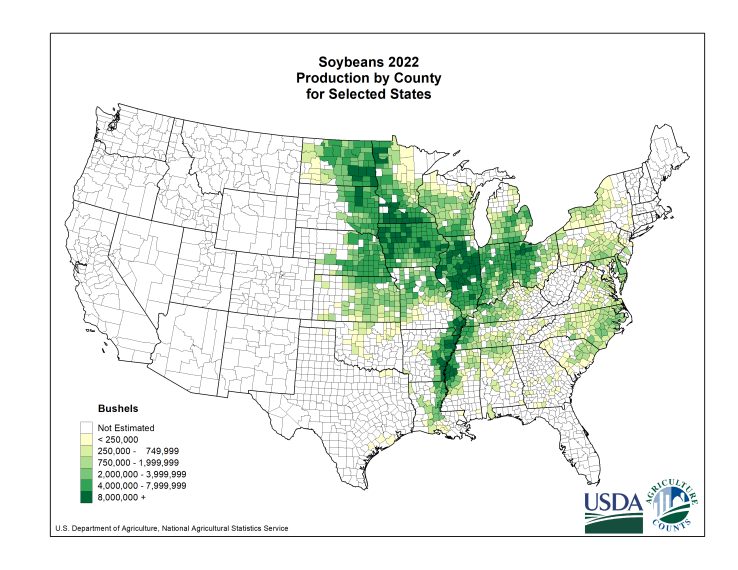
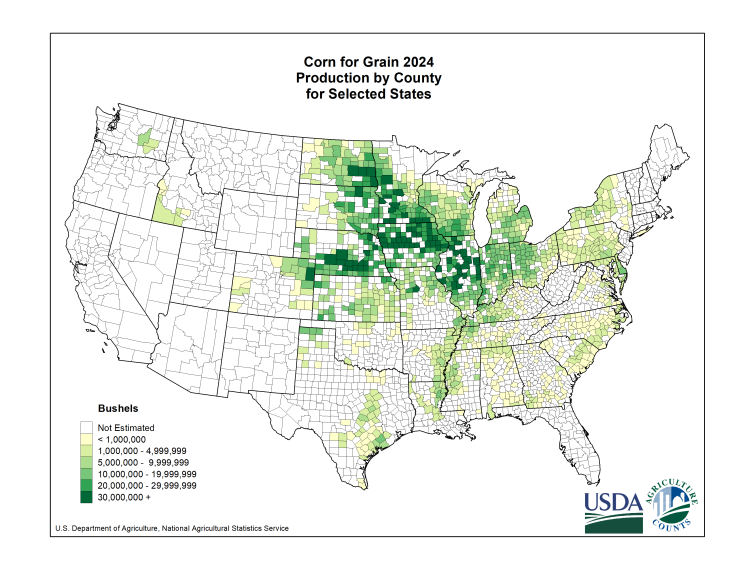
Looks like it. Same sort of counties:

Soy production:

https://www.nass.usda.gov/Charts_and_Maps/graphics/SB-PR-RGBChor.png

Corn production:

https://www.nass.usda.gov/Charts_and_Maps/graphics/CR-PR-RGBChor.png

So might mean more corn production over time.

[–] tal@lemmy.today 2 points 2 months ago (3 children)

Well, yeah, but let's say that you buy a truckload of soybeans. What do you plan to do with it?

[–] tal@lemmy.today 21 points 2 months ago* (last edited 2 months ago) (2 children)

I was commenting the other day on how she says that Margaret Thatcher is her greatest hero, but that she's an advocate of economic policy more in line with Shinzo Abe's stuff, which really isn't in line with Thatcher.

IIRC Liz Truss had some similar statement, and the policy that she went for during her time as Prime Minister was also pretty loose.

[–] tal@lemmy.today 17 points 2 months ago (3 children)

farmers...reap what they have sown

Dammit. I wish I'd come up with that one.

[–] tal@lemmy.today 41 points 2 months ago* (last edited 2 months ago) (14 children)

https://www.csmonitor.com/Business/2025/1015/soybean-farmers-trump-bailout-china

Mr. Trump has angered many farmers by providing economic aid for Argentina, which almost immediately responded by suspending its export taxes on soybeans and other goods. That allowed China to buy a large lot of Argentina’s soybeans at a discount, further undercutting U.S. soybean farmers. Farmer sentiment – a measure of how farmers view their financial future – fell last month, reversing all the gains it had made since Mr. Trump’s election last year, according to the Purdue University-CME Group Ag Economy Barometer Index.

When America’s soybean exports diminish, farmers in Brazil and elsewhere in the Southern Hemisphere expand their acreage and grow more soybeans for export, diminishing U.S. farmers’ market share. That’s what happened in Mr. Trump’s first trade war with China in 2018.

South American farmers are beginning to plant their soybean crop. If there’s no imminent sign of a U.S.-Chinese arrangement over soybeans, then they have more incentive to increase soybean acreage. That’s a long-term threat, Mr. Gerlt says, because once in cultivation, those acres don’t go away.

view more: ‹ prev next ›