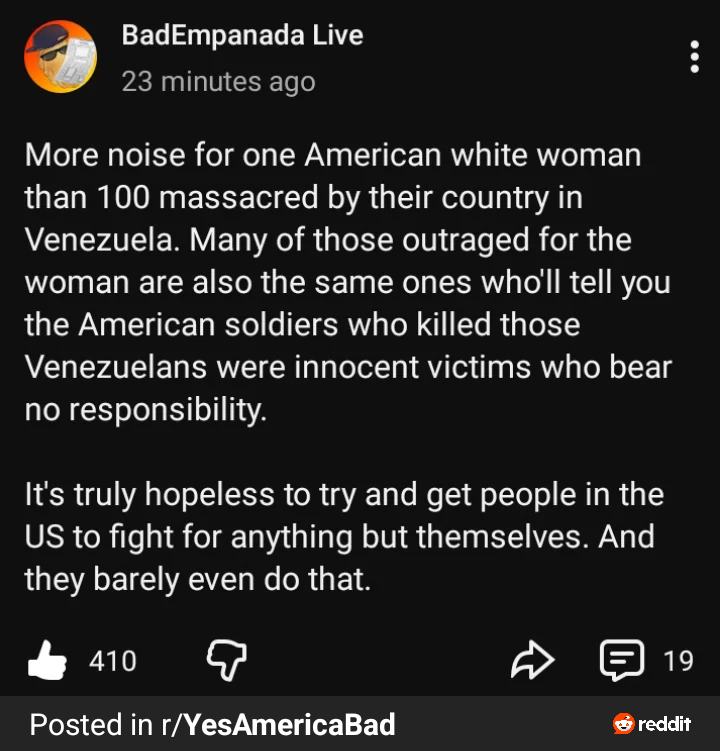
No comment from me
This is a Dengist community in favor of Bashar al-Assad with no information that can lead to the arrest of Hillary Clinton, our fellow liberal and queen. This community is not ironic. We are Marxists-Leninists.
See this GitHub page for a collection of sources about socialism, imperialism, and other relevant topics.
This community is for posts about Marxism and geopolitics (including shitposts to some extent). Serious posts can be posted here or in /c/GenZhou. Reactionary or ultra-leftist cringe posts belong in /c/shitreactionariessay or /c/shitultrassay respectively.
We have a Matrix homeserver and a Matrix space. See this thread for more information. If you believe the server may be down, check the status on status.elara.ws.
Rules:
No comment from me
To try to clarify some things:
I will also admit I'm not in a great mood about any of this right now and that is affecting how I read things.
On the “much of the world” phrasing: I’m not claiming a universal global consensus. I’m speaking from experience as someone from the periphery who has had the privilege to be able to travel across the periphery, where this is a recurring sentiment I’ve encountered again and again. “Much of the world” may be an exaggeration, but the underlying perspective is far from rare, especially among people whose political reference points are mass struggle, repression, and real confrontations with state power rather than liberal civil society rituals.
On calling them “parades”: I’m not implying joy or celebration. I use the term because these events are seemingly typically state-sanctioned or permitted, confined to approved routes, heavily policed yet managed, and highly choreographed from start to finish. The presence of tear gas or batons doesn’t negate that. Violence can occur entirely within a controlled script, and when the outcome is predictable dispersal rather than escalation or leverage, “parade” is an accurate structural description, not a moral slight.
And to be clear, this isn’t about denying complexity or flattening liberation struggle, it’s about refusing to romanticize impotence. Western protest culture elevates these managed spectacles into moral absolutes while systematically marginalizing forms of struggle that actually threaten power. That’s not neutral; it actively disarms movements by teaching people that symbolic display and sanctioned outrage are the peak of political action. Naming that isn’t disrespectful to those who suffer within these protests, it’s a necessary critique of a model that reproduces defeat while insisting it represents resistance.
If you’re not in a great mood, I get that. But the disagreement here isn’t about empathy; it’s about analysis. And analytically, a system that can absorb mass outrage, brutalize it, and still face no material threat is not being seriously challenged, regardless of how real the pain involved is. And as sad as it sounds a protest that doesn't challenge power in any meaningful way is best described as a parade.
FWIW, I would probably take no issue on the "much of the world" phrasing if you reference it as "based on my recurring experience with others in the periphery." It makes it clear what your source is, while also still carrying a certain authoritative weight to it, to say that this is what keeps cropping up for you over and over. With the other phrasing, my bullshit meter goes off and I have to wonder if the person isn't just pulling it out of their backside, no matter how much good faith I may or may not have in them as a person.
Right and I understand the impotence of that and am not in disagreement there. However, I still don't think parade is appropriate phrasing for every type of it. There is protest that probably fits that description well and then there is protest that is more spontaneous and faces more of a reaction and political repression than otherwise. That the state is willing to do violence in the face of any of it shows that it's not all state-sanctioned and choreographed and some of it is at most the state grudgingly allowing it to a certain degree it finds acceptable.
I think it would be safe to say the liberal capitalist apparatus only wants to allow the "parade" style of protest. But I think it would be inaccurate to say that's the only style that ever occurs. It may be fair to say they're all impotent styles regardless, considering the seeming lack of any resultant change that holds as a broader challenge. But I still don't think they all qualify as parade-like in the definition you use.
I think where we’re talking past each other, I’m not claiming Western protest takes only one empirical form. There are broadly two recurring styles in my view. One is the riot: spontaneous, emotionally charged, sometimes violent, often met with sharp repression, but lacking durable organization, coherent leadership, concrete demands, or any capacity to sustain itself beyond the moment. The other is the parade: non-violent, usually permitted or tolerated, more organized on the surface, but structurally hollow, no leverage, no escalation strategy, no consequences for being ignored. I focus on the “parade” not because riots don’t happen, but because parades are culturally and politically dominant in the West. They are normalized, celebrated, taught as the legitimate form of dissent, and elevated in the cultural zeitgeist as the model of “good protest.” That makes them far more analytically significant. They shape how people understand politics, what kinds of action are deemed acceptable, and crucially what kinds are ruled out in advance. Neither form, however, really qualifies as protest in a meaningful political sense. Both lack what actually matters: mass organization, enforceable demands, and a credible threat of escalation if ignored or repressed. One burns hot and collapses; the other marches safely and dissipates. The state can absorb both without fear. That’s the core issue. The problem isn’t tone or terminology, it’s that Western protest culture is seemingly structurally incapable of converting mass discontent into anything other than showmanship.
It is likely we are talking past each other to some extent. Though I am curious to ask, what forms of resistance in history you think are good examples of not falling prey to this kind of thing (beyond just principles we could state like "political power comes out of the barrel of a gun"); maybe you have studied it more detail than I have and can provide insight. One that comes to mind for me is the IRA in Ireland.
One thing that does strike me as odd about the US is how gun-happy the culture is on the whole, yet the gun-happy culture seems primarily centered around the "right", with the "left" being more likely to be shy of it. But this may be due to militant left struggle facing assassination and imprisonment (ex: The Black Panther Party) and largely leaving behind liberal pacifists to dominate the narrative.
I agree with you on the IRA, and more than that, I see it as a clear example of an anti-imperialist, anti-colonial movement that extracted real material gains from a vastly more powerful state. Whatever one thinks of its limitations or internal contradictions, the IRA and the broader republican movement forced the British state to negotiate, reshaped the political terrain in Ireland, and secured concrete concessions that would have been impossible through moral appeal or symbolic protest alone. It didn’t achieve everything it set out to, but it demonstrated decisively how mass community support, disciplined organization, clear objectives, and a credible capacity for escalation can make an occupying power unable to simply ignore resistance. If I had to point to a broader analytical frame before listing examples, as I did elsewhere in this thread, I’d flag two texts that get at the underlying problem. Guy Debord’s The Society of the Spectacle is useful for understanding how, in advanced capitalist societies, representation, spectacle, and performance replace real action and interaction. Politics becomes something to be seen rather than something that exerts force. Jones Manoel’s essay Western Marxism, the Fetish for Defeat, and Christian Culture is important for explaining why even the Western left internalizes this logic, mistaking visibility, suffering, and moral witness for power, and repeatedly reproducing forms of action that feel meaningful but are materially ineffectual. Historically, politically meaningful protest, even in the West, has looked very different. It has depended on mass organization, clear material demands, and a credible threat of escalation. During the U.S. civil rights movement, disciplined organizations like the NAACP, SCLC, and CORE coordinated sustained campaigns, while armed self-defense formations such as the Deacons for Defense made repression costly and instability plausible. Later, the Black Panther Party took this further by combining political education, mass programs, and armed deterrence, precisely why it was met with assassination, infiltration, and destruction. A third example is the early labor movement. Strikes worked not because workers marched politely, but because organized labor could shut down production, disrupt profits, and escalate to militancy if ignored. The difference between these cases and modern Western “parades” (a term I’ll continue to use because it best captures the structure) is decisive. Effective movements were not oriented toward spectacle, moral signaling, or catharsis. They were oriented toward leverage. They built durable organizations, articulated concrete demands, and created conditions in which ignoring them carried real costs. Contemporary Western “protests”, whether riots that burn out quickly or sanctioned marches that dissipate harmlessly, lack those fundamentals. That’s why they are absorbable. And that’s why, analytically, they function less as protests in the classical sense and more as managed expressions of dissent within a system that no longer fears them, angry parades rather than challenges to power.
Thanks for sharing your thoughts on it. I've read Jones Manoel's essay before multiple times, but I'll have to make a note to look into Guy Debord’s The Society of the Spectacle.
The point about the power of negotiation, disruption, etc., I try to think of what signs there are left of this in the US and all I can think of that seems noteworthy is newer union efforts. (Older ones, to my understanding, often suffer from problems of diluted power/influence.) But then I also read stories about one business or another, where a union was being formed and the company shut down entirely the branch it was being formed at in order to stop the unionization.
In general, the modern USian "left" seems broadly mired in a mode of thinking and strategy that goes something like the following: "The constitution gives people certain legal human rights (at least in theory). Rather than challenging the validity of relying on an old document built out of a settler-colonial project that committed genocide and was built through slavery, we start with the belief that the constitution had the right idea but never actualized it. Therefore, to fix problems, we act within the framework of behaving in a way that is legal (as it pertains to theoretical rights provided by the constitution) and challenging what is illegal (as it pertains to theoretical rights provided by the constitution)."
In this way, "civil disobedience" (which often translates to the kind of protest we're talking about) can be viewed as an actualization process of the constitution rather than a challenge to it. What little potentially "illegal" action people are willing to take becomes a validation of the state project and its origins rather than an invalidation of it. I'm not sure this is what the left wants to be doing as strategy, but it may be somewhat of a fear/survival response to the violence of imperial repression and the dismantling of more militant efforts. The general thought process being that by raising awareness, we can become strong enough to transform into the other, more militant form. The problem there, of course, is that transformation does not arise magically out of numbers. Raised awareness and outrage that is not organized and grounded in disciplined theory and practice leads to riot rather than sustained leverage. (Some of this may apply similarly to parts of the EU, but I don't know enough about them to say with confidence one way or another.)
This is such a banger of a comment that if you ever get the chance please flesh it out into a post/substack/essay series etc and also with what you propose should happen from a dialectical materialist perspective (with citations etc). Only if you ever get the chance/time.
(If the person you're replying to reads this: please don't take this personally from me against you. I too am still learning and your posts are always an interesting read.)
Thank you for your reply I would like to go much more in depth at some point as I find it to be a very interesting topic but for now I think I'll simply point to a book and an essay that I feel each encapsulate part of the issue.
First is Guy Debord The Society of the Spectacle, this I feel brings to light the issue in advanced capitalist countries for spectacle to replace real action and interaction.
Second is Jones Manoel Western Marxism, the Fetish for Defeat, and Christian Culture, which I feel succinctly explains in some way why even the western left falls prey to the spectacular yet materially ineffectual parades and riots as opposed to real organized protest with mass organisation, concrete demands and an escalation plan.
As for “what is to be done,” as much as I'd love to simply say form a maoist guerilla force and overthrow your overlords, I don’t think the real answer is that interesting or that novel a concept even in the west. Politically meaningful protest (even in the West) has historically depended on mass organization, clear material demands, and a credible threat of escalation. During the civil rights movement, disciplined organizations like the NAACP and CORE coordinated sustained action, while local militant currents, such as the Deacons for Defense, made repression costly and instability plausible. Later organizations, including the Black Panther Party, built on these lessons, demonstrating how escalation coupled with strong organization could influence political outcomes. Without comparable structures, leverage, and escalation potential, protest tends to collapse into either brief outbursts or sanctioned displays, both of which the state can safely absorb.
Second one I am familiar with but the first I am not; thanks for the recommendation
For What Is To Be Done: I don't think we collectively we have an answer that does not end up being waiting for Global South spearheaded accelerationism but the latter is not good enough from a Westerner perspective - a materialist political movement also has to come from within as well. But as marxists we should make/stake claims in theory, even with the risk of being "wrong", and feel the response/heat we get from it to fine tune our practice (ie dialectics).
Lemmygrad is still susceptible to westernism (despite it being arugable one of, if not the best, reddit-like forums on the anglosphere. And I too am guilty of this) and comments like yours are excellent analyses of symptoms.
In the end the synthesis of theory and practice to sharpen and refine each other should be the main aim as highlighted by every successful revolutionary from Stalin to Ho to Chairman Mao. All I can realistically currently do for the Western left is wish them luck and provide critique and observation from a hopefully at least somewhat novel perspective.