Direct link to the LLM Policy Discussion: https://invent.kde.org/plasma/plasma-workspace/-/work_items/187
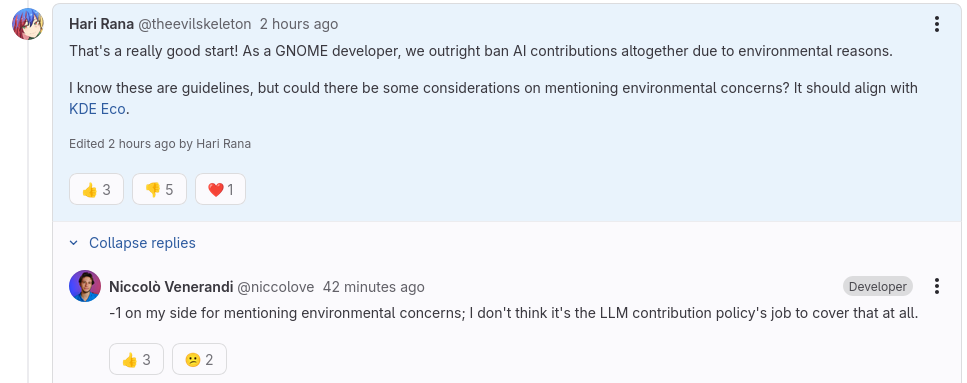
Example of a KDE dev not wanting environmental concerns to play any role, despite KDE having an environmental project:
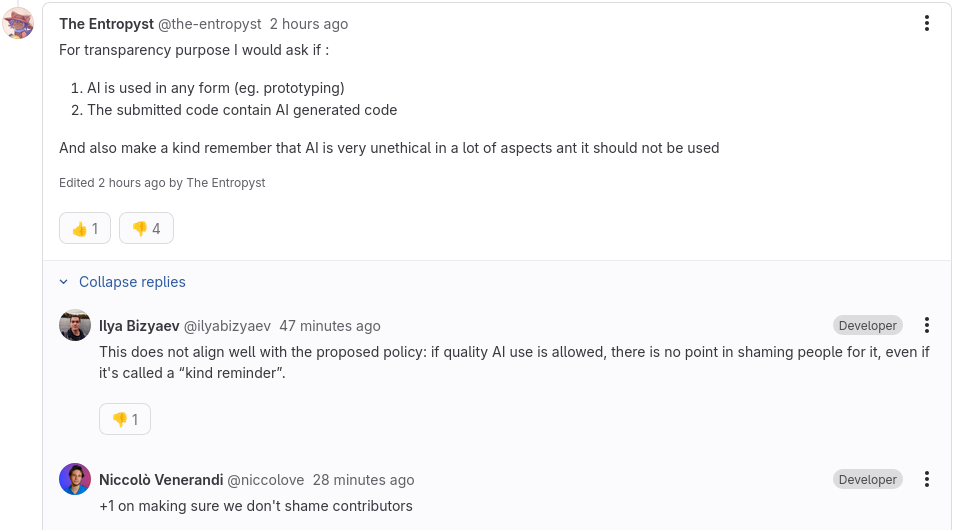
Devs rejecting any notion of transparency by disclosing AI usage in code submissions (in direct opposition to advice from the FSFE):
And all of this is coming right after the debacle with an AI slop project being allowed to give a presentation at Akademy, and the person asking how this was allowed being blocked by KDE:
https://lemmy.nz/post/42029517
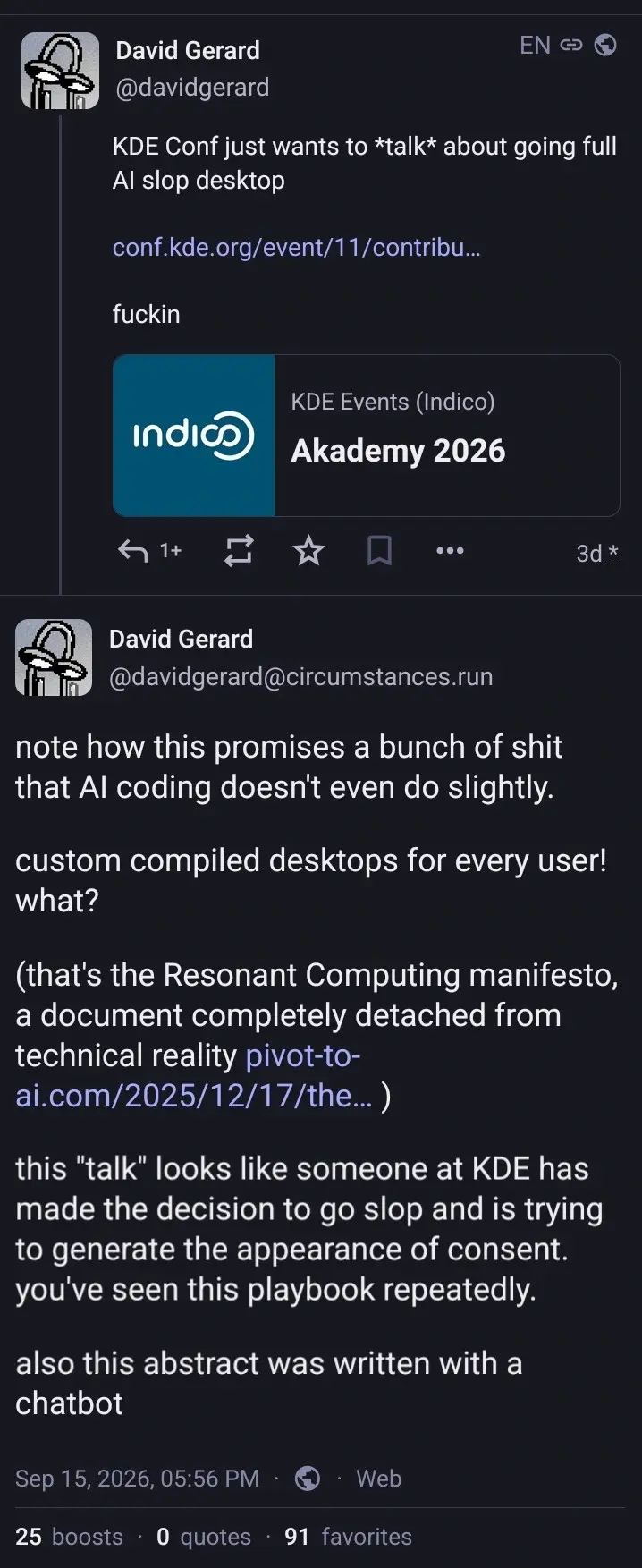
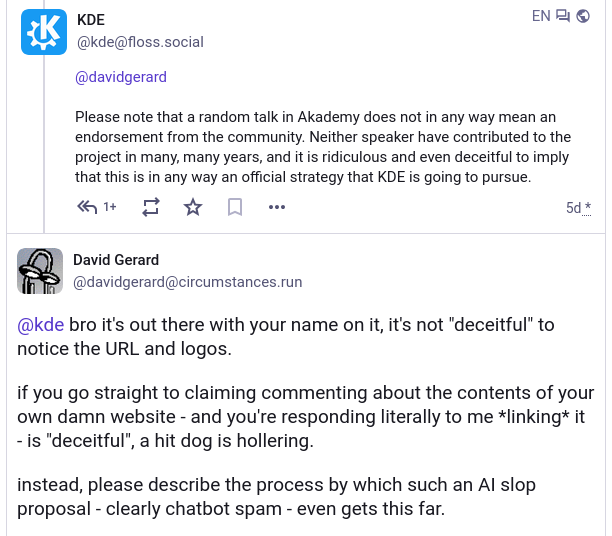

as well as the discussion thread bringing up legitimate concerns about AI usage being closed:
https://discuss.kde.org/t/sorry-to-bring-up-a-contentious-topic-kde-ai-llm-policy/46333/164
As someone who genuinely loves KDE, and has even donated to the project multiple times, I sadly have to accept that the majority of KDE have hopped onto the Pro-AI train, and they will not be dissuaded otherwise.
I'll likely be switching my gaming PC to Gnome due to all this :\
(on a side note, the Gnome dev in that thread mentions that Gnome bans AI usage, but I haven't been able to find anything that confirms that, and AFAICT Gnome doesn't have an official AI usage policy, only Gnome Circle does for 3rd party Gnome Extensions).
She's updated the comment now to say 'a lot of us outright ban', which is more accurate.
Just a side note, GNOME Circle and Extensions are two different things (but both do ban AI projects). Circle is a way for GNOME to say a third party app is good, while Extensions are like browser extensions but for the DE.
You can bet your behind that the developers employed by IBM Red Hat are 100% using LLMs to code. Chances are they are even mandated by corporate higher-ups to do so.
Red hat is a big contributor to gnome? I didn't know that.
Is the default DE for fedora so it makes sense
Yeah, that I did know
are you switchong off linix since the linu kernel allows ai?
As it is impossible to completely avoid AI use with Linux, I must content myself with only minimization instead of complete elimination, as I won't let the pursuit of perfection mean I just give up entirely. Any reduction is still meaningful, just as it's still worthwhile to minimize fossil fuel usage and meat consumption as much as is reasonably possible.
I do not think LLMs can be "just a tool".
Most LLM use is with corporate AI, and this KDE policy explicitly allows corporate AI usage. If they had restricted it to only open-source local models, I wouldn't have nearly as many environmental concerns (though that would not solve the plagiarism issue).
For a more complete look at all of the downsides of AI usage, I'd encourage you to take a look at this comment.
"If they had restricted it to only open-source local models"
Is this even remotely enforceable? Stylometry can pretty effectively determine between AI and human written text ( not sure about code specifically since those are much stricter languages), but can it tell the difference between models or even if the LLM was run locally? (almost certainly not in the latter case).
Most contributors generally respect the rules of a project, and there are other rules put in place that are also not technically enforceable, such as asking a contributor to not submit copyrighted code (this would be virtually impossible for a reviewer to distinguish if it came from a closed source project), which also gives the project a stronger defense if brought to court, as they can then at least point to the rules and show where a contributor willfully broke them. In comparison, I suspect a court would not look kindly on a policy that says "Don't disclose that you used a tool that has a 3 to 10% chance of introducing plagiarized copyrighted code with every prompt to avoid being shamed."
As an example, the WINE project has a rule to not allow anyone who has even seen Windows source code from contributing to the project. This is to avoid the chances of someone subconsciously or consciously submitting a reproduction of what they saw in the Windows source code, and thus hopefully prevent the project being sued into oblivion from Microsoft (who would likely love to see that happen).
Adding a stipulation in the guidelines that contributors can only use more-ethical LLMs likely wouldn't entirely prevent someone breaking that rule, but by in large, it is likely that most would adhere to it, making it an effective rule despite being difficult to enforce.