I switched to Niri a few months ago as an experiment but now I guess I will not go back to KDE anytime soon
Linux
A community for everything relating to the GNU/Linux operating system (except the memes!)
Also, check out:
Original icon base courtesy of lewing@isc.tamu.edu and The GIMP
It starts with "oh, just clean up any code generated" and "you must understand what your code does" and then in a decade that person won't remember how to code at all because they self-lobotomized themselves for the convenience.
If slop coding is so great why is everyone so adamant about hiding it from users?
If you're not willing to disclose something, maybe take that as a hint.
I feel like using ai is like using drugs, they're bad, but regulating them is muuuuuuuch better than just prohibiting, people will use it anyways.
It's not a one to one comparison but I feel encouraging witch hunts will definitely do more harm than normalizing it.
To be clear, I don't want it either, I'm acknowledging it's the lesser of two evils.
I'm 12 and this is deep level of take right here
I feel like using ai is like using drugs, they’re bad, but regulating them is muuuuuuuch better than just prohibiting, people will use it anyways.
crime won't happen because it is illegal?
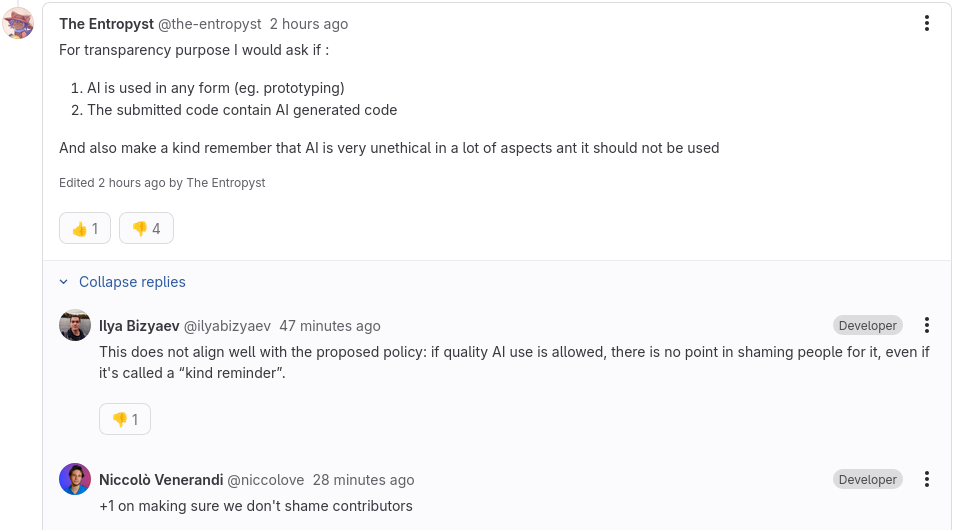
As a user, I think this is the biggest issue I have with this policy. Disclosure is a big part of open source and hiding whatever tools are used is fundamentally against that philosophy.
Would you be willing to expand on what you mean by disclosure being a big part of open source?
I ask because it has not been my experience that OSS developers have ever had a habit of disclosing what tools they use. If you are lucky then a repo has instructions for contributors, that may describe tools being used, or CI configuration for running tests and linters, but most projects have neither. Mostly you just get instructions for building the project, but sometimes not even that
The stupidity of bandwagoners is on full display in this comment section.
You cannot tell from the code necessarily anyway so anti-AI policies are hard to enforce. In the end the developer (or AI wielding human) is responsible for the code quality and its license which is what matters. All this discussion feels just like the usual culture war dividing the community. I’m more concerned about the intentions of people adding fuel to the fire.
In the end the developer (or AI wielding human) is responsible for the code quality and its license which is what matters.
They literally may not have any control over the license, that is one of the many big problems people have. Please read the article linked by OP about the copyrightabilty of LLM generated code - https://fsfe.org/news/2026/news-20260825-01.html. It depends heavily on how they used the LLM, so if there is zero disclosure required the entire project could get into licensing hell down the road.
Yes obviously the code you commit must be yours and you need to make sure it is. That is already a rule, what's the point of telling people how to work above that?
Due to the nature of LLMs being trained on existing code there is a chance that generated code is lifted verbatim from another piece of software whose license doesn't permit the copy without attribution. Its a potential legal minefield that I think FOSS project should just steer clear of until the legal landscape surrounding generative AI cools off some.
time to stop donating then. Ai crap results in death by a thousand cuts.
the policy in question:
The golden rule for LLM usage in KDE is Don't be lazy:
Don't try to use a tool to replace your own judgment, interpersonal communication, or learning process.
Don't take unsustainable shortcuts.
Don't avoid growing as a person.
The result will be poor-quality work that eventually becomes someone else's problem.
Nobody in KDE should know if you use an LLM — not because you're concealing it, but because your usage of it produces output indistinguishable from what you could produce yourself. Contributions with obvious and lazy LLM usage may be ignored or closed.
Using an LLM to generate contributions
KDE follows a "human in the loop" principle: you must be making decisions and adjustments beyond mere prompting. The output must express your unique humanity in some way.
- Don't be a "meat proxy". For example:
- Don't submit throwaway LLM-created changes as a "first draft or proof-of-concept for maintainers to improve".
- Don't submit "vibe-coded" changes you don't understand and couldn't make yourself.
- Don't disclose LLM usage as a way of trying to excuse the potential errors or poor quality of a contribution that you haven't put much effort into.
- Don't add "Assisted-by: [some LLM]" tags to your commits; it's just free advertising for the LLM's provider.
(emphasis original, except for the fourth bullet point)
"You are responsible for the code you submit, regardless of tools used."
Literally the same stance Linus had on Linux. I'm okay with it as long as it's enforced.
Yes, that's fine. And it's also easy to enforce - just treat any code as if it's written by a human (except obviously machine generated code like hardware descriptions etc).
Being against AI and LLMs is all fine and dandy, but it kinda takes ridiculous shape now.
However, I would prefer if open source tools would only allow the usage of open weight models and self-hosted systems. But then again, that's my idealism talking.
I hate vibe coding, detest it, i'm tired of it. it wastes time and resources. That being said I use AI for debugging and as a glorified rubber duck. I don't let it write ANYTHING but I will allow it to review code and make suggestions. Generally, I'd say 8 times out of 10 the suggestions are garbage BUT it will lead me down the right path. it's a rubber duck that can talk back. So in that regards it has improved my build times, it has sped me up without actually touching the code itself.
THAT's what AI/LLMs SHOULD be used for. an assistant that doesn't directly interact with the project. a consultant to your code if you will.
unfortunately many people can't make that separation and they sit on both sides of the fence.
This seems fine
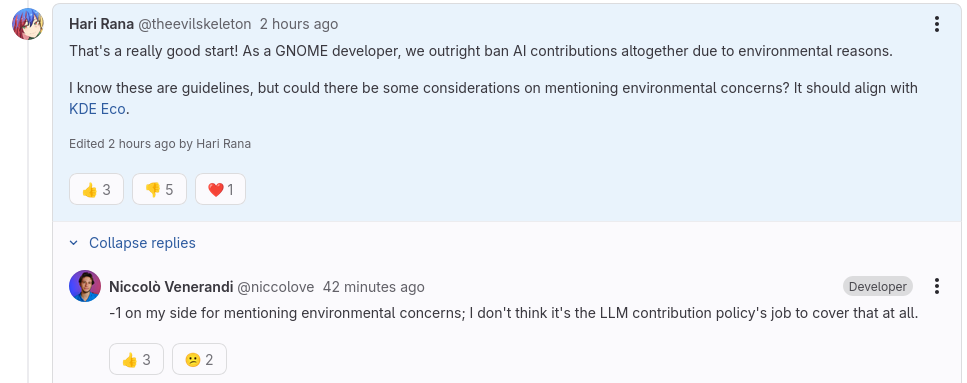
This isn't a bad policy, but outright ignoring ethical and environmental concerns doesn't seem very wise either. That should still be discussed, even if this becomes the final version of the policy.
Sounds pretty reasonable to me. Don't go saying "well chatgpt said it", no, you are responsible for it.
This seems fine to me, it's all they can really do since banning AI entirely just isn't possible; someone could use it and submit very high quality code and no one would know AI was involved.
And if its very high quality, does it matter?