Direct link to the LLM Policy Discussion: https://invent.kde.org/plasma/plasma-workspace/-/work_items/187
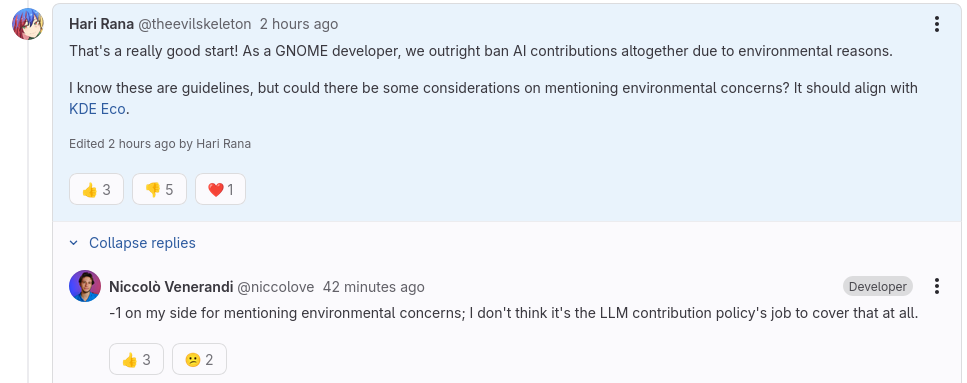
Example of a KDE dev not wanting environmental concerns to play any role, despite KDE having an environmental project:
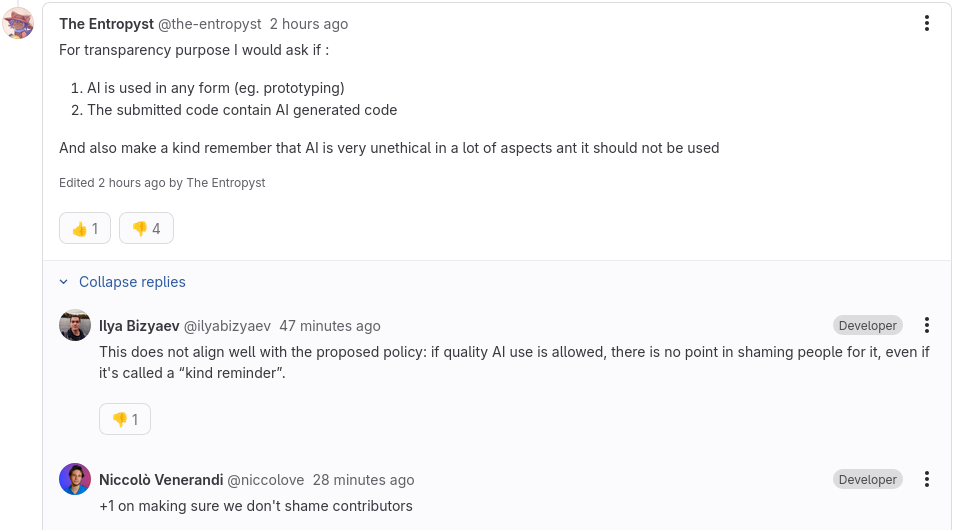
Devs rejecting any notion of transparency by disclosing AI usage in code submissions (in direct opposition to advice from the FSFE):
And all of this is coming right after the debacle with an AI slop project being allowed to give a presentation at Akademy, and the person asking how this was allowed being blocked by KDE:
https://lemmy.nz/post/42029517
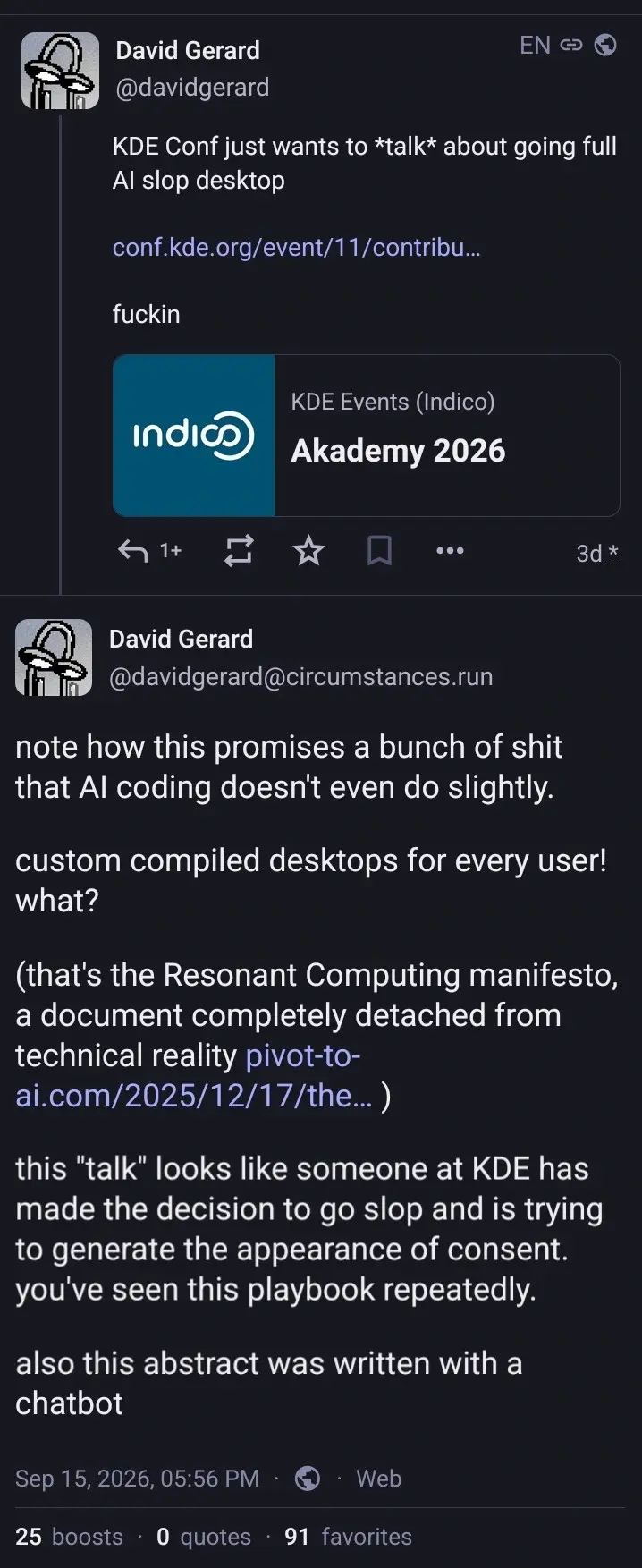
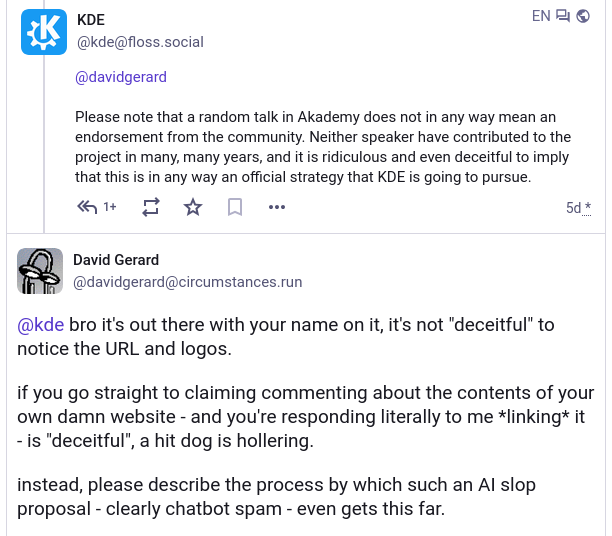

as well as the discussion thread bringing up legitimate concerns about AI usage being closed:
https://discuss.kde.org/t/sorry-to-bring-up-a-contentious-topic-kde-ai-llm-policy/46333/164
As someone who genuinely loves KDE, and has even donated to the project multiple times, I sadly have to accept that the majority of KDE have hopped onto the Pro-AI train, and they will not be dissuaded otherwise.
It's that humans cannot be trusted to not take shortcuts and AI has proven time and time again to be a literal gambling machine that uses persuasive writing techniques to convince you of things you wouldn't otherwise think.
KDE is also fighting transparency which is terrible.
It's not going to be shocking when KDE starts performing worse. If more than one person works on a project and you're just hoping people use things responsibly, you're dreaming.
Humans optimize everything and AI pretends to be the greatest optimization tool of all time while it spits spaghetti code it's authors understand less of over time while it tells them "great idea! I'll get to work right away!
you couldn't trust humans to not take shortcuts long before the advent of ai. That's the point of my previous comment.
KDE's stance is literally "as long as the code is of sufficient quality and you're able to take the responsibility over it, we don't care which tools you were using along the way". Policing people over what they're (not) allowed to use never yielded positive results.
If anything, such policy allows less slop to slip through, than in any project with anti-ai policy, simply because the maintainers would be aware of the possibility, and thus would have to pay closer attention to the PR quality.
Finally, it's an open source project. Even if anything sloppy slips past the eyes of maintainers, rather sooner than later it would be noticed by the community and fixed.
Which is obvious to you, me, and trust me when i say that it's obvious to anybody who ever tried using ai for even the most minor coding tasks harder than webdev.