Ask Lemmy
A Fediverse community for open-ended, thought provoking questions
Rules: (interactive)
1) Be nice and; have fun
Doxxing, trolling, sealioning, racism, toxicity and dog-whistling are not welcomed in AskLemmy. Remember what your mother said: if you can't say something nice, don't say anything at all. In addition, the site-wide Lemmy.world terms of service also apply here. Please familiarize yourself with them
2) All posts must end with a '?'
This is sort of like Jeopardy. Please phrase all post titles in the form of a proper question ending with ?
3) No spam
Please do not flood the community with nonsense. Actual suspected spammers will be banned on site. No astroturfing.
4) NSFW is okay, within reason
Just remember to tag posts with either a content warning or a [NSFW] tag. Overtly sexual posts are not allowed, please direct them to either !asklemmyafterdark@lemmy.world or !asklemmynsfw@lemmynsfw.com.
NSFW comments should be restricted to posts tagged [NSFW].
5) This is not a support community.
It is not a place for 'how do I?', type questions.
If you have any questions regarding the site itself or would like to report a community, please direct them to Lemmy.world Support or email info@lemmy.world. For other questions check our partnered communities list, or use the search function.
6) No US Politics.
Please don't post about current US Politics. If you need to do this, try !politicaldiscussion@lemmy.world or !uspolitics@lemmy.world
7) No Hit-and-Run questions.
Please don't delete your post for no apparent reason. If you plan on deleting a question later, say so in the post, or if you feel that you have a good reason to remove it, message a mod beforehand. It's not fair to the ones who took their time to answer, and it's not in the spirit of the community.
8) No Bots.
Posts or comments from bots, LLM's, AIs, Neural Networks, Transformers, or Marvin the Paranoid Android are not welcome in AskLemmy. Real humans only please.
Reminder: The terms of service apply here too.
Partnered Communities:
Logo design credit goes to: tubbadu

view the rest of the comments
Because speed limits are designed for the largest, clunkiest vehicles on the road (semi trucks, specifically). If they can't handle the road at a certain speed, then the speed limit is dropped to a level that can be comfortably driven by them.
This means that the average car can drive comfortably 10-15 MPH faster than the posted limit. And a lot of drivers feel that desire to drive faster.
Also, I don't know if it's still a thing, but in my childhood (roughly the '90s), cops wouldn't pull you over for speeding unless you were going at least 10 MPH over the limit. The reason being, the speed detector equipment they used had about a 10 MPH margin of error. If they pulled you over for driving 7 MPH over the limit, you could argue in court that their equipment was faulty and you were being unfairly assessed. You could sew seeds of doubt and get the traffic ticket stricken down. So cops just didn't bother unless you could be positively identified, without a doubt, as speeding.
I don't know if the accuracy of their equipment has improved since then, but the mentality back in the day was that you had some leeway with how fast you were driving, leading to people driving faster than the limit in most places.
Because it risks all vehicles - including semis, RVs, delivery trucks, etc. - driving too fast for their large, heavy, awkward bodies to handle. Then they become a hazard on the road. You ever see a semi tip over because it took a corner too fast? If you're in a car next to it, you're pretty much toast.
It's like queueing in line. Sure, it would be faster to crowd toward the front, but you're pushing people out of the way; people who may have been there first and deserve a turn before you. And depending on how aggressively they're crowded out, it may become hazardous for some people.
In the interest of fairness, everyone queues and respects the line, so the system stays safe and orderly. Same with speed limits. Everyone is expected to stick to the limit so ALL traffic on roads are safe and orderly. But sometimes, people are people and will do whatever they want, even at the expense of their fellow human beings.
This is a discussion that's been going on for decades now. I know traffic cams are set up in some European countries and work pretty well, but here in America, historically, we've had a thing against being recorded publicly. Traffic cams haven't taken off here because the idea of a small camera recording data about our cars without our knowledge freaks us out.
Heck, we had to create entrapment laws to prevent cops from hiding while checking speed limits. If you watch old cop movies, they'll sit behind billboards and catch speeders who fly by. That's illegal in the US nowadays; cops have to be out in the open and visible if they're going to watch traffic for speeding. It gives a fair chance for drivers to check their speed and adjust before the cop records them speeding and gives them a ticket.
But most people will miss a camera in the wild. There's no chance to argue a speeding incident in the moment. You get a ticket in the mail a few days later, then need to think back to that day and try to remember where you were and what speed you were going. You can fight it in court, but good luck having any evidence to counter a camera, unless you were recording the interior of your vehicle that day.
With all that said, Flock cameras sprouted practically overnight here in the US and have set off distopian levels of surveillance paranoia. Especially since their setup was so fast that no laws or safety measures have been respected in their usage and the system is already being abused to watch and track people in unprofessional capacities. We kind of skipped the whole traffic cam issue and went straight to 1984 levels of public surveillance. So we'll see how that plays out over the next few years.
What kind of traffic calming measures do you have in mind? You mentioned the flashing speed limit signs, but that's not going to stop some people. Speeders are gonna speed. It's just human nature. The system we have is ineffective in a grand scale, but it works as a mental deterrent for most people. The fear of being pulled over by a cop for speeding keeps a lot of drivers in line.
I once drove in the small African country of Djibouti, where the government had to post signs every mile to remind drivers which side of the road they should be driving on. Driving education was available, but most people just hopped in a car and took off; no license or training. There were accidents every couple miles. Trucks flipped over and abandoned on almost every sharp corner. Potholes so big you might lose a car in them.
The system in America isn't perfect, but it's a whole lot better than it could be. You're never going to stop people from speeding, even if we did set up cameras everywhere.
My final thought on the whole matter is that speeding tickets should be based on a percentage of annual income. Say, 5% or so. Because a flat rate for speeding is just a punishment for poor people. Rich folks can afford to pay a fine with what amounts to pocket change for them, so there's no incentive for them to correct the behavior. Correct me if I'm wrong, but I believe it was Steve Jobs who refused to get a driver's license or plates for his car or something? Every time he got pulled over, he just paid the fine and continued on with what he was doing. Meanwhile, someone living paycheck to paycheck is going to have their life ruined by a fine. If you ask me, making fines a flat percentage rate is the first step to curbing bad driving practices. Punish people fairly across the board.
Meanwhile in Germany:
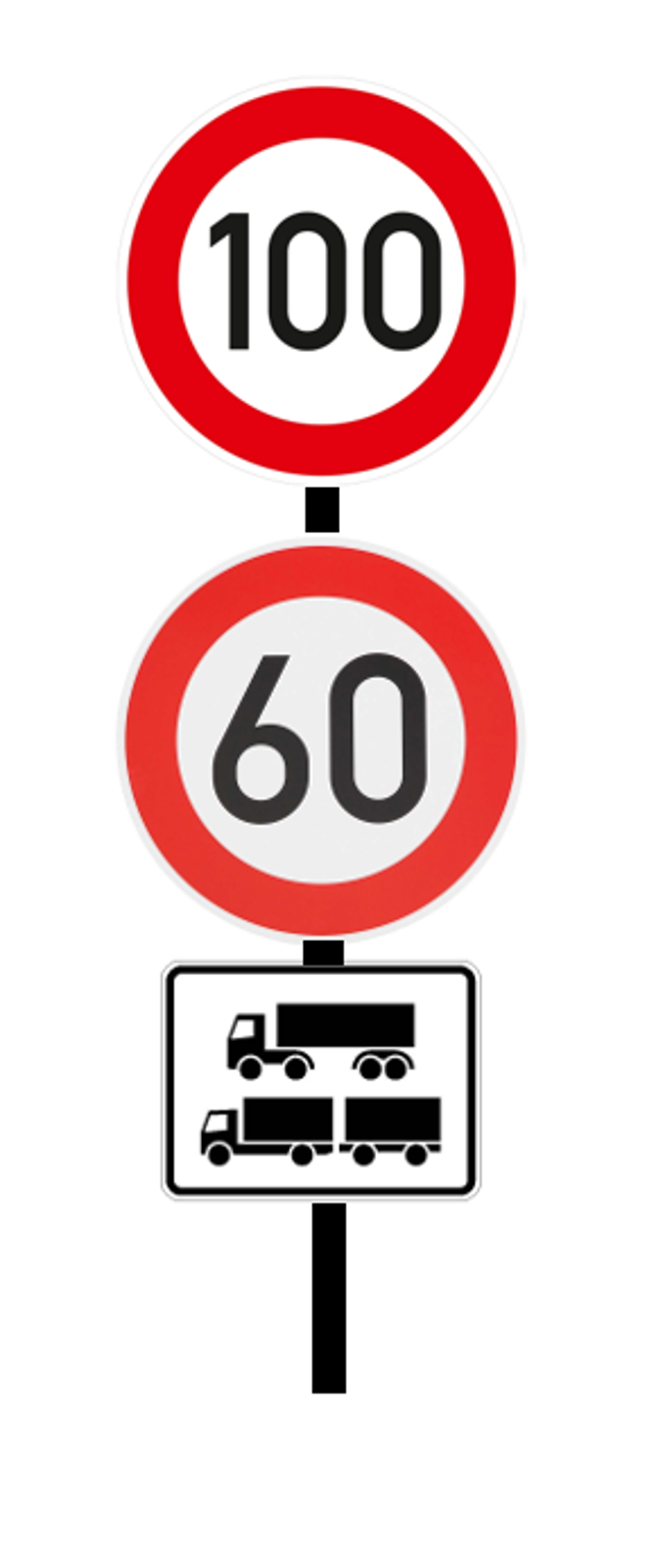
Depending on where you are in the US, there are similar signs here too. Usually just posting a minimum speed limit, not a truck-specific one though. But they're not standard across the entire US, so the rule of the lowest common denominator applies.
And the reason most places in the US don't standardize is because we have too much traffic in populated areas. Despite forcing semi trucks to stick to the slower lanes, some will move to the fast lanes either to pass other slow trucks, or just to make up some lost time on their route. Which keeps all traffic at safe truck-driving speeds anyway.
In a capitalist society, time is money and truck drivers can't afford to be late. A lot of delivery services won't pay the drivers if they show up late, which encourages a lot of poor practices on the public roads.
Yes, it's a system that needs to be changed as well, but without standard unions across the country, businesses can pull shady practices and you can either suck it up and deal with it, or quit and find a new profession. The latter being next to impossible to do with the economy the way it is right now.
Also, another reason the US doesn't standardize is because our country is so extremely massive. Most people don't realize just how huge the US is. Some of our individual states are as big as many European countries. And states have their own rights and laws separate from the federal government. So getting everyone to agree to update public road laws across the entire United States is difficult. A lot of our laws were agreed upon a long time ago and there just haven't been much updates since. So modernizing road laws is a challenge, even with a good administration in charge of the federal government. And we don't have one of those right now.
I see people outside the US asking why Americans don't just protest for better laws, rights, regulations, etc. I mean, we do, but getting us to protest in any meaningful way is like convincing citizens across the entire EU to organize and protest for a single cause. It's next to impossible to organize a protest of that scale, but we'd need that because of how large our country is. There could be a protest in Oregon, but people in California next door might say it's an Oregon issue and not directly affecting them. Getting everyone on board for a singular issue is extremely difficult when we're spaced so far apart. A problem on one side of the country might as well be happening on the other side of the planet as far as most Americans are concerned.
And the more our lives are tied to our pithy income, the harder it is to break away long enough for a meaningful protest. A majority of American's lives would fall apart if they spent a week without working, but the rich 1%ers could go months without breaking a sweat. Outlasting those in power is next to impossible with the way our society is right now.
Couple that with that the fact that we're isolated from the rest of the world and most Americans grow up in that echo chamber about how we're the "greatest country in the world" and you get a lot of passive citizens who don't address issues until they are directly affecting them. Which is too late by that point. America is just in a bad place geographically and politically to organize its citizens for better reform.
Sorry that this devolved into political discourse, but that's kind of the root behind a lot of our unchanging and ineffective laws right now.
Also an issue in Germany. We call that practice "Elephant race" because those massive semi trucks will hinder any other traffic at passing each other until the 5 km/h faster truck passed the other.
And that does take a while.
Don't you guys have any generic laws about driving "carefully and considerately"? It's completely common in my country for the speed limit to be higher than what many vehicles can safely handle. That just means those drivers have to judge for themselves how fast they can safely drive while remaining "careful and considerate".
Americans are too literal, irresponsible, and frankly narcissistic to follow something like that. We see a posted speed limit, that's the speed we're going to drive. Or we'll go faster if we think we can handle it (and get away with it). We try to use the literal law to prove our position in court, so "careful and considerate" is too generic of a phrase to uphold legally.
I lived in Germany for a couple years and I was surprised at how responsible drivers were there. Everyone stuck to the slow lane unless they wanted to drive super fast. The autobahns had no posted speed limit, but it was understood that if you got into an accident over 130 KPH, you were 100% responsible and insurance wouldn't cover anything. So people just... drove more responsibly! Americans are too self-centered to behave that way.
I especially liked how Germans would flash their brights if they were going much faster in the fast lane and everyone would just automatically pull over to the slow lane. No fuss, no drama. I do that in America and it just causes road rage. Americans don't like brights being flashed at them. As a matter of fact, in my home state of Minnesota, it's illegal to flash your brights at another car for any reason.