
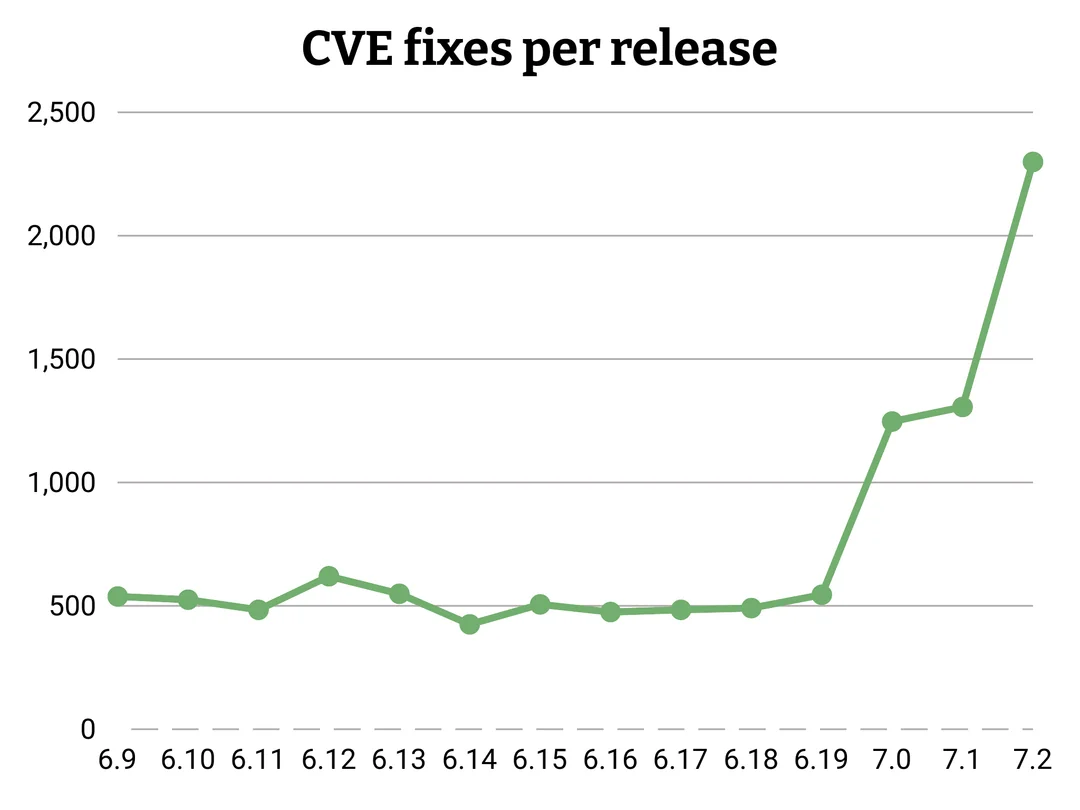
AI coding tools are pretty good at finding bugs and make it easier and faster to fix them.
Importantly, security vulnerabilities in new releases seem to stay roughly the same and the change to which bugs count as CVEs was around version 6.8 already.
A community for everything relating to the GNU/Linux operating system (except the memes!)
Also, check out:
Original icon base courtesy of lewing@isc.tamu.edu and The GIMP
AI coding tools are pretty good at finding bugs and make it easier and faster to fix them.
Importantly, security vulnerabilities in new releases seem to stay roughly the same and the change to which bugs count as CVEs was around version 6.8 already.
For anyone curious about the number of bugs introduced in each kernel release, LWN.net has a plot of Bugs fixed and introduced in each kernel release.
However, it has the obvious limitation that recent releases will appear to have fewer commits introducing bugs, simply because kernel developers haven't had as much time to find and fix the bugs introduced in those releases. So it'll be a while before we can actually see the consequences (positive or negative) of more widespread LLM usage by kernel developers
As somebody who is quite critical of AI, I will say, it is a fantastic tool for finding bugs early. I advise getting all your changes reviewed by a decent LLM before you push them. It often finds edge cases I forgot in my testing
To add to this, allium is a weirdly effective tool for finding bugs and clarifying intent despite being nothing more than a prompt that you present to a frontier model.
I’ve started using allium spec files as a replacement for handoff documents. It records what you want your program to do without any of the implementation details that might pollute an LLM’s context window.
That's a pretty big limitation! They shouldnt have bothered plotting that, it's basically just a plot of time.