this post was submitted on 07 Sep 2026
69 points (98.6% liked)

Linux

67456 readers
177 users here now

From Wikipedia, the free encyclopedia

Linux is a family of open source Unix-like operating systems based on the Linux kernel, an operating system kernel first released on September 17, 1991 by Linus Torvalds. Linux is typically packaged in a Linux distribution (or distro for short).

Distributions include the Linux kernel and supporting system software and libraries, many of which are provided by the GNU Project. Many Linux distributions use the word "Linux" in their name, but the Free Software Foundation uses the name GNU/Linux to emphasize the importance of GNU software, causing some controversy.

Rules

Related Communities

Community icon by Alpár-Etele Méder, licensed under CC BY 3.0

founded 7 years ago
MODERATORS
 

cross-posted from: https://feddit.org/post/35110129

This year I decided to switch my “default license” to EUPL-1.2. This is an OSI-approved free software license created and published by the European Union. And it is quite a divergence from the licenses I’ve used in the past. EUPL is a strong copyleft license that closes the “SaaS loophole” by requiring reciprocal licensing regardless of how the software is distributed.

Over the years it has been clear that we in the “open source” camp (as opposed to the “free software” camp) were wrong all along.

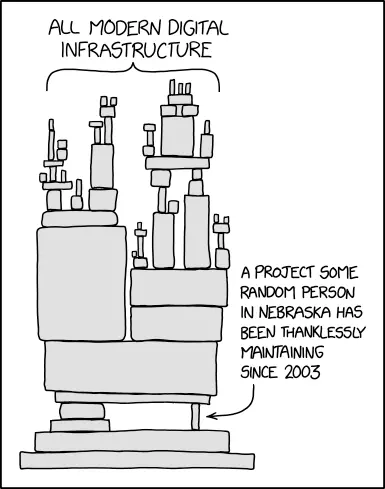
We won the debate, and gained little for users or developers. All that our efforts did was to make it easier for big corporations build things more cheaply and for billionaires to become trillionaires.

And so it is time to stop messing about with permissive licenses. If corporations don’t want to use our software under our terms, they are free to spend the effort or tokens to build their own.

top 25 comments
sorted by: hot top controversial new old
[–] cyclohexane@lemmy.ml 5 points 4 hours ago (2 children)

Not good enough. Companies are still allowed to use this software freely, make massive profits without anything going to the developer. It is truly free labor.

They are even allowed to modify it, even make derivative work, without open sourcing it, as long as they don't distribute said derivative work.

[–] KullumDaue@lemmy.world 1 points 3 hours ago (1 children)

They are even allowed to modify it, even make derivative work, without open sourcing it, as long as they don't distribute said derivative work.

i am not a lawyer, but isn't that similar to gpl?

also, why should the company's profit go to a developer they don't employ?

[–] laurelraven@lemmy.zip 1 points 24 minutes ago

And who literally gave the work away without asking for payment, for anyone to use freely?

Like, do we want free software or not? We can't have it both ways

[–] danielquinn@lemmy.ca 18 points 14 hours ago (2 children)

I understand why you'd want to avoid MIT, but as someone who generally favours the AGPL for everything I do, I'm curious why you opted for the EUPL instead.

[–] HaraldvonBlauzahn@feddit.org 10 points 10 hours ago* (last edited 10 hours ago)

To clarify any confusion: I posted this, but this is not my blog article; it is from a different person.

[–] talkingpumpkin@lemmy.world 2 points 11 hours ago (1 children)

IIUC the EUPL is more similar to the GPL that the AGPL (ie. there's no "network use" clause)

[–] provectus@lemmy.ml 1 points 5 hours ago* (last edited 5 hours ago)

Is it still considered strong copyleft if it is similar to the GPL then?

[–] HaraldvonBlauzahn@feddit.org 24 points 18 hours ago* (last edited 17 hours ago) (1 children)

Personally, I also think that much of the hate which one would find e.g. on reddit or the orange site against copyleft licenses in general, and the GPL specifically was probably astroturfing from corporations for which it was just an obstacle to appropiate more unpaid volunteer work for the commons for free.

For the Linux kernel - and for GNU/Linux as an OS - the GPL was never a problem. On the contrary: Without it, the kernel would not be what it is (the historic Torvalds - Tanenbaum debate shows the reasons quite clearly).

The same is true, by the way for the GNU Guix project: Very few arguments against it are logical or really hold water. It is, for example, perfectly possile to publish a Guix channel for a commercial game or proprietary software on ones own web site - just as you can do with a docker image. And the way Guix takes care of dependencies and updates makes it probably the easiest way to do such. Because you can use Guix as a package manager on most distros - I use it both on Debian and Arch - I find it more reasonable than using snaps, docker, or flatpaks.

The reason for the hate is likely something else: That you can't commercialise and embrace the whole, source-based ecosystem.

For example, you can't use the Guix infrastructure (e.g. their mailing list or download server) to promote or advertise commercial, non-free stuff. But expecting or demanding to be able to do that is just ridiculous: Nobody expects from Microsoft or Apple that they feel obliged to promote or market Adobe or Oracle products. Alone the idea that companies could demand that shows how entitled the corporations behave in respect to free software.

[–] Obin@feddit.org 3 points 6 hours ago* (last edited 6 hours ago)

was probably astroturfing from corporations

Could be. At least When I still was on r/linux a few years ago there were about three usual suspects who would pop up every time a topic even went in the general direction of licensing and spewed their toxicity. To me these people had less of a corporate shill vibe and more of a undiagnosed mental health issues vibe, but I obviously can't say for sure.

[–] ulu_mulu@lemmy.zip 9 points 16 hours ago
[–] SocialistVibes01@lemmy.ml -3 points 10 hours ago* (last edited 10 hours ago)

EUPL

Why should a FREE software license have colonizer finger print?

[–] raspberriesareyummy@lemmy.world 0 points 15 hours ago (2 children)

What a shitty choice of a license. Typical EU legal garbage full of duplications and "lawyers" thinking "more is better".

Also:

The provisions of this Licence can be accepted by clicking on an icon ‘I agree’ placed under the bottom of a window displaying the text of this Licence or by affirming consent in any other similar way, in accordance with the rules of applicable law. Clicking on that icon indicates your clear and irrevocable acceptance of this Licence and all of its terms and conditions.

Lol, these morons. Of course the EU pencil pushers would hyperfixate on "clicking a button".

/a European

[–] libewa@feddit.org 3 points 15 hours ago* (last edited 15 hours ago) (2 children)

And the GPL has less legal garbage? One of the goals of the EUPL was that it can be understood by laymen, which doesn't really hold true for the GPL. Those "simple" licenses like the MIT license don't work in the EU btw, since you cannot completely renounce liability or copyright.

[–] lemmyvore@feddit.nl 12 points 13 hours ago (1 children)

You may be right about liability, I don't know. But public domain is a thing in the EU and it applies to expired copyright, things that cannot be copyrighted, explicit attribution etc.

Besides, the MIT license does not renounce copyright, on the contrary.

[–] yetAnotherUser@discuss.tchncs.de 2 points 8 hours ago (1 children)

Public domain is a thing in the EU but not releasing anything into public domain.

In Germany, I cannot renounce my copyright to anything. I can give you an indefinite, unrestricted license to do whatever but I still own the copyright. It will only ever become public domain 70 years after my death, not a day sooner or later.

[–] lemmyvore@feddit.nl 1 points 7 hours ago (1 children)

I can give you an indefinite, unrestricted license to do whatever but I still own the copyright.

Isn't this distinction academic?

Not quite, this does have certain legal implications. Check out the CC0 license's "Public License Fallback" text: https://creativecommons.org/publicdomain/zero/1.0/legalcode.en#fallback

The "license to do whatever" is more like a "license to do whatever except for whatever a court ruled I cannot give a license for".

[–] IanTwenty@piefed.social 2 points 12 hours ago (1 children)
[–] libewa@feddit.org 4 points 12 hours ago (1 children)

Maybe it's not the EU as a whole? But interestingly, your article says that FLOSS is exempt from these rules, which is great!

[–] HaraldvonBlauzahn@feddit.org 6 points 10 hours ago* (last edited 8 hours ago)

Generally, what we have in the EU is strict liability for commercial products, but not for things like gifts or FOSS software developed in a non-commercial manner. Except when damages are caused on purpose or because of gross negligence.

Some examples (German law, which is quite strict about personal liability):

  • You cause an accident -> you are liable.

  • Your small kid causes an accident -> you are liable.

  • Your unleashed dog runs over the street, causes a truck to steer into a shop -> you are liable.

  • Your car does not work because of improper maintenance, and causes an accident -> you are liable.

  • Your dishwasher floods the flat below you with water while you are away -> you are liable.

  • Your car's assisted braking system goes out of control because of defective software delivered by the manufacturer -> the manufacturer is liable.

  • You gift somebody a car with a minor defect which you are not aware of, he has an accident -> no liability for you.

  • You knowingly gift somebody a car with defective brakes, without telling him, he has an accident -> you are liable.

  • Your physician uses some X-Ray device software which has a catastrophic bug and causes that you have radioactive burns all over your body -> the manufacturer of the software is liable.

(and here is where EU law probably differs form US law: In the US, software vendors can and do disclaim all liability. THIS IS NOT POSSIBLE IN THE EU, and thus such a contractual clause is probably invalid in its entirety, while leaving the contract valid. (And that is why you should NOT write your own licenses.))

  • That X-Ray software uses a non-commercial contribution for solving matrices in Numerical Python which a volunteer wrote in 2015 -> the FOSS contributor is not liable, the responsibility is for the manufacturer to test for correctness of the free stuff.

What is interesting is: The EU has now decent security to the expectations which manufacturers of software or mechatronic systems are liable for.

[–] HaraldvonBlauzahn@feddit.org 2 points 15 hours ago (2 children)

Well, I already wrote that copyleft licenses get hate from corporations...

[–] raspberriesareyummy@lemmy.world 4 points 9 hours ago

I am not a corporation, and I don't hate copyleft in general, just redundant and abundant legalese like in this one.

[–] jaypatelani@lemmy.ml -1 points 14 hours ago (1 children)
[–] HaraldvonBlauzahn@feddit.org 2 points 10 hours ago

It is generally not a good idea to write an own license. Because it is complex legal stuff.

Also, when using licenses, one should check whether the interactions with other licenses are as intended. Some licenses are compatible in a two-way manner, some only in one way, some not at all. The GNU project has a page for that.