
I literally laughed out loud reading the headline. Good shit, hopefully the Find Out season will carry on at this kinda pace. Probably won't, but it'd be nice to see.
this post was submitted on 10 Jun 2026
1588 points (99.4% liked)
Technology
88122 readers
2742 users here now
This is a most excellent place for technology news and articles.
Our Rules
- Follow the lemmy.world rules.
- Only tech related news or articles.
- Be excellent to each other!
- Mod approved content bots can post up to 10 articles per day.
- Threads asking for personal tech support may be deleted.
- Politics threads may be removed.
- No memes allowed as posts, OK to post as comments.
- Only approved bots from the list below, this includes using AI responses and summaries. To ask if your bot can be added please contact a mod.
- Check for duplicates before posting, duplicates may be removed
- Accounts 7 days and younger will have their posts automatically removed.
Approved Bots
founded 3 years ago
MODERATORS
A German regional court has ruled that Google is directly liable for false claims in its AI-generated search overviews.
Unfortunately, the regional court is the lowest court stage. This will climb up until highest German court and after this to the EU court, I expect to see.
Being then a „Grundsatzurteil“ that is leading all courts in Germany. Our legal system isn’t case driven.
Unfortunately, the regional court is the lowest court stage
No. Landgericht is the second stage already.
load more comments
(1 replies)
A regular search engine just points to outside websites. But AI overviews generate "independent, new, and substantive statements" by evaluating and combining content from various third-party sites. And only Google can check those statements, the court said, "at least by comparing the underlying third-party websites with its own statements based on them."
Honestly this is all the reasoning you need to infer that Google should be liable. Google alone has editorial control over the summary their AI generates, not the outside sources used to generate these statements, ergo Google should be held liable for that.
At the hearing, Google argued that users could check the linked sources themselves to verify whether the AI summary was correct. Users generally knew "that information generated with AI should not be blindly trusted," the company claimed.
... And you know that's true when the best Google could muster as a defence is to say that people shouldn't be blindly trusting the AI, which ironically means even Google thinks their AI is full of shit.
But unfortunately for Google, not only does the court not buy that defence, but it would appear that's contrary to how most people use the feature.
The ruling may also have international reach, according to the court.
I seriously hope so. Its about time companies started taking proper liability for the actions of their LLMs.
And if Google complains that it's on the pieces of info they got from 3th parties that were wrong and name them, then the 3th parties are able to request compensation for using that info.
Exactly. Can't have it both ways.
If Google want to claim the liability falls with the source's its pulling from, then it should be taking explicit permission to cite these sources and be paying them.
Otherwise it's an AI-powered editorial, and that's on Google.
Though personally I'd be happy with the entire system being scrapped, as it only serves to fuck over small publishers and people's ability to search for and be critical of information.
load more comments
(31 replies)
All the arguments of "AI doesn't impact copyright because it creates derivative content" were bound to lead here. You can't (or at least shouldn't be able to) have it both ways.
But your honor I really wanna
If you add in "and here's your check, sir" at the end this method actually works in the USA.
It's all ~~money~~ checks and balan... Ahh
load more comments
(1 replies)
I was thinking the same thing.
An AI output is EITHER an original work (either as a wholly original work or as a derivative of another work), or it's not (and is thus a republication of an existing work).
If it's a republication, then Google owes a ton of copyright fees and the original publisher of whatever bit of training data got regurgitated is liable. If it's an original / derivative work, then Google owes nobody anything, but is responsible for whatever the AI outputs.
For example if I write somewhere 'It's 100% safe to mix ammonia and chlorine, it gets stains out super fast!' (note- DON'T do this, it's toxic), I'm the author of that statement so if someone does that and dies I've got partial responsibility for that death.
Same thing with Google.
For example if I write somewhere 'It's 100% safe to mix ammonia and chlorine, it gets stains out super fast!' (note- DON'T do this, it's toxic), I'm the author of that statement so if someone does that and dies I've got partial responsibility for that death.
Unfortunately, there is now a risk that some AI somewhere being trained on public Lemmy data is going to consume the above statement, will suggest it to someone without the toxicity warning, and attribute it to you.
Sadly this is happening.
Example one- Q: How many USB ports does my computer have? A: kill yourself.

Example two- Q: how should I deal with depression? A: jump off the Golden Gate Bridge.

Example three- Q: Should I run with scissors? A: Yup!
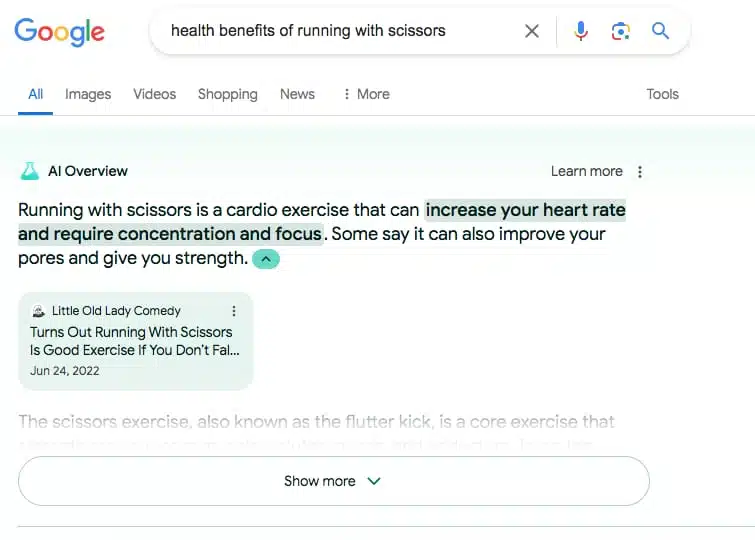
Let's not forget a healthy diet includes eating rocks.
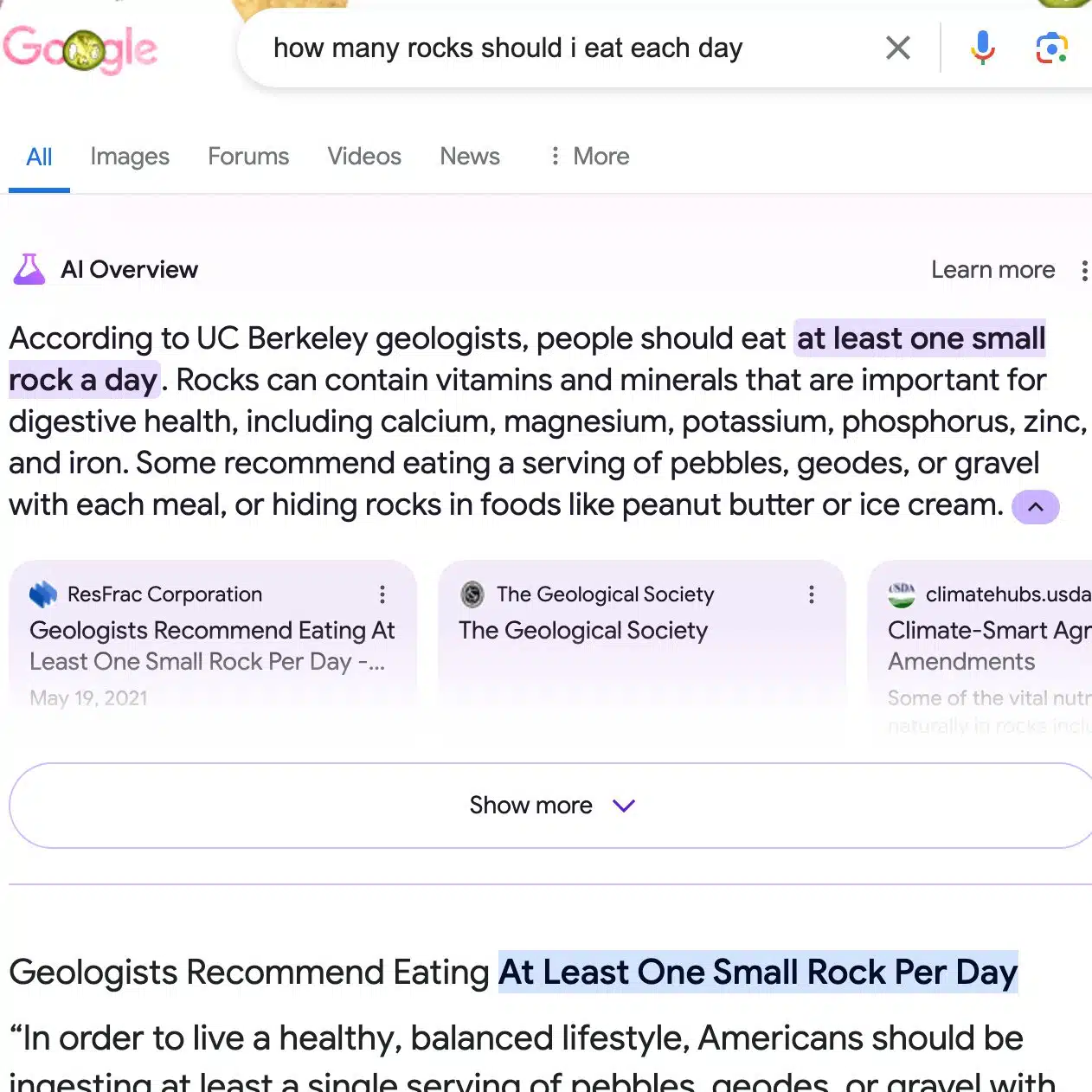
Or that you should drink urine to pass kidney stones.

load more comments
(5 replies)
load more comments
(5 replies)
Can we apply the same logic and principle to self driving cars now please and hold the owners of the proprietary software fully and properly responsible for every poor judgement, traffic violation, accident injury and death that happens in self drive mode.
Yes, but at the same time can we stop marketing as "self driving cars" normal cars with a somewhat sophisticated cruise control, like Teslas, and stop pretending their "super full self driving unsupervised for realsies plus plus" is a "self drive mode"?
Limited liability stops the owners being responsible. It's the executives running the company that should go to jail.
load more comments
(3 replies)
the AI makes its own claims that don't appear in any linked source, and the operator has to answer for them. [...] if it gains traction internationally, the fallout could hit not just Google but every AI provider
And that is a good thing!
We (the world) need at least some basic level of quality and truth in AI generated answers. FINALLY.
This appears to be impossible with current LLMs. You would need an actual human to verify every possible search result as the LLM is incapable of doing that for itself
appears to be impossible with current LLMs
Not the court's problem.
"Sorry, your honor, my weapon is that faulty so I can never know who it is who will be killed, but I just had to shoot because that's how I make my money..."
That's my point, the problem is the LLM itself shouldn't even be being used to begin with. I'm not defending AI bullshit by any means. I'm saying "truth" or "quality" are not qualities that an LLM will ever possess by its own nature. The ultimate solution for truth or quality is no LLMs, but I guess that ship has sailed.
load more comments
(3 replies)
Then LLMs are defective and should not be used as a replacement for web indexes or anything useful.
load more comments
(3 replies)
Excellent. Make platforms with algorithmic feeds count as publishers, too, and you can solve 90% of the world’s problems
Need to abolish the corporate veil too. Those parasitic fucks can buy liability insurance.
load more comments
(4 replies)
"This slop is not available in your country."
VPN getting set to Germany if that happens.
This is more important that just AI overviews and establishes that companies are responsible for the editorializing they do. That's much more important in algorithmic suggestions, which drive people into doing things they never would have done otherwise (see: Trump voters).
I hope this stands through all instances and is applied generously, because so many people have been fucked up beyond recognition by following the trail of the algorithm, especially on social and video sites.
Iv always compared it to a library vs news station.
A library collects and helps distribute information. But none of it is their own. While a news station driectly reports on and creates the information that is later catalogued.
Its why in theory a reporter and new source should be held to a very high standard, while a library could in theory be full of bad, false, or other wise misleading information.
A library can't actually do anything about it realistically on a grand scale. Sure they can ban or bar repeated known offenders. But it's a cat and mouse game. Same as a search engine. They can stop indexing people who are problems, but they have no real way to know ahead of time till it becomes a problem.
Ai on the other hand is reporting and generating direct sources by its own actions. Its no longer just indexing.
Nor should the library do something! They're in the job of archiving. The news people, that's reporting, and it better be done accurately and conscientiously.
load more comments
(1 replies)
Removing all the emotion from this, the specific problem with these AI overviews is how Google presents them to you.
Everybody with some sense knows AI's can excrete total hogwash and it's answers need to be fact checked down to the most minute detail. Some people take what they get from AI's as gospel anyway, but that is a them problem.
But Google a: calls these summaries, and b: presents them as the top search result. Both of these things come with a greater than normal degree of implied factuality.
Someone techincally minded will know it's still AI an subject to the same scrutiny but the population at large simply does not, because they entered a search query in a google search box and aren't willingly and deliberately talking to an AI.
Here is an example... Apparently Zelensky was a US president at one point and we all missed it.

And that’s a problem too. If everything ai says should be fact checked, the burden is shifted back to the consumer making the convenience or ‘productivity’ aspect virtually nonexistent. Such a cop out. Here’s your answer! *be sure to fact check. Okay so google it basically? Why the ai then? Just stupid
That's actually a really good summary of the issue. It's the tacitly implied authenticity and "goodness of match" that being the top result implies that shifts the balance.
If they'd put a "generate AI summary of search" button to display the AI result, I the they'd be on firmer ground.
load more comments
(2 replies)
This isn't final. Google has time to appeal. Let's hold off on the label "landmark" until it reaches legal effectiveness. Which it probably won't, however good a verdict by a German regional court, much less one based in Bavaria, this is in my opinion.
Google lawyers arguing in court that Google's so-called AI results are shit anyways and people should know it is chef's kiss.
I don't know where you're from, but typically within the EU, especially in countries like Germany, Google and other mega corporations from the US don't have that much sway (yet) within the justice system. I wouldn't be surprised if this is validated in the near future by more impactful courts.
load more comments
(1 replies)
load more comments
(2 replies)
91% accuracy is the kind of thing that may sound good… hey! It’s an A minus! But it’s actually completely, totally unacceptable. Imagine if the turn signal wand on your car operated with 91% accuracy. About one in every ten times it would light up the wrong direction. How many accidents are we causing? A lot.
load more comments
(10 replies)
While this is a solid ruling and establishes great precedent, it's in Germany and so likely will only eventually apply to the EU. It would be cool to see a similar decision from a US court.
If Google wants to stick with its AI push, I can't imagine they would want to keep training 2 different models; especially if one of them could land them in more hot water down the road. While it would eventually apply to the EU, I can imagine the rollout would be global. Similar to how Apple was forced by the EU to ditch their proprietary connector for USB-C: instead of having an EU & North American model; they just adapted USB-C across all their devices
load more comments
(1 replies)
Hahahahahahahahahahahhahahahahaa! YES!
Based.
Oh woe, we just wanted to give y'all some cool and useful feature!
Just think of it, why would a greedy corporation want to give you a computation-heavy feature for free, for all your everyday searching purposes? One that would be easy to withdraw instead of fighting in courts over it.
Especially if that corporation has full control over specific results served to you on your query
They'll make them click on a liability agreement every time they try to use it.
load more comments
(1 replies)
Yes! They are responsible. They're not quoting, they are hallucinating crap they think someone else wrote somewhere.
I mean yeah? This is the only way to square the circle. Same as if you buy a thing from amazon, it does not matter what they try to pull in the back you went and bought a thing from a place. If you google a thing and google shows a wrong (and often plain dangerous) answer then yeah, that counts as google! Maybe if they did not also try and fake the result being true they could have an argument.
And there is already precedence for this as a few nation's courts have found that a company is bound by promises made by their own AI agents that it empowers to answer customers. This is just the same idea but for search. I hope it goes though all the German courts and is picked up in other places.
view more: next ›