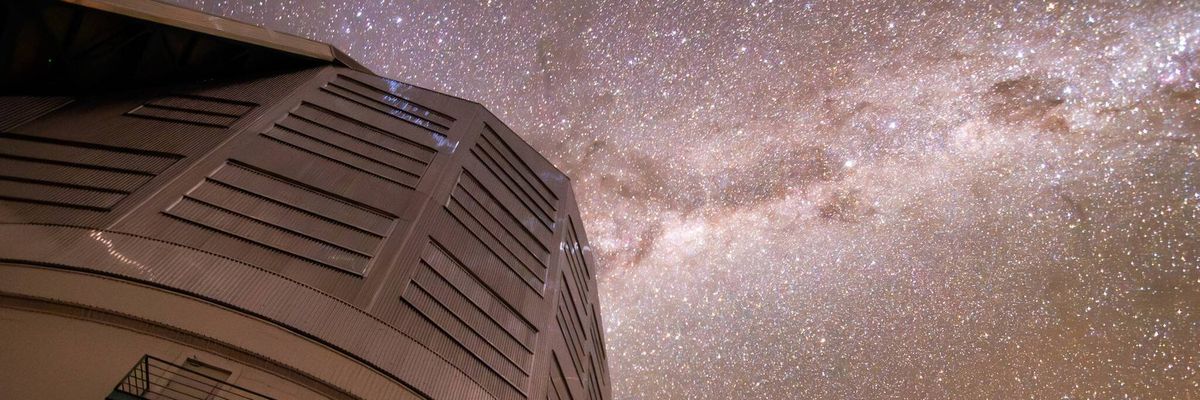
European astronomers on Wednesday urged the US Federal Communications Commission to block a plan led by SpaceX CEO Elon Musk to launch a total of 1.7 million satellites into the Earth's orbit, warning that the use of so many extremely bright satellites—partially to support artificial intelligence data centers—would have “devastating consequences for astronomy.”
SpaceX's Starlink telecommunications program has already rapidly increased the number of satellites orbiting the Earth, with the total now exceeding 14,000 since 2019.
Now the space exploration company led by Musk—a former special government employee under the Trump administration—has plans to send 1 million more satellites into space, which would "significantly alter the appearance of the sky," according to a new study by the European Southern Observatory (ESO).
Scientists found that 100,000 is the maximum number of satellites—ones that are faint enough to be invisible to the naked eye—that can orbit the Earth in order to allow astronomers to continue observing the sky with modern telescopes.
In addition to Musk's launches, the US startup Reflect Orbital has proposed launching a constellation of 50,000 "very large mirror-like satellites to provide sunlight at night," said ESO.
"These satellites would be the brightest ever in orbit, with damaging consequences for dark skies on Earth," said the observatory. "Seen from within a reflected beam, the satellite delivering sunlight would appear four times brighter than the full Moon. Even if no satellite points its beam directly at an observer, each would be as bright as the planet Venus, the ‘morning star.' From a light-polluted city, like Munich, Germany, these hundreds of satellites would be the only ‘stars’ visible in the night sky."
The startup E-Space and two Chinese constellations, CTC-1 and 2, would also add hundreds of thousands of satellites into orbit.
The companies' satellite project could hinder scientists' ability to observe far-away galaxies, Earth-like planets near other stars, and asteroids that could potentially endanger the planet.
"Satellites, illuminated by the sun, are much brighter than distant galaxies. When a satellite crosses what we observe, it makes a bright streak on our image, zapping whatever is behind it," said ESO astronomer Olivier Hainaut, who led the study.
Hainaut noted that the planned launches could have economic and ecological impacts on the planet and humankind as well as harming astronomy.
Extreme light pollution from the bright satellites could disrupt people's biological clocks and ecosystems across the planet, and the satellites could also directly impact air quality due to the numerous launches required to send them into space and the "atmospheric pollution caused as they burn up on reentry at the end of life."
ESO conducted the research as the FCC considers applications from SpaceX and Reflect Orbital regarding the satellite launches
“The FCC received over 1800 comments regarding Reflect Orbital and nearly 1,500 comments on the application by SpaceX,” said ESO institutional affairs officer Betty Kioko. “The ball is now in the FCC’s court, and we wait to see the determinations they make on both filings. For optical astronomy, this is an existential threat, and we hope that the regulators will share that view.”
From Common Dreams via This RSS Feed.

Opponents of a bill that is purported to protect children online said Monday night, after the legislation passed in the US House, that laws are "urgently" needed to stop Big Tech companies from preying on kids' vulnerabilities.
"The KIDS Act is not that piece of legislation," said Rep. Pramila Jayapal (D-Wash.), who was one of 117 lawmakers who voted against the Kids Internet and Digital Safety (KIDS) Act, which passed with 267 votes, while 47 members of Congress did not vote.
The bipartisan bill requires online platforms to use new safety features and parental controls, restricts the use of minors' personal data to target ads, and establishes new restrictions for AI chatbots and online games.
But ahead of the bill's passage, the Electronic Frontier Foundation (EFF) was among the opponents raising alarm about other provisions "buried inside the KIDS Act" that would "push online services to verify all users’ ages, require government-directed moderation policies for online speech, and even create new rules about private and encrypted communications."
The legislation, drawing from portions of 14 different online safety bills, "is a mess, with different age-gating schemes for different services, using different standards," wrote EFF senior policy analyst Joe Mullin. "It’s a lot of complexity, and a lot of legal risk. Faced with that, many companies will conclude that the safest option is restrictive age-checking practices across their entire platforms."
As Mullin explained:
Throughout the KOSA section of the legislation, special protections, controls, messaging settings, and parental tools are required whenever a website or app “knows or should have known” a user is a child (defined in the bill as anyone under 13) or a teen (defined as anyone between 13 and 16 years old).
The problem is a website operator doesn’t need actual knowledge that a user is a minor to get in legal trouble. It applies when a platform “knows or should have known” a user’s age—a low, negligence-style standard of knowledge. If an online service gets it wrong, it’s going to be up to courts and regulators to decide, after the fact, if an online service “should” have known a user was 16.
To try to avoid liability, services will have to determine which users are teenagers and which are not. Most won’t be able to simply trust their users. They’ll have to collect more information about age, before any lawsuit or government action arises. Some companies may respond by requesting driver's licenses or passports. Others will rely on age-estimation systems that attempt to guess users' ages by looking at existing activity or doing facial scans.
At The Intercept, Caitlin Vogus of the Freedom of the Press Foundation and Aliya Bhatia of the Center for Democracy and Technology’s Free Expression Project warned ahead of the bill's passage that while the legislation is ostensibly meant to protect children, the age verification requirement could impact all users' ability to access social media platforms without revealing their identities—chilling anonymous speech and threatening would-be whistleblowers.
"Threats to online anonymity harm everyone, but one group is often overlooked: journalists and the sources who talk to them," wrote Vogus and Bhatia. "Age verification requirements will help the Trump administration carry out its vendetta against the press by creating new avenues to identify journalists’ confidential sources."
While the KIDS Act says it won't require online platforms to collect government IDs for age verification, they said, "at least some platforms will likely choose this route to comply with the law or offer it as a fallback approach when other methods inevitably fail."
Former Republican congressman Justin Amash, a libertarian, accused the lawmakers who voted "yes" on the legislation of betraying "the Constitution and the American people."
Other opponents of the legislation, including Jayapal, argued that the bill would allow tech companies to continue targeting children with algorithms that send harmful content to the youngest users.
The legislation omits a "duty of care" provision that was included in the Kids Online Safety Act (KOSA), which was passed by the US Senate in 2024—a requirement that tech firms "exercise reasonable care” to prevent harms to children.
Jayapal noted that the bill, which faces an uphill battle in the Senate, leaves "suicide, depression, addiction, substance use disorders, and eating disorders from the list of harms" that tech companies like Meta must address in their algorithms.
The "duty of care" provision has been criticized as too vague by several digital rights groups, while some child safety groups said its omission in the KIDS Act would "let Big Tech off the hook."
"We have seen time and again that these corporations cannot be trusted to put children's safety over their own profit margins," said Jayapal. "We cannot keep exposing our kids to platforms that are either completely indifferent to their safety or a direct threat to it."
The KIDS Act, Jayapal said, also includes provisions "that do not do enough to actually address the harms of" artificial intelligence.
"I voted no," said Jayapal, "because we have a real opportunity to pass bipartisan legislation that holds these companies to not just be transparent about the harms and mitigate them, but to actually prevent them."
From Common Dreams via This RSS Feed.
The crisis on the Colorado River is simple: The seven Western states that border the essential waterway use more water than it contains. Chronic overuse has drained its two largest reservoirs, Lake Powell and Lake Mead, and a two-decade drought cycle has pushed them to the point of collapse.
The dream solution to this crisis is an agreement among all involved to use less water. Such a deal would decide who must reduce consumption, which means asking which cities would ban irrigating lawns and washing cars and which farmers would rip up their fields.
This has proven impossible. The states have been trying to work this out since the last dry spell, in 2022, but talks have ended in frustration and name-calling. The main sticking point is between the “Upper Basin” states led by Colorado and Utah (along with Wyoming and New Mexico) and the “Lower Basin” states of Arizona, California, and Nevada. Each side believes the other has a legal and a moral responsibility to cut usage during dry years. The stalemate means the Trump administration must design a schedule of restrictions ahead of a crucial deadline in September. So far, Interior Secretary Doug Burgum has balked at resolving the quarrel.
Instead, the administration is turning to a far less controversial plan: Throw money at the problem. The Interior Department and Congress are pondering a slew on projects that could increase supply, a reversal of Trump’s zeal for cutting federal grants. The seven state governors have sent Washington a “wish list” of over $50 billion, and several startups have their hands out as well.
Federal investment makes sense given the scale of the problem and the intractable impasse, said Jennifer Pitt, the Colorado River program director at the National Audubon Society and an expert on the governance of the river
“It is something easier for people to agree on,” she said. “This is a slow moving crisis, but it is a crisis, and we do see the federal funding come in to address crises in other parts of the country. Just because this is a slow moving one doesn’t make it any less worthy.”
During a Senate committee hearing last week, the Interior Department’s top water official, Andrea Travnicek, said the agency has yet to vet the wish list. She didn’t offer a specific funding request, and urged lawmakers to be “thoughtful” about how they spend taxpayer money. But senators of both parties seemed to encourage new investments. “The basin should not be forced to choose between stabilizing the present and negotiating the future,” said Senator Martin Heinrich, a Democrat from New Mexico.
The possibility of new funding marks a return to the policy of the Biden administration. During the last extreme drought in 2022, the Interior Department paid farmers billions to leave their fields fallow, but that money, from the Inflation Reduction Act, has almost run dry.
The difference now is that the roster of proposals is far more ambitious, and some far less certain to bolster the basin’s water supply. They range from desalination plants to desert groundwater pipelines to forest ecosystem restoration.
Here are a few of the major solutions state officials and companies are proposing.
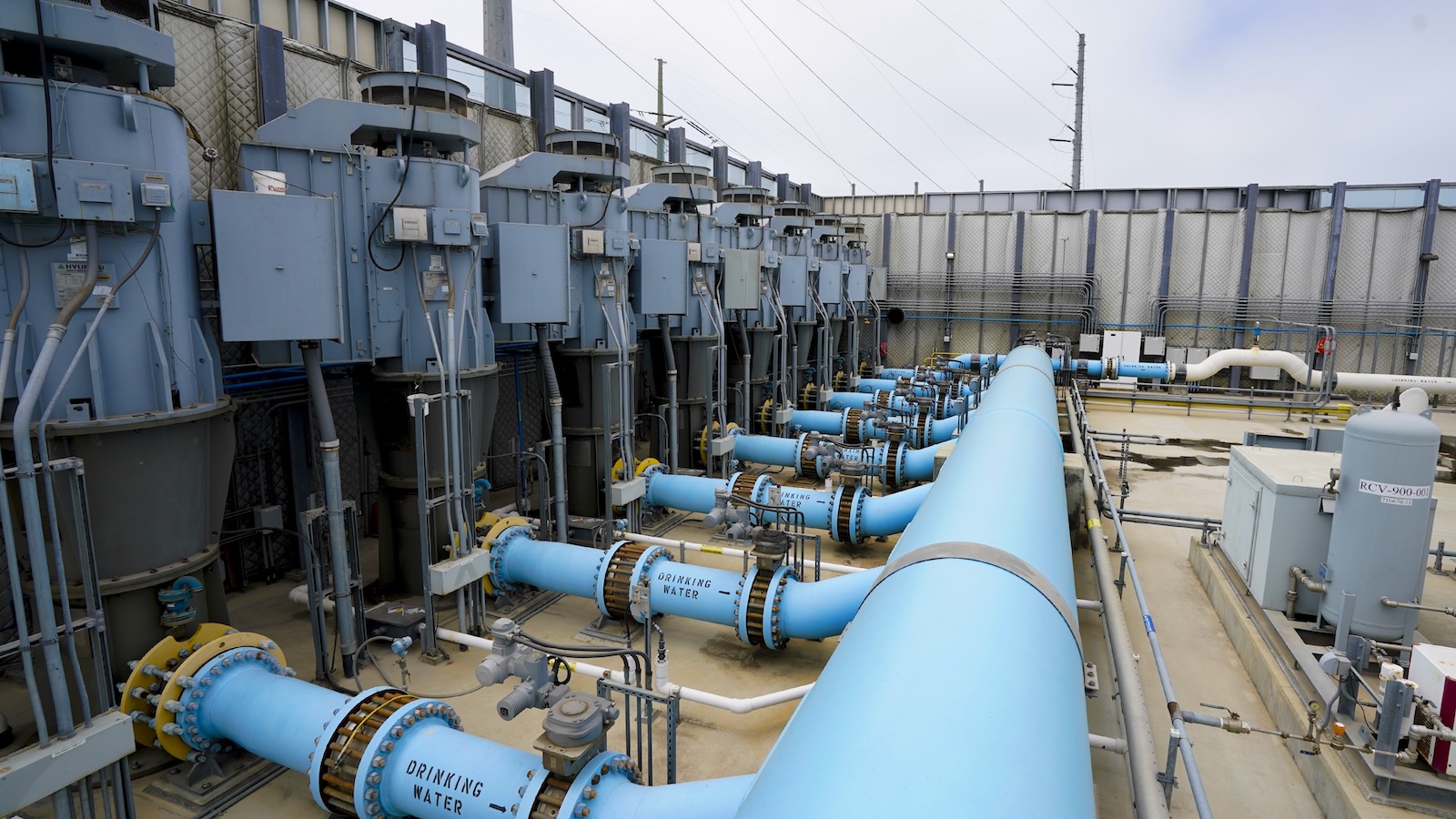
Spending $6 billion to build another facility like the Carlsbad Desalination Plant is among the proposed solutions to the water crisis. Nelvin C. Cepeda/The San Diego Union-Tribune via Getty Images
Desalination
As the Colorado River crisis has deepened, some cities in the Southwest have eyed desalination, which extracts salt from sea water. A company called Poseidon Water opened such a plant in San Diego in 2015, and tried for decades to open another in Los Angeles. The wish list to Interior requests as much as $6 billion to build one in Baja California to supplement Arizona’s vanishing Colorado River supplies.
The Interior Department also signed an agreement in early June with San Diego’s water agency that explains how that plant would help. Rather than sending treated seawater inland, states would pay the city to take less from the Colorado River. Arizona stands to lose the most water during drought years, and it would be the most likely to participate in that exchange.
But desalination is expensive, requires enormous amounts of electricity, and state-of-the-art industrial technology. The Poseidon facility cost $1 billion, but San Diego has diversified its water portfolio so much that it no longer needs all the water it must purchase from the plant. Trading water could help it offset some of that cost.
Taming tech and power
Nevada uses less water than any state on the river, and has cut usage in Las Vegas by replacing grass with artificial turf. It is now seeking money to slake some of its last thirsty industries — power plants and data centers. These facilities need a fraction of what agriculture requires, but dominate usage in The Silver State.
The state’s wish list includes $300 million to retrofit its largest natural gas plant and reduce water consumption by an amount equivalent to more than 3,000 average homes. It also seeks $650 million to install zero-water cooling systems in its airports, schools, and industrial facilities. These closed-loop systems, which recirculate the same cooled water or, in the case of data centers, blast hot servers with cold air, have become more popular in Western states amid concerns about the tech boom’s growing thirst.

A Chinese worker fires rockets for cloud seeding effort in Huangpi, China in 2011. There are similar calls to do so in the United States to help restore the Colorado River. CN-STR / AFP via Getty Images
Squeezing rain from the clouds
Whereas Lower Basin states like Arizona and California can draw from the Colorado River’s big reservoirs on demand, northern states at its headwaters only receive the rain and snow that feed it.
These Upper Basin states have been trying for decades to engineer more precipitation, with support from Washington. It sounds futuristic, but cloud seeding — spraying salt or silver iodide into clouds, forcing them to release water they might otherwise retain — has proven fairly effective on a small scale. Utah spends a few million dollars each year doing this, and officials say it could boost annual snowpack by as much as 10 percent.
In addition, a few startups are pitching cheaper and more scalable versions of this technology. Rain Enhancement, a Florida-based outfit, says it has brought about 15,000 homes’ worth of rain to a river tributary in Utah this year; another, Rainmaker, says it can produce 1,000 times that much by 2031. That’s enough to close the supply gap on the river. That promise is fanciful, but these companies could secure federal funding from an administration that loves the tech industry.
Mining a hoard of desert groundwater
The West teems with companies that have promised miracles, from building a 300-mile pipeline to tapping a hoard of groundwater in Nevada. But perhaps no project has had a longer and more turbulent history than Cadiz, a proposal, almost 30 years old, to export groundwater from an aquifer in the Mojave Desert.
This has drawn vicious opposition from environmentalists and the late California Senator Dianne Feinstein, who called it a “grave threat” to the desert. Cadiz experienced several setbacks during the Biden administration: It lost a federal permit, California ended its pipeline lease, Arizona declined to support it, and its stock price fell to almost zero. But Susan Kennedy, its CEO, says Cadiz is flowing again with a funding agreement from the Interior Department to study exchanges between Cadiz and the Colorado River.
The company still needs to finish two pipelines, one to the Central Valley and another to the aqueduct that carries Colorado River water to California. It also must build a plant to remove contaminants in the water, but Kennedy believes she can have the tap running by 2028.
“This isn’t a competition, it’s an all-of-the-above situation,” she said of the situation on the river. That may be so, but the seven states did not include Cadiz on the “wish list” sent the Interior Department.
This story was originally published by Grist with the headline The Colorado River is vanishing — and the fixes are getting weird on Jun 23, 2026.
From Grist via This RSS Feed.

This story was originally published by Daily Montanan.
Micah Drew
Daily Montanan
American Prairie and other conservation organizations have filed appeals in the federal government’s decision to terminate bison grazing leases on Bureau of Land Management parcels in Montana.
As a result of the lease cancellation, American Prairie has halted an annual bison harvest program — which would have issued 17 hunting permits to members of the public this year — and tribal nations argue it will have a negative impact on food sovereignty programs.
The BLM issued its final decision in early May, canceling all seven bison-grazing permits for American Prairie with a September deadline to remove its herds from federal land.
On June 4, American Prairie filed its appeal with the Department of the Interior, and the week of June 8, conservation organizations Defenders of Wildlife and the Western Watersheds Projectalso filed appeals.
“BLM’s new interpretation has no basis in law and contradicts its own findings,” said Pete Frost, attorney at the Western Environmental Law Center representing Western Watersheds. “BLM reversed itself due to politics, not the law, nor the need to restore prairie grasslands.”
American Prairie is a nonprofit dedicated to conserving prairie land in Montana and manages more than half a million acres between private holdings and leased land. The organization also has a focus on species restoration, including bison, the national mammal.
The organization has around 900 animals in its herd, and has been grazing them under BLM authorization, with some leased acreage stretching back two decades.
But over the last few years, with appeals filed during the Biden administration, Montana officials have argued bison grazing is a risk to Montana’s ranching community.
Montana, along with the Montana Stockgrowers Association and other livestock groups, appealed a 2022 decision that authorized the American Prairie’s bison grazing leases, which had followed nearly three years of public scoping and environmental analysis by the bureau.
Under the Trump administration, direct appeals from Montana Gov. Greg Gianforte, Attorney General Austin Knudsen, and the state’s congressional delegation saw a response from Interior Secretary Doug Burgum, who “assumed jurisdiction” of the cases dealing with American Prairie’s grazing rights.
Conservation groups have said the decision to terminate those leases is political at its core.
Western Watersheds, in a press release, cited reporting by Public Domain pointing out Karen Budd-Falen, now the third-ranking official in the Interior Department, represented some ranching groups in the appeals of the original 2022 decision allowing bison grazing.
Montana officials, on the other hand, argue grazing bison doesn’t fit the purpose of those federal lands, and working lands should support ranching families who help feed the country.
Bison productivity requirement
In the May decision canceling the leases, the BLM focused on the 1934 Taylor Grazing Act, the legal framework that governs leases on federal lands. Using a new definition of livestock, the decision states grazing permits are limited to cases where the animals “will be used for production-oriented purposes.”
But American Prairie argues it has “contributed hundreds of bison to tribal food sovereignty programs, supplied bison as breeding stock to grow bison herds for meat production and economic benefits, and allowed the public to harvest hundreds of bison for meat consumption,” arguments that BLM has so far rejected.
“The agency overturned American Prairie’s grazing permits on unrelated factors: the organization’s conservation goals, management, purpose, and intent,” the appeal states. “In other words, BLM set up one standard based on the animal’s use and then — ignoring American Prairie’s strong evidence meeting that standard — the agency arbitrarily denied the permits on an entirely different basis.”
American Prairie notes the cancellation of hunting permits means a loss of $25,000, but the impacts of the new livestock definition could ripple past American Prairie’s lease holdings, with multiple tribal nations concerned it could limit their own ability to manage bison herds.
Earlier this year, the Coalition of Large Tribes — a group representing more than 50 Native American Tribes — protested BLM’s proposed decision, saying the new definition of livestock would impact tribal bison herds and “any related bison co-stewardship or surplus programs.”
The decision, as written, makes it “unlikely that any tribal government or tribal citizen buffalo herd would ever be eligible for BLM grazing leases,” the Coalition wrote in its protest.
According to American Prairie, the organization has supplied 645 bison to entities in eight states plus Washington D.C., including shipping bison to nine tribal nations — five in Montana.
“These animals are going to local tribes for their food sovereignty,” said Chamois Andersen with Defenders of Wildlife. “What an incredible opportunity to be managing the bison resource ecologically for Native nations to have that benefit.”
“The opportunity to graze on public land should not be exclusive to cattle – they’re not native. It should be open to our native grazer, bison,” Andersen said in an interview with the Daily Montanan. “They in fact have far more ecological benefits to habitat restoration – which BLM is supposed to do – not just provide forage for bovine cattle, but that the animal is contributing to the health of rangelands.”
According to a 2025 BLM infographic about the agency’s grazing program, there are 41 grazing permits for bison issued by the Bureau across the country, alongside 18,000 permits and leases overall.
When the decision to rescind the grazing leases was announced, Montana’s elected officials praised the federal government for prioritizing Montana ranchers over “an ideological experiment.”
“This final decision is a victory for the rule of law and the generations of Montanans who have stewarded our lands with care,” Gianforte said.
The post American Prairie, conservation groups appeal bison grazing decision appeared first on ICT.
From ICT via This RSS Feed.